
Nov 28, 2021 | RESEARCH, SPORTS BETTING
Read the original article on The BASIS website.
By: Caitlyn Fong
Cryptocurrency, or “crypto”, is a digital currency that can be used to buy goods and services, or be traded for profit, with similarities with day trading on the stock market. Day trading itself is similar to gambling in some ways, and many day traders are also heavy bettors. Crypto trading is emerging as a similarly risky gambling-like activity. This week, The WAGER reviews a study by Paul Delfabbro and colleagues that investigated the gambling and stock trading habits of sports bettors, cryptocurrency traders, and people who do both.
What was the research question?
How do gambling habits, problem gambling rates, and prevalence of stock trading differ between sports bettors, crypto traders, and people who do both?
What did the researchers do?
The researchers surveyed 543 participants who reported gambling on sports or trading cryptocurrency at least once per month during the previous year. An international sample was recruited from the online platform Prolific and participants answered questions related to their gambling habits, crypto trading, and stock trading. Participants also completed the Problem Gambling Severity Index (PGSI). Then, the researchers compared three groups of participants: (1) those who only gambled on sports, (2) those who only traded cryptocurrency, and (3) those who did both.
What did they find?
Individuals who reported both crypto trading and sports wagering were more likely to have engaged in casino card games, race betting, and slots than those who reported either crypto trading or sports betting. Compared to sports bettors and those who did both, participants who only traded cryptocurrencies were less likely to gamble on all activities. The cryptocurrency-only group also had the lowest rates of moderate risk and problem gambling. Individuals who engaged in both crypto trading and sports wagering had significantly higher rates of moderate risk and problem gambling compared to sports bettors (see Figure). Importantly, however, 9.5% of the cryptocurrency-only group scored above the threshold for problem gambling on the PGSI, which is higher than the general population estimate of 0.5-2.0%. Stock trading was most likely to be reported by those who both traded cryptocurrency and wagered on sports.
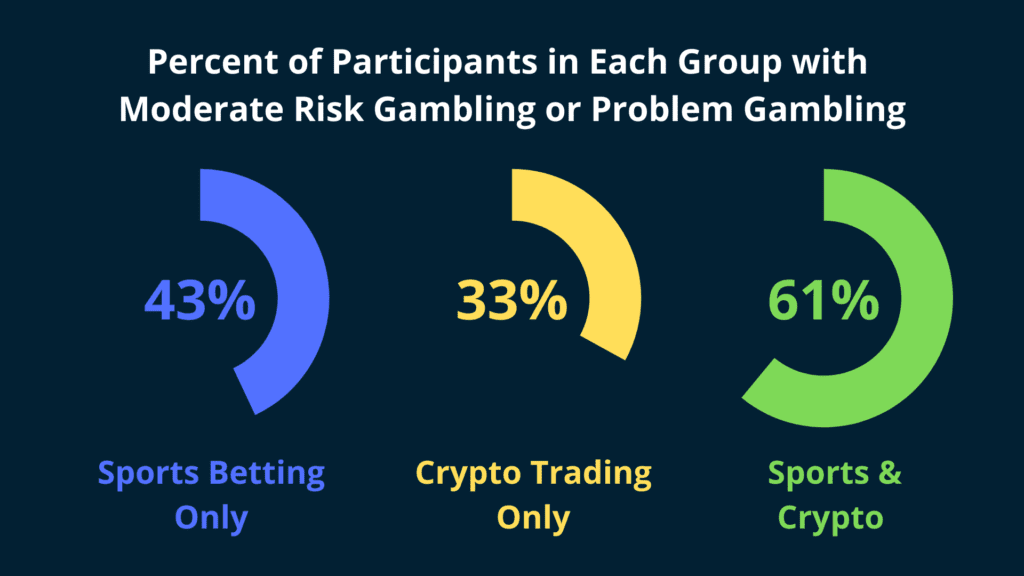 Figure. Comparing the percent of participants in each group based on activities engaged in at least once per month during the past year whose PGSI score indicated moderate risk gambling or problem gambling. The difference between groups was statistically significant.
Why do these findings matter?
The results show that crypto trading on its own is associated with increased problem gambling risk. Trading cryptocurrency also appears to amplify the risk of gambling alone, with those engaging in both activities most likely to experience gambling-related problems. Additionally, researchers have raised concerns that crypto trading has addictive qualities. Trading cryptocurrency is popular among gamblers, and should be incorporated into problem gambling screening and assessment protocols.
Every study has limitations. What are the limitations in this study?
This study was cross-sectional, so we cannot conclude whether trading cryptocurrency causes an increased risk for problem gambling or whether those already experiencing problem gambling have a greater inclination to engage in crypto trading. The study also relied on self-reported data, so participants might have under- or over-reported their actual gambling and/or crypto-related behaviors.
For more information:
Do you think you or someone you know has a gambling problem? Visit the National Council on Problem Gambling for screening tools and resources.
-- Caitlyn Fong, MPH
Figure. Comparing the percent of participants in each group based on activities engaged in at least once per month during the past year whose PGSI score indicated moderate risk gambling or problem gambling. The difference between groups was statistically significant.
Why do these findings matter?
The results show that crypto trading on its own is associated with increased problem gambling risk. Trading cryptocurrency also appears to amplify the risk of gambling alone, with those engaging in both activities most likely to experience gambling-related problems. Additionally, researchers have raised concerns that crypto trading has addictive qualities. Trading cryptocurrency is popular among gamblers, and should be incorporated into problem gambling screening and assessment protocols.
Every study has limitations. What are the limitations in this study?
This study was cross-sectional, so we cannot conclude whether trading cryptocurrency causes an increased risk for problem gambling or whether those already experiencing problem gambling have a greater inclination to engage in crypto trading. The study also relied on self-reported data, so participants might have under- or over-reported their actual gambling and/or crypto-related behaviors.
For more information:
Do you think you or someone you know has a gambling problem? Visit the National Council on Problem Gambling for screening tools and resources.
-- Caitlyn Fong, MPH

Nov 24, 2021 | ADVOCACY, PROBLEM GAMBLING, RESEARCH, RESOURCES
In the second of a series profiling organizations receiving grants from Minnesota’s Department of Human Services (DHS), this issue of Northern Light features Asian Media Access.
Asian Media Access (AMA) is a comprehensive community media arts education agency supporting creative solutions for problems facing the Asian American & Pacific Islander (AAPI) community through education, production, information technology and community organizing. It’s bringing its resources and mission to bear on the issue of problem gambling to this community.
AMA’s effort began with research to understand more about the cultural impacts creating different problem gambling behaviors. They conducted interviews with 25 members of the AAPI community representing different ethnicities and social status.
“We found that our communities share the secrecy surrounding problem gambling like other communities,” says AMA founder and executive director Ange Hwang. “There is the challenge of people recognizing that they have a gambling problem and seeking help.”
According to Ange, approximately 25% of those interviewed say they gamble because they want more money. In one instance, a woman with low income explained she hoped to get more money to support newborns. “This type of thinking was a surprise to us as we thought they might gamble because they needed an escape from the stress of trying to speak English.”
“Many think that gambling, even in small amounts, is the best route to get more money,” says Ange. “We need to change that mindset so that people understand that if you lose a little, it’s still a large percentage of their assets. We’re trying to find a new way to discuss this with the community.”
The AAPI community uses a communication style that’s different than the Eurocentric way of contacting a hotline and talking to a counselor. Thus, the goal is to create messages that can become immersed in the environment so that it starts to build context and trust.
Another emphasis is to educate members of the community about the importance of financial management. “Many people don’t have exposure to mainstream society and don’t understand the complex financial structure present in the U.S."
AMA is working to share messages in a variety of ways, including brochures, educational workshops and in-person. “From past experience, we know it’s hard for people to come and say, ‘Yes, I’m a problem gambler and need this workshop,” says Ange. The use of creative materials to open up community discussion is part of a four-year process.
AMA will also be creating YouTube videos that they can present at events and share through social circles. They’ve also started a youth group of “cultural brokers” that will use the heritage language to create postcards and other items that will be circulated to the community. “Communication through heritage language is a key for members who don’t know English,” says Ange.
AMA is collaborating with various organizations to educate the community about problem gambling. These include Asian temples in the Twin Cities, local chambers of commerce, restaurant owners and other organizations that help those new to the area.

Oct 14, 2021 | PROBLEM GAMBLING, RECOVERY, RESEARCH
Read the original article on The BASIS website.
Problem gambling occurs more frequently among men, but it is still present among women and is understudied in this population. Gambling Disorder (GD) refers to persistent and problematic gambling behavior leading to distress, and that causes financial, relationship, and psychological harm. The effectiveness of GD treatment has received limited attention in the scientific literature. Common factors that might influence treatment effectiveness include discontinuing treatment and relapse. This week, The WAGER reviews a study by Marta Baño and colleagues that examined the short-term therapy outcomes of group CBT among women with Gambling Disorder.
What were the research questions?
What is the short-term effectiveness of group standardized cognitive behavioral therapy (CBT) among women with GD? Also, what are the most important predictors of primary therapy outcomes (discontinuing treatment and relapse)?
What did the researchers do?
The researchers assigned 214 women seeking treatment for Gambling Disorder at the Pathological Gambling and Behavioral Addictions Unit at the Bellvitge University Hospital in Barcelona, Spain to a group CBT program. Participants attended weekly 90-minute sessions for 16 weeks and learned CBT strategies to recondition cognitive distortions and improve emotional regulation, with the ultimate goal of absolute and continued abstinence from all gambling behavior. These CBT strategies included education on vulnerability factors, ways to avoid possible triggers, and how to respond to urges with alternative healthier behaviors. The researchers used logistic regression, negative binomial regression, and survival analysis to assess predictors of discontinuing treatment and relapse.
What did they find?
During the course of treatment in the study, 90 women (42%) skipped three consecutive treatment sessions and 77 women (36%) had at least one relapse. Women with relatively less severe Gambling Disorder, and experiencing greater psychological distress, were more likely to discontinue treatment. On the other hand, relapse risk was higher among women with lower education levels, those without gambling-related debt, and divorced women. Drug use (other than smoking), placing more maximum bets per gambling-episode1, preferring gambling games that rely on chance alone such as bingo or slot machines2, and lower socioeconomic status were also associated with higher relapse rates during CBT (see Figure).
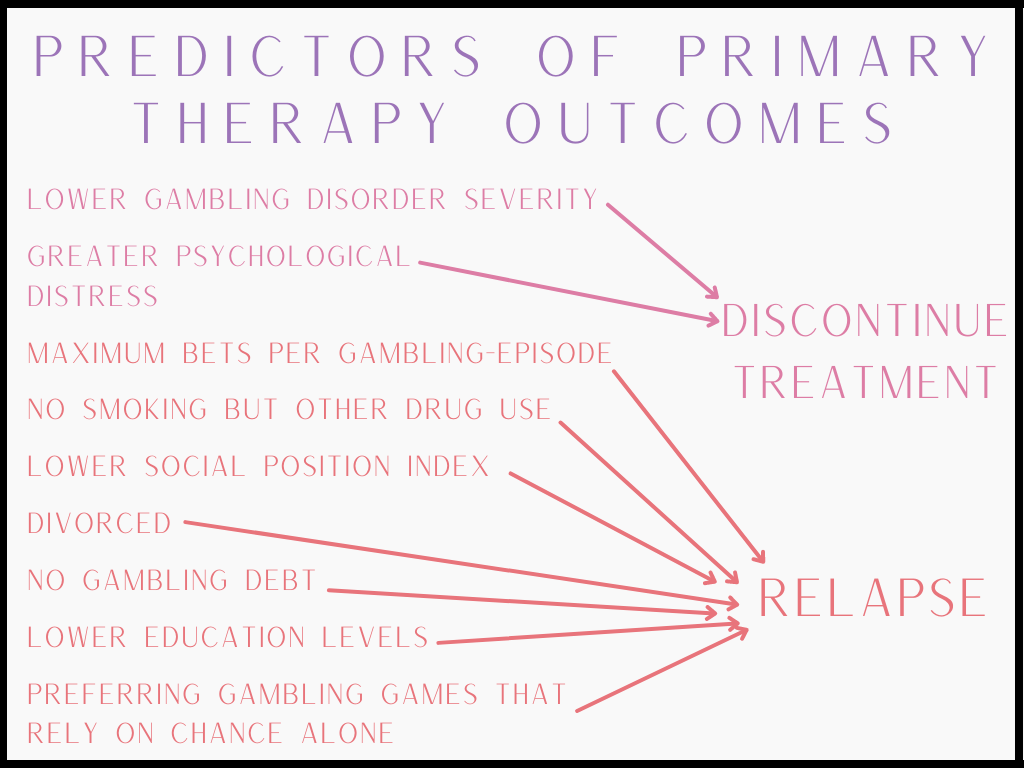 Figure. Statistically significant predictors of primary therapy outcomes—discontinuing treatment and relapses— among women in CBT treatment for Gambling Disorder (n = 214). Arrows indicate significant predictors of either discontinuing treatment or relapse.
Why do these findings matter?
Learning more about female gambling behavior and identifying specific predictors of discontinuing treatment and relapse can help clinicians provide better GD treatment. For example, severe emotional distress may indicate a need for greater emphasis on emotional regulation techniques (e.g., through mindfulness meditation) or healthy coping mechanisms. CBT might also need to be adapted for those with lower education levels to be more engaging and comprehensible. These findings also demonstrate a clear need for future research on women with GD to understand their unique lived experiences.
Every study has limitations. What are the limitations of this study?
As a study with only female participants, the findings can not be generalized to men. Additionally, measures such as amount bet per gambling episode relied on self-reported data, in which participants may have over- or underestimated their actual gambling behavior.
For more information:
Do you think you or someone you know has a gambling problem? Visit the National Council on Problem Gambling for screening tools and resources.
________________
[1] In this context, “maximum bets per gambling-episode” refers to most bets placed during any single past gambling experience.
[2] As opposed to games like poker, which include both chance and skill.
Figure. Statistically significant predictors of primary therapy outcomes—discontinuing treatment and relapses— among women in CBT treatment for Gambling Disorder (n = 214). Arrows indicate significant predictors of either discontinuing treatment or relapse.
Why do these findings matter?
Learning more about female gambling behavior and identifying specific predictors of discontinuing treatment and relapse can help clinicians provide better GD treatment. For example, severe emotional distress may indicate a need for greater emphasis on emotional regulation techniques (e.g., through mindfulness meditation) or healthy coping mechanisms. CBT might also need to be adapted for those with lower education levels to be more engaging and comprehensible. These findings also demonstrate a clear need for future research on women with GD to understand their unique lived experiences.
Every study has limitations. What are the limitations of this study?
As a study with only female participants, the findings can not be generalized to men. Additionally, measures such as amount bet per gambling episode relied on self-reported data, in which participants may have over- or underestimated their actual gambling behavior.
For more information:
Do you think you or someone you know has a gambling problem? Visit the National Council on Problem Gambling for screening tools and resources.
________________
[1] In this context, “maximum bets per gambling-episode” refers to most bets placed during any single past gambling experience.
[2] As opposed to games like poker, which include both chance and skill.

Jul 27, 2021 | PROFESSIONALS, RESEARCH
Read the original article from The BASIS website.
Written by: Taylor Lee
Various in-person and online games allow players to purchase randomized packs of rewards, such as collectible card packs and virtual items. Some places are imposing regulations on video games offering loot boxes—purchasable virtual containers with randomized items—as they seem to fit traditional definitions of gambling. Indeed, people who report more problem gambling symptoms tend to spend more on loot boxes. Due to some similarities with loot boxes, collectible card game ‘booster packs’ have come under scrutiny as well. Collectible card games (CCGs) allow for the purchasing of physical booster packs containing cards that are sealed and random in game value. This week, The WAGER reviews a study by David Zendle and colleagues that examined the association between problem gambling symptoms and the amount of money spent on physical booster packs of trading cards.
What was the research question?
What is the relationship between the severity of problem gambling symptoms and the quantity of money spent on collectible card game booster packs in real-world and digital stores?
What did the researchers do?
The researchers used a cross-sectional survey advertised on the online message board Reddit, and obtained 726 usable responses from participants 18 and older. About 60% of respondents were from the U.S., but many different countries were represented. The survey asked participants about CCG physical booster pack spending in (1) real-world stores and (2) digital stores within the past month. It also assessed problem gambling using the Problem Gambling Severity Index (PGSI). The researchers used PGSI scores to classify respondents as non-problem gamblers (n = 429), low-risk gamblers (n = 244), moderate-risk gamblers (n = 35), and people experiencing gambling problems (n = 18). They then used Kruskal–Wallis tests to examine if respondents in different PGSI groups differed in terms of how much money they spent on physical booster packs in real-world stores and digital stores.1
What did they find?
Zendle and colleagues did not find evidence for an association between problem gambling and quantity spent on booster packs in real-world stores (see Figure). Even though there was a statistically significant relationship for problem gambling and the quantity of money spent on booster packs in digital stores, the effect was too small to be considered clinically significant. There was also no significant difference in quantity spent on booster packs between people with and without gambling problems.
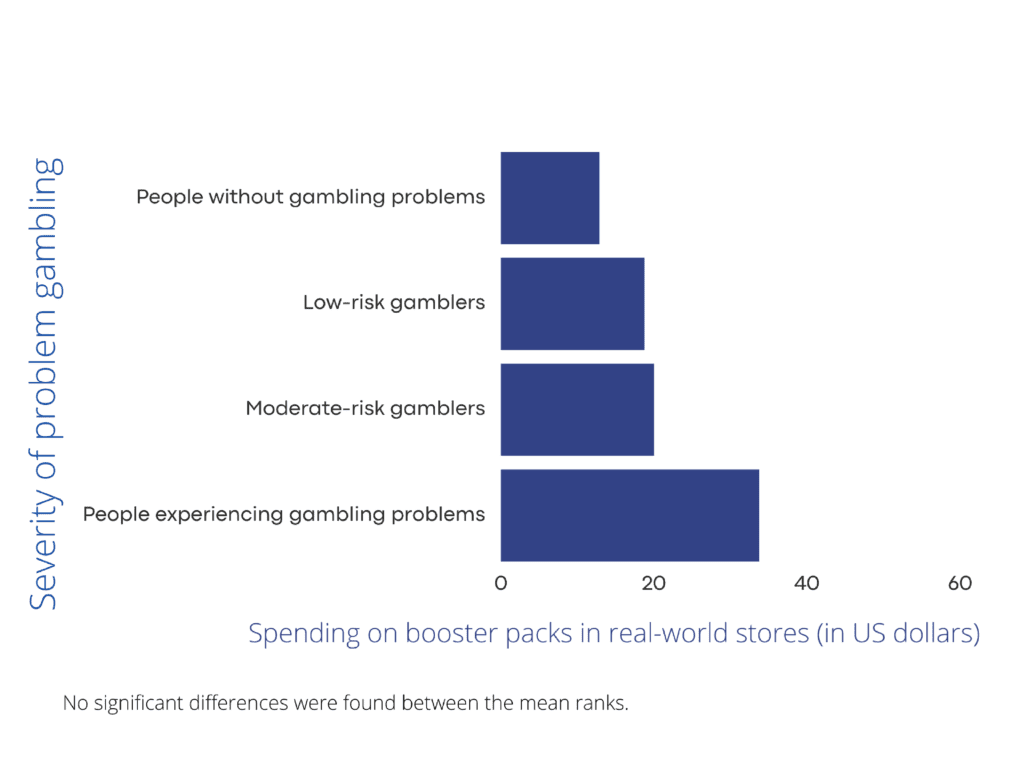 Figure. Problem gambling severity and spending (in US dollars) on booster packs in real-world stores among survey respondents (total n = 726). Although the authors performed their statistical tests on mean ranks, we provide medians to illustrate the trends across PGSI categories. The interquartile range (IQR) around each median was $39 for people without gambling problems (n = 429), $50 for low-risk gamblers (n = 244), $69 for moderate-risk gamblers (n = 35), and $119 for people experiencing gambling problems (n = 18).
Why do these findings matter?
This study suggests that while booster packs in collectible card games may appear similar to gambling in some ways, users do not seem to engage with them in ways comparable to traditional gambling activities. Thus, regulations—like those developed for loot boxes—might not be necessary for booster packs. This suggests that there is likely a difference in the ways that players interact with physical booster packs and digital loot boxes. Ultimately, the findings were cross-sectional, so the researchers could not establish causality; additional longitudinal and/or experimental research would help better illuminate the specific factor that accounts for the difference in loot box and booster packs’ relationship with problem gambling symptoms.
Every study has limitations. What are the limitations of this study?
Participants were recruited from Reddit’s online message boards targeting fervent players of collectible card games. An over-representation of enthusiastic players in the study’s sample may lead to findings that are not representative of more casual players. Social desirability bias through self-reporting may also contribute to participants misrepresenting their true spending or gambling behaviors. The most severe PGSI category had only 18 people in it, which likely limited the chances that the authors would statistically detect a difference among groups.
For more information:
Do you think you or someone you know has a gambling problem? Visit the National Council on Problem Gambling for screening tools and resources. For additional resources, including gambling and self-help tools, please visit The BASIS Addiction Resources page.
-- Taylor Lee
______________
[1] The authors used rank transformations and Kruskal–Wallis tests to replicate past research in this area, and because they could not be sure if their spending data would meet the normality distribution assumptions of ANOVA.
Figure. Problem gambling severity and spending (in US dollars) on booster packs in real-world stores among survey respondents (total n = 726). Although the authors performed their statistical tests on mean ranks, we provide medians to illustrate the trends across PGSI categories. The interquartile range (IQR) around each median was $39 for people without gambling problems (n = 429), $50 for low-risk gamblers (n = 244), $69 for moderate-risk gamblers (n = 35), and $119 for people experiencing gambling problems (n = 18).
Why do these findings matter?
This study suggests that while booster packs in collectible card games may appear similar to gambling in some ways, users do not seem to engage with them in ways comparable to traditional gambling activities. Thus, regulations—like those developed for loot boxes—might not be necessary for booster packs. This suggests that there is likely a difference in the ways that players interact with physical booster packs and digital loot boxes. Ultimately, the findings were cross-sectional, so the researchers could not establish causality; additional longitudinal and/or experimental research would help better illuminate the specific factor that accounts for the difference in loot box and booster packs’ relationship with problem gambling symptoms.
Every study has limitations. What are the limitations of this study?
Participants were recruited from Reddit’s online message boards targeting fervent players of collectible card games. An over-representation of enthusiastic players in the study’s sample may lead to findings that are not representative of more casual players. Social desirability bias through self-reporting may also contribute to participants misrepresenting their true spending or gambling behaviors. The most severe PGSI category had only 18 people in it, which likely limited the chances that the authors would statistically detect a difference among groups.
For more information:
Do you think you or someone you know has a gambling problem? Visit the National Council on Problem Gambling for screening tools and resources. For additional resources, including gambling and self-help tools, please visit The BASIS Addiction Resources page.
-- Taylor Lee
______________
[1] The authors used rank transformations and Kruskal–Wallis tests to replicate past research in this area, and because they could not be sure if their spending data would meet the normality distribution assumptions of ANOVA.

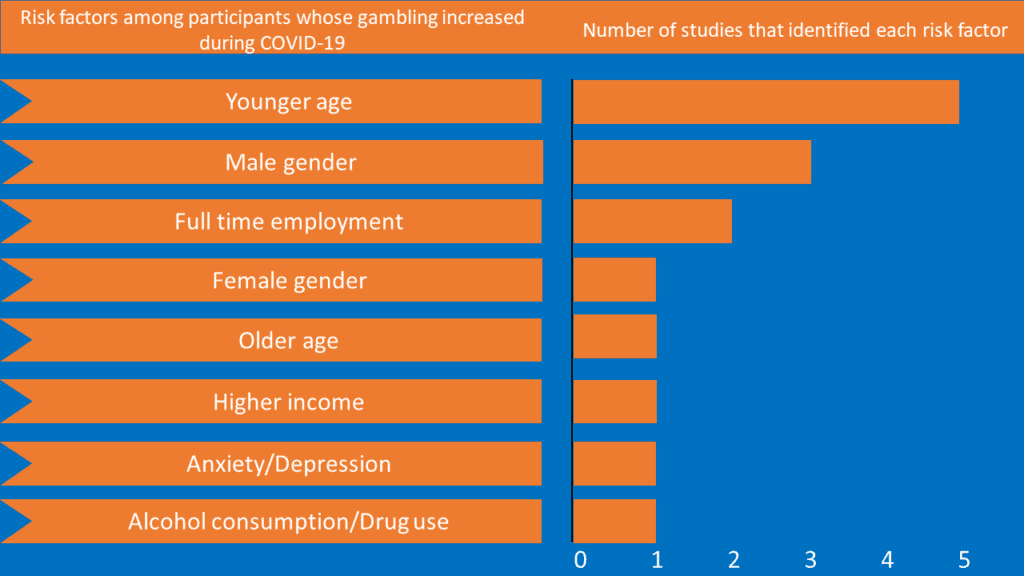 Figure. Number of studies that found certain characteristics and behaviors (i.e., risk factors) of subgroups of individuals who increased their gambling during the pandemic. The total number of studies included was n = 17.
Why do these findings matter?
These findings are important because they indicate that gambling trends during the current COVID-19 pandemic situation are complicated and may be worsening for some individuals as a result of psychological and financial stress. Online gambling—which appeared to have increased in popularity in some subgroups—
Figure. Number of studies that found certain characteristics and behaviors (i.e., risk factors) of subgroups of individuals who increased their gambling during the pandemic. The total number of studies included was n = 17.
Why do these findings matter?
These findings are important because they indicate that gambling trends during the current COVID-19 pandemic situation are complicated and may be worsening for some individuals as a result of psychological and financial stress. Online gambling—which appeared to have increased in popularity in some subgroups—
 Figure. Common associations between spending on gambling transactions and financial, health, and leisure & interests. In these graphs, the x-axis shows percentile of gambling spend (e.g., 1% includes individuals in the sample who were in the lowest 1% in terms of how much of their spending was on gambling; 99% includes individuals in the sample who were in the 99th percentile in terms of how much of their spending was on gambling). The y-axis measures either the level of the outcome (e.g., how many pounds [£] an individual has in savings), or the percent of customers who had that outcome (e.g., the percent who missed a mortgage payment). The charts do not depict actual data from the study, but representative curves for each set of outcomes. Adapted from Muggleton et al. (2021).
Why do these findings matter?
This study confirmed that gambling is associated with a wide range of negative outcomes, using objective, representative data based on millions of banking records. It is one of the largest studies ever conducted on gambling transactions and how they relate to other financial transactions. However, the study also showed that in most cases, these relationships are much stronger at higher levels of gambling. The results of these studies can be used to guide interventions and prevention efforts. For example, banks could
Figure. Common associations between spending on gambling transactions and financial, health, and leisure & interests. In these graphs, the x-axis shows percentile of gambling spend (e.g., 1% includes individuals in the sample who were in the lowest 1% in terms of how much of their spending was on gambling; 99% includes individuals in the sample who were in the 99th percentile in terms of how much of their spending was on gambling). The y-axis measures either the level of the outcome (e.g., how many pounds [£] an individual has in savings), or the percent of customers who had that outcome (e.g., the percent who missed a mortgage payment). The charts do not depict actual data from the study, but representative curves for each set of outcomes. Adapted from Muggleton et al. (2021).
Why do these findings matter?
This study confirmed that gambling is associated with a wide range of negative outcomes, using objective, representative data based on millions of banking records. It is one of the largest studies ever conducted on gambling transactions and how they relate to other financial transactions. However, the study also showed that in most cases, these relationships are much stronger at higher levels of gambling. The results of these studies can be used to guide interventions and prevention efforts. For example, banks could