Apr 10, 2026 | PROBLEM GAMBLING, RESOURCES, SPORTS BETTING, YOUTH GAMBLING
We come across numerous articles about problem gambling and problem gaming. Here are a few:
The article reports that Washington State has sued the makers of the Bingo Blitz app, alleging it operates as illegal gambling and uses child-appealing content, weak age controls and aggressive in-app purchases that expose minors and other users to addiction risks and significant financial harm.
https://gamblingharm.org/bingo-blitz-app-illegal-gambling-children/
The column argues that the growing ubiquity and normalization of gambling—especially through sports betting and youth exposure—risks fostering addiction, financial harm and a cultural shift toward chasing quick wealth through luck rather than stable, meaningful paths.
https://www.startribune.com/brown-when-betting-is-everywhere-we-gamble-with-our-future/601567918
NPR's A Martinez speaks with journalist and author Danny Funt about his new book, "Everybody Loses: The Tumultuous Rise of American Sports Gambling."
https://www.npr.org/2026/01/19/nx-s1-5602138/everybody-loses-chronicles-the-rise-of-americas-sports-betting-boom
A piece by PBS on How Sports Betting is changing our Brains and Behavior, features Danny Funt and Dr. Tim Fong.
https://www.pbs.org/newshour/video/horizons/2026/02/how-sports-betting-is-changing-our-brains-and-behavior
This Teach-Out is open to anyone interested in learning more about the sports betting industry and its effects on the general population, but it is particularly relevant for young adults and their parents, athletes, educators, and policymakers looking to mitigate the effects of sports betting.
https://online.umich.edu/teach-outs/sports-betting-risks-and-ripple-effects-teach-out/

Apr 7, 2026 | PROBLEM GAMBLING, RESOURCES
Sweepstakes casinos have grown rapidly in recent years, offering online slot machines, poker and other casino-style games without describing themselves as traditional gambling. While they are often marketed as “free-to-play entertainment,” their structure has raised questions among regulators, public health professionals and policymakers.
How sweepstakes casinos work
At first glance, sweepstakes casinos look similar to real-money online casinos. Players sign up, choose games and spin reels or play table games. The key difference is the use of a dual-currency system.
Most platforms offer two types of virtual coins:
- Gold Coins – used only for entertainment play and have no cash value
- Sweeps Coins – used for promotional games and can be redeemed for cash or prizes
Players typically receive Sweeps Coins as a bonus when they purchase Gold Coin packages. They may also obtain Sweeps Coins through free methods such as daily login bonuses, promotions or mail-in requests (often called an Alternate Method of Entry). Because there is always a free way to participate, operators argue that no purchase is required.
This structure is designed to avoid the legal definition of gambling, which generally requires three elements: prize, chance and consideration (payment). By offering a free entry option, sweepstakes casinos attempt to remove the “consideration” element.
Why many view them as gambling
Despite the legal framing, critics argue that sweepstakes casinos function much like traditional gambling for these reasons:
- Games rely on chance and offer real-world prizes.
- Players often purchase virtual currency in practice, even if technically optional.
- The purchase of Gold Coins frequently includes bonus Sweeps Coins, which can be redeemed for cash, creating a financial incentive to spend.
Regulators have described the two-currency model as a way to disguise paid gambling activity. In Minnesota, officials noted that consumers who appear to be buying entertainment currency are effectively purchasing access to prize-eligible play.
Research and surveys also indicate that many users participate with the intention of winning money, reinforcing concerns that the experience mirrors gambling behavior.
Legal and regulatory concerns in Minnesota
Minnesota has taken a particularly strong stance. In 2025, the Attorney General ordered multiple sweepstakes casino operators to stop offering services in the state, stating that such platforms may violate gambling and consumer protection laws.
State officials emphasized several risks, claiming:
- These sites operate outside Minnesota’s regulated gambling system
- Most are based out of state or overseas, limiting oversight
- Players lack protections such as fair-play audits, reliable payouts or dispute resolution
Because the activity is unregulated, it also generates no state tax revenue and does not contribute to programs typically funded by legal gambling, such as public services or problem gambling prevention.
Why the issue matters
Sweepstakes casinos exist in a legal gray area nationwide, but Minnesota’s actions reflect growing concern. When casino-style gambling operates outside regulatory frameworks, states lose both consumer safeguards and public revenue, while residents face potential financial and behavioral risks.
For policymakers and prevention professionals, sweepstakes casinos highlight a broader challenge: as gambling-like products evolve online, the line between entertainment and wagering becomes increasingly blurred. Clear regulation, consumer education and ongoing monitoring will be critical to ensure that emerging gaming models do not bypass the protections and public benefits that accompany legal, regulated gambling.

Apr 7, 2026 | PROBLEM GAMBLING, RESOURCES, YOUTH GAMBLING
As legalized sports betting and digital wagering continue to expand, gambling has become a routine part of life for many young adults. For colleges and universities, this shift raises an important question: how can campuses help students make informed choices and avoid gambling-related harm?
Dr. Michelle L. Malkin, assistant professor at East Carolina University, is working to answer that question through The Betting Blueprint, a wellness-oriented curriculum designed specifically for students ages 18–24. Her approach combines screening, education, financial wellness and early intervention to reduce risk and support healthier decision-making.
Start with awareness and screening
One of the key messages from Dr. Malkin’s work is that screening should be ongoing, not limited to a single awareness campaign. While March’s Problem Gambling Awareness Month provides an important opportunity for outreach, students engage in gambling year-round. Ideally, campuses host multiple screening efforts, including events early in the fall semester and again in March when March Madness increases betting activity.
Peer-led outreach has proven especially effective. Students are more likely to participate when encouraged by their peers and when screening is quick and accessible, such as through a QR code completed on a phone. Brief screening tools that use clear language like “betting and/or gambling” help identify students who may be experiencing harm and connect them with resources before problems escalate.
Redefining what gambling looks like
The curriculum challenges students’ assumptions about gambling, as many young adults associate gambling only with casinos or money-based games. In reality, gambling includes any activity involving something of value and an element of chance.
Today’s gambling landscape includes, but is not limited to, sports wagering, fantasy sports, prediction markets, loot boxes, esports, cryptocurrency speculation, in-play betting and social gaming features. By broadening students’ understanding, the curriculum helps them recognize behaviors they might not otherwise identify as gambling.
The curriculum also explores why some individuals struggle to gamble responsibly. For certain people, brain responses to rewards can lead to chasing losses, overconfidence or difficulty stopping. Students learn to recognize warning signs such as borrowing money, hiding gambling or continuing despite negative consequences.
Importantly, the focus is not prohibition. Instead, the curriculum promotes lower-risk strategies for those who choose to gamble: setting time and money limits, avoiding gambling when stressed or emotional, understanding the odds and using responsible gambling tools available on many platforms. Students also learn that gambling harms extend beyond the individual, affecting roommates, partners, family members and others.
Financial wellness at the center
Another important aspect of The Betting Blueprint is connecting gambling decisions to financial health. Many students have limited experience managing money, making them particularly vulnerable to overspending on entertainment, including betting.
Through budgeting exercises and real-life scenarios, students explore what financial wellness means and how to give every dollar a purpose. They learn to identify priorities, track income and expenses, and distinguish between appropriate entertainment spending and high-risk funding sources such as borrowed money, financial aid or credit card debt.
A key point is that gambling winnings should never be treated as income. Activities encourage students to track results over time, understand variability and consider how unexpected wins or loses affect long-term goals. The emphasis is on building habits that support stability and reduce financial stress.
Students as problem solvers
A distinctive feature of the curriculum is its interactive design. Small-group activities ask students to respond to common beliefs, such as “I can win back my losses” or “My gambling is under control.” By researching data and developing peer-focused messages, students generate their own solutions rather than being lectured.
This collaborative approach increases engagement and helps shift campus norms around gambling.
Meeting Students at a Critical Time
College campuses provide a unique environment to reach emerging adults during a formative period. Dr. Malkin’s work highlights the importance of integrating gambling awareness into broader wellness efforts, including mental health, substance use prevention and financial education.
As gambling opportunities continue to grow, so does the need for practical, student-centered prevention. With ongoing screening, peer engagement and a focus on financial and personal well-being, The Betting Blueprint offers campuses a proactive way to help students make informed choices and avoid harm—long before problems take hold.
The information in this article was taken from Dr. Malkin’s presentation at the MNAPG conference last November. For more information about the curriculum, please contact Dr. Malkin at malkinm20@ecu.edu.

Jan 29, 2026 | PROBLEM GAMBLING, RESEARCH, SPORTS BETTING, YOUTH GAMBLING
Read the original article on The BASIS here.
By John Slabczynski
As legalized sports betting grows in popularity, public health experts have raised concerns about its potential harms. As advertisers and sports leagues continue to make gambling a key part of spectatorship, this could normalize betting as a natural part of sports fandom. Previous research suggests that these practices are contributing to an increase in gambling problems, particularly among young adults. To better address these concerns, public health advocates need to understand the specific problems associated with young adult sports betting. This week, The WAGER reviews a study by Nerilee Hing and colleagues that explored young adult sports bettors’ experiences of gambling harm and their perspectives on changing their gambling behavior.
What were the research questions?
(1) How do young adult sports bettors experience gambling harms? (2) How do they conceptualize and engage in changing harmful gambling?
What did the researchers do?
The researchers recruited 50 Australians between the ages of 18 and 25 who reported experiencing moderate or severe harm from sports betting in the past year. Participants completed interviews with the research team that asked about the nature of sports betting-related harms they experienced, perceived barriers and facilitators of gambling behavior change, and strategies they used to change their gambling. The researchers then coded the transcribed interviews to identify relevant themes.
What did they find?
The interviews revealed five distinct types of sports betting-related harm: 1) financial harm, 2) harm to mental health, 3) harm to work or study, 4) relationship harm, and 5) harm to physical health. Participants reported that many of these harms built up over time and intersected with one another. For example, several participants indicated that financial harms grew over time, and that these harms worsened their mental health. At the time of interviews, some participants were unwilling to change their gambling behavior. Others, however, pointed to improved knowledge of gambling disorder and an awareness of gambling harms as key factors in choosing to change their harmful behavior (see Figure).
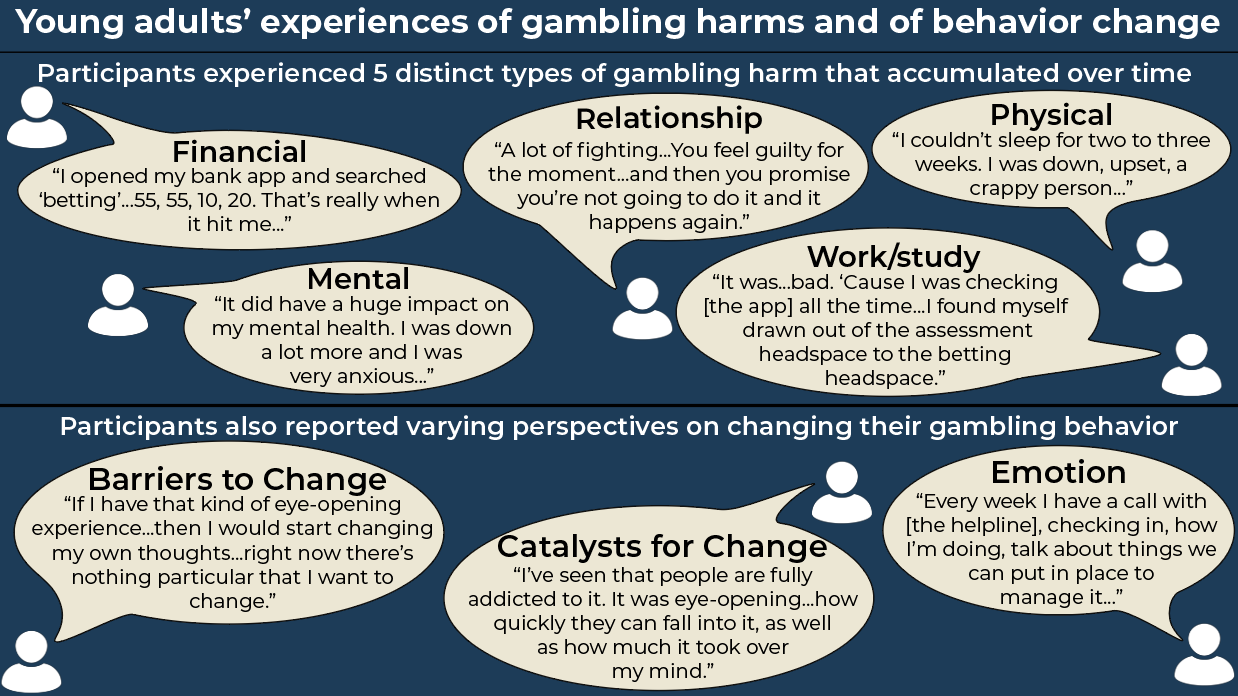 Figure. Displays participant quotes representing each theme identified through thematic analysis. Click image to enlarge.
Why do these findings matter?
Information on the types of harm experienced by young adult sports gamblers can help public health practitioners identify potential gambling problems quickly and accurately, allowing for timely intervention and support before more significant harms happen. This study’s findings on behavior change are especially important. Many participants emphasized the value of awareness of gambling as an addiction as a catalyst for behavior change. Initiatives such as The Faces of Gambling that highlight how gambling problems develop from the perspective of people with lived experience may be especially effective in reducing the prevalence of gambling harms.
Every study has limitations. What are the limitations in this study?
This study screened participants for a history of experiencing gambling harms using a list of previously researched harms, which may have primed the sample to report these very same types of harm. Similarly, because the study focused on moderate to severe cases of gambling disorder among young adults, the results of this study may not be generalizable to those who experience less severe forms of the condition, or the wider gambling population.
Figure. Displays participant quotes representing each theme identified through thematic analysis. Click image to enlarge.
Why do these findings matter?
Information on the types of harm experienced by young adult sports gamblers can help public health practitioners identify potential gambling problems quickly and accurately, allowing for timely intervention and support before more significant harms happen. This study’s findings on behavior change are especially important. Many participants emphasized the value of awareness of gambling as an addiction as a catalyst for behavior change. Initiatives such as The Faces of Gambling that highlight how gambling problems develop from the perspective of people with lived experience may be especially effective in reducing the prevalence of gambling harms.
Every study has limitations. What are the limitations in this study?
This study screened participants for a history of experiencing gambling harms using a list of previously researched harms, which may have primed the sample to report these very same types of harm. Similarly, because the study focused on moderate to severe cases of gambling disorder among young adults, the results of this study may not be generalizable to those who experience less severe forms of the condition, or the wider gambling population.
Dec 17, 2025 | HEALTHY PLAY, HELP, PROBLEM GAMBLING, RESOURCES, SPORTS BETTING
MNAPG posed questions to Lori Kalani, DraftKings' chief responsible gambling officer to learn more about DraftKings’ problem gambling efforts. Below are her responses:
MNAPG: We understand that My Budget Builder and My Stat Sheet are new responsible gaming (RG) tools for DraftKings. Can you share more about them?
LK: My Budget Builder guides customers through a simple process to set personalized entertainment budgets, reminders and limits. My Stat Sheet provides customers with a clear personalized snapshot of their play activity, including time spent, deposits, withdrawals, wagers and outcomes. Both are designed to help customers make informed decisions and play responsibly.
MNAPG: What information is included with alerts and does anything happen if a customer exceeds the limits they set?
LK: We proactively encourage every player to set budgets for their deposit amounts, play time and size of bets, and we provide access to a range of tools and resources with which they can engage. Customers receive reminders when they approach the limits they’ve set. If a limit is reached, the platform enforces it automatically—for example, preventing additional deposits or gameplay until the current limit resets. Once a limit is set, it cannot be increased or cancelled until the timeframe for the limit has ended. More restrictive limits can be added at any time.
MNAPG: How many customers are currently using some of DraftKings’ responsible gaming tools and resources?
LK: Since launching our Responsible Gaming Center in 2024—a centralized hub for all the DraftKings RG tools and resources available at rg.draftkings.com—more than 5.6 million customers have visited. Approximately 3.5 million unique customers have used My Stat Sheet since the industry-first tool was introduced early last year. This June, we launched our newest tool, My Budget Builder, and we expect usage to increase throughout the NFL season.
MNAPG: How do you help make customers aware that these tools and resources exist?
LK: We highlight responsible gaming tools and resources throughout the customer journey. Some examples include promoting RG tools and resources at onboarding, in-app messaging, emails and various campaigns throughout the year. Within the app and online, an RG shield icon appears at the top of the screen, making the DraftKings Responsible Gaming Center just one click away so that tools and resources are seamlessly available as part of the product experience. To mark this year’s Responsible Gaming Education Month, we launched an NFL sweepstakes that incentivizes customers who use tools like My Budget Builder and My Stat Sheet with the chance to win weekly NFL ticket prizes, culminating in a grand prize trip to the Super Bowl.
MNAPG: Do you work with any external organizations or researchers to improve your responsible gaming efforts?
LK: Yes. We work with organizations such as the Cambridge Health Alliance, BetBlocker, Evive, the Responsible Online Gaming Association (ROGA) and the International Center for Responsible Gaming. Our work with Cambridge Health Alliance includes expanding research on responsible gaming and facilitating new opportunities to educate customers about the tools and resources that are available to help them play responsibly. We also provide funding to the National Council on Problem Gambling. DraftKings’ State Council Funding (SCF) program provides annual donations to 35 state problem gaming councils across the country to support their work. Since announcing the SCF program in 2022, we have donated millions of dollars, including to the Minnesota Alliance on Problem Gambling. (Editor’s note: MNAPG used the funds provided by DraftKings to develop a pilot casino employee training program that’s currently being tested at Canterbury.)
MNAPG: Do you proactively identify customers who may be having challenges? If so, how is this done?
LK: We proactively encourage every player to set budgets for their deposit amounts, play time and size of bets, and we provide access to a range of tools and resources with which they can engage. We use modeling techniques and advanced technology, including machine learning, to help identify when someone may no longer be playing for fun, which is then reviewed by our Responsible Gaming team for further analysis.
MNAPG: Does DraftKings work with the other members of the Responsible Online Gaming Association (ROGA) to ensure that if one of your customers is given a time out or excluded that it is active across all the other platforms?
LK: Today, most jurisdictions where we operate maintain shared exclusion databases, which are distributed to all licensed operators. In some states, operators also contribute their own self-exclusion data. While there isn’t yet an industry-wide system among operators, through ROGA we have announced the creation of a centralized exclusion clearinghouse. The first phase will introduce a national shared self-exclusion list so that when a player self-excludes with one member operator, that exclusion will also extend across all ROGA member platforms.
MNAPG: How do you see your RG tools and resources evolving over the next 2–3 years?
LK: In the next few years, we expect RG tools and resources to further evolve through AI and personalization. Smarter technology will allow these tools and resources to adapt dynamically, making them even more intuitive and seamless to the customer.
MNAPG: How do you measure success in responsible gaming initiatives?
LK: We consider, among other things, adoption rates, customer feedback and independent evidence-based research as we continue to enhance our responsible gaming tools and resources. Success means responsible play continues to be embedded in the DraftKings experience for every customer.

Dec 17, 2025 | HELP, PROBLEM GAMBLING, RECOVERY, STORIES
I’m 42 years old, and I never thought gambling would take over my life the way it did. Growing up, I played lotto tickets occasionally, but it was harmless, nothing more than a little game. I could walk away without a second thought. Gambling didn’t become a real problem until about 10 years ago, and even then it wasn’t because I suddenly developed a taste for it. It was because of a medication.
I was diagnosed with bipolar disorder and put on a drug called Latuda. At the time, I didn’t know that one of its rare side effects was compulsive gambling. It’s right there in the warnings, but no one ever told me. Looking back, it feels like a switch flipped in my brain. All of a sudden, I couldn’t stop.
Poker and electronic machines became my games of choice. Omaha, Hold ’Em, slots and electronic pulltabs, which were a real curse for me. I could be up thousands of dollars, but by midnight it was gone. Friends and family would urge me to cash out, but I couldn’t.
The first time I realized I was addicted to gambling was in 2016. But I didn’t talk to a therapist about it until years later. By then, gambling had already destroyed so much of my life. It pushed me into doing things I never imagined myself capable of. I borrowed money I couldn’t repay, stole from people I loved and even stole credit card information from a friend on her deathbed.
My addiction led me to commit aggravated armed robbery. I was preparing to go to treatment at Project Turnabout, waiting for medical records to clear, and in the middle of that chaos I made a bad decision. I got caught and went to prison for 33 months. I asked the judge to send me to treatment instead, but he wouldn’t.
There are no real gambling programs in the prison system, and I struggled in there. Gambling is everywhere—sports bets, high-stakes spades games, etc.—with considerable money moving through canteen accounts. The system hides it from the outside world, but it’s real. I even talked with a chaplain about starting a GA group inside the prison. He told me, “If you can find a volunteer, we’ll do it.” But no one ever stepped up.
Since getting out, I’ve been working with a counselor through Club Recovery. I’ve had stretches of abstinence—four months clean at one point—but I’ve struggled too. I even put Gamban on my phone to block gambling apps, but then I bought a new phone so I could gamble again. That’s how strong the pull can be. But I’ve realized I can’t be a hypocrite. If I want to help others, I have to stay clean myself.
I’m starting a new Gamblers Anonymous group in Little Falls. Zoom meetings didn’t work for me—they didn’t feel personal enough. I wanted a place where people could sit down face-to-face, look each other in the eye and admit what’s really going on. There’s an epidemic of gambling up there. People buy pulltabs by the box, yet most don’t think of gambling as a real addiction.
That’s bullshit. I know firsthand how destructive it is.
Starting the GA group wasn’t easy. I had to call GA International, get a starter kit, work with the library to secure space, put flyers up in hospitals, bars, even in the local paper and radio. But it matters. These programs hold me accountable, and hopefully they’ll give others the same chance.
I’ve thought about suicide from time to time. But one day, a driver told me about his best friend who killed himself because of gambling. Hearing that cracked me open. I teared up in the car and knew it was time for me to step up—for myself, for others and for my family.
Thanks to gambling, I’ve lost a lot—money, relationships, trust. Some of those losses I’ll never get back. But I’m trying to move forward. I want to bring GA into prisons. I want to write a blog about addiction and suicide. I want to make sure others know they’re not alone, and that gambling addiction is every bit as real and dangerous as alcohol or drugs.
I can’t change the past, but I can use it. If sharing my story helps one person stop before they lose everything, then it’s worth it.