Apr 10, 2026 | PROBLEM GAMBLING, RESOURCES, SPORTS BETTING, YOUTH GAMBLING
We come across numerous articles about problem gambling and problem gaming. Here are a few:
The article reports that Washington State has sued the makers of the Bingo Blitz app, alleging it operates as illegal gambling and uses child-appealing content, weak age controls and aggressive in-app purchases that expose minors and other users to addiction risks and significant financial harm.
https://gamblingharm.org/bingo-blitz-app-illegal-gambling-children/
The column argues that the growing ubiquity and normalization of gambling—especially through sports betting and youth exposure—risks fostering addiction, financial harm and a cultural shift toward chasing quick wealth through luck rather than stable, meaningful paths.
https://www.startribune.com/brown-when-betting-is-everywhere-we-gamble-with-our-future/601567918
NPR's A Martinez speaks with journalist and author Danny Funt about his new book, "Everybody Loses: The Tumultuous Rise of American Sports Gambling."
https://www.npr.org/2026/01/19/nx-s1-5602138/everybody-loses-chronicles-the-rise-of-americas-sports-betting-boom
A piece by PBS on How Sports Betting is changing our Brains and Behavior, features Danny Funt and Dr. Tim Fong.
https://www.pbs.org/newshour/video/horizons/2026/02/how-sports-betting-is-changing-our-brains-and-behavior
This Teach-Out is open to anyone interested in learning more about the sports betting industry and its effects on the general population, but it is particularly relevant for young adults and their parents, athletes, educators, and policymakers looking to mitigate the effects of sports betting.
https://online.umich.edu/teach-outs/sports-betting-risks-and-ripple-effects-teach-out/
Apr 10, 2026 | RECOVERY, SPORTS BETTING, YOUTH GAMBLING
When I quit using alcohol and drugs, I thought that was the hard part. What I didn’t realize was that I had created a huge void in my life. I wasn’t getting those instant dopamine hits anymore, and I didn’t know what to do with myself. That’s when gambling quietly slipped in.
My gambling didn’t start in a casino or with sports betting like it does with a lot of people. It started, oddly enough, with clothes.
When I was in college, streetwear was big. There were online raffles for limited-edition clothing. You’d throw in $10 or $25 for a chance to win something worth a lot more. I started doing those raffles all the time. If I won, I’d try to resell the item. Before long, I was doing this every single day—including watching the raffle videos—while having basically no money. That should’ve been a red flag, but I didn’t see it that way at the time.
I did the clothing raffles for about two years and then stopped gambling for about a year. Then I started playing fantasy football with friends and things gradually progressed. I started doing future bets, like whether a team would win the championship or how it would do for the whole season. Then it became point spreads and over/unders for individual games. Then it became in-game live betting. That all felt “manageable,” at least compared to what came next.
My sports betting got worse. DraftKings wasn’t what it is today, so I used an illegal offshore site. It started small with $5 and $10 bets, but gradually turned into betting every day, multiple times a day. I was betting on games I didn’t even watch or know anything about, like baseball games in a league on the other side of the world. That made it harder to lie to myself that this was just for fun.
What really pushed me over the edge was online casino gambling. While watching sports, I started clicking into online casinos on my phone for fun. I quickly went through five-dollar slots and started chasing my losses. Then I’d lose $100 trying to get it back on roulette or blackjack. I started using money I didn’t have—dipping into credit cards and debit cards. I wasn’t paying rent and was barely eating. I had a decent job and still couldn’t afford to live.
I was living with my girlfriend at the time, as gambling slowly took over my life. I’d get home from work and watch games from 4 p.m. until midnight instead of spending time with her. She had no idea how bad it was. When she eventually broke up with me and moved out—taking the dog—I couldn’t afford the apartment on my own because of gambling.
I had only been to one or two GA meetings at that point, so I didn’t really have a GA program. I asked someone in AA if they knew anyone who had been to GA, and I got connected with someone who offered to take me to a meeting. He became my GA sponsor. I thought it would be just like AA—and at a high level it is—but it’s clearly different because I couldn’t manage my gambling addiction as well as I managed my alcohol addiction.
I was surprised how few young people were in the GA rooms. Given how much I know younger people are gambling, particularly on sports, I’d expected more people in their 20s and 30s. I found that many of the people went to live casinos and played a lot of scratch-offs, activities I think are less common in my age group.
As I look back on my gambling, I wasn’t really chasing wins; I was chasing a feeling. I don’t even remember having many big wins. No win ever felt that good and every loss felt awful. I just wanted to feel something, or avoid being present in my own life.
After I stopped gambling almost two years ago, I couldn’t watch sports for a long time. I’d always think, “I would’ve won that if I’d bet.” Eventually, I was able to watch again, but the ads are everywhere now. I honestly can’t imagine trying to quit for the first time today with all those reminders.
I just turned 30. I still get urges to gamble more than I ever get urges to drink. Gambling ads hit me in a way alcohol ads don’t. I also see how normalized betting has become, especially for younger people. My little brother is in college, and betting is just part of the culture—everyone seems to be doing it. I try to keep the door open so he knows he can talk to me if it ever becomes a problem.
Thankfully, life today is much more manageable. I know my brain is always going to look for something, so I try to channel that energy into healthier things—running, relationships, being present. I’m not perfect, but I’m honest now. And that makes all the difference.
If any of this sounds familiar, I promise you’re not alone—and that there is hope. Help is out there. Recovery doesn’t make life perfect, but it does make it livable—and for me, that’s more than enough.

Jan 29, 2026 | PROBLEM GAMBLING, RESEARCH, SPORTS BETTING, YOUTH GAMBLING
Read the original article on The BASIS here.
By John Slabczynski
As legalized sports betting grows in popularity, public health experts have raised concerns about its potential harms. As advertisers and sports leagues continue to make gambling a key part of spectatorship, this could normalize betting as a natural part of sports fandom. Previous research suggests that these practices are contributing to an increase in gambling problems, particularly among young adults. To better address these concerns, public health advocates need to understand the specific problems associated with young adult sports betting. This week, The WAGER reviews a study by Nerilee Hing and colleagues that explored young adult sports bettors’ experiences of gambling harm and their perspectives on changing their gambling behavior.
What were the research questions?
(1) How do young adult sports bettors experience gambling harms? (2) How do they conceptualize and engage in changing harmful gambling?
What did the researchers do?
The researchers recruited 50 Australians between the ages of 18 and 25 who reported experiencing moderate or severe harm from sports betting in the past year. Participants completed interviews with the research team that asked about the nature of sports betting-related harms they experienced, perceived barriers and facilitators of gambling behavior change, and strategies they used to change their gambling. The researchers then coded the transcribed interviews to identify relevant themes.
What did they find?
The interviews revealed five distinct types of sports betting-related harm: 1) financial harm, 2) harm to mental health, 3) harm to work or study, 4) relationship harm, and 5) harm to physical health. Participants reported that many of these harms built up over time and intersected with one another. For example, several participants indicated that financial harms grew over time, and that these harms worsened their mental health. At the time of interviews, some participants were unwilling to change their gambling behavior. Others, however, pointed to improved knowledge of gambling disorder and an awareness of gambling harms as key factors in choosing to change their harmful behavior (see Figure).
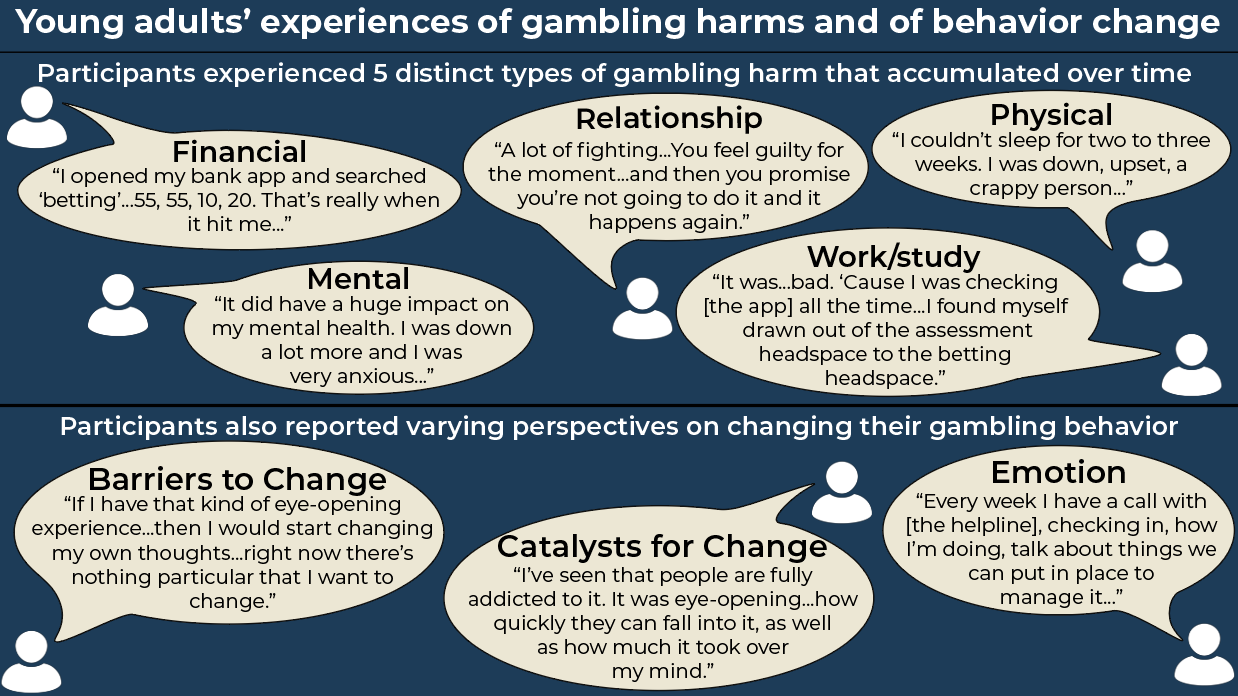 Figure. Displays participant quotes representing each theme identified through thematic analysis. Click image to enlarge.
Why do these findings matter?
Information on the types of harm experienced by young adult sports gamblers can help public health practitioners identify potential gambling problems quickly and accurately, allowing for timely intervention and support before more significant harms happen. This study’s findings on behavior change are especially important. Many participants emphasized the value of awareness of gambling as an addiction as a catalyst for behavior change. Initiatives such as The Faces of Gambling that highlight how gambling problems develop from the perspective of people with lived experience may be especially effective in reducing the prevalence of gambling harms.
Every study has limitations. What are the limitations in this study?
This study screened participants for a history of experiencing gambling harms using a list of previously researched harms, which may have primed the sample to report these very same types of harm. Similarly, because the study focused on moderate to severe cases of gambling disorder among young adults, the results of this study may not be generalizable to those who experience less severe forms of the condition, or the wider gambling population.
Figure. Displays participant quotes representing each theme identified through thematic analysis. Click image to enlarge.
Why do these findings matter?
Information on the types of harm experienced by young adult sports gamblers can help public health practitioners identify potential gambling problems quickly and accurately, allowing for timely intervention and support before more significant harms happen. This study’s findings on behavior change are especially important. Many participants emphasized the value of awareness of gambling as an addiction as a catalyst for behavior change. Initiatives such as The Faces of Gambling that highlight how gambling problems develop from the perspective of people with lived experience may be especially effective in reducing the prevalence of gambling harms.
Every study has limitations. What are the limitations in this study?
This study screened participants for a history of experiencing gambling harms using a list of previously researched harms, which may have primed the sample to report these very same types of harm. Similarly, because the study focused on moderate to severe cases of gambling disorder among young adults, the results of this study may not be generalizable to those who experience less severe forms of the condition, or the wider gambling population.
Dec 17, 2025 | HEALTHY PLAY, HELP, PROBLEM GAMBLING, RESOURCES, SPORTS BETTING
MNAPG posed questions to Lori Kalani, DraftKings' chief responsible gambling officer to learn more about DraftKings’ problem gambling efforts. Below are her responses:
MNAPG: We understand that My Budget Builder and My Stat Sheet are new responsible gaming (RG) tools for DraftKings. Can you share more about them?
LK: My Budget Builder guides customers through a simple process to set personalized entertainment budgets, reminders and limits. My Stat Sheet provides customers with a clear personalized snapshot of their play activity, including time spent, deposits, withdrawals, wagers and outcomes. Both are designed to help customers make informed decisions and play responsibly.
MNAPG: What information is included with alerts and does anything happen if a customer exceeds the limits they set?
LK: We proactively encourage every player to set budgets for their deposit amounts, play time and size of bets, and we provide access to a range of tools and resources with which they can engage. Customers receive reminders when they approach the limits they’ve set. If a limit is reached, the platform enforces it automatically—for example, preventing additional deposits or gameplay until the current limit resets. Once a limit is set, it cannot be increased or cancelled until the timeframe for the limit has ended. More restrictive limits can be added at any time.
MNAPG: How many customers are currently using some of DraftKings’ responsible gaming tools and resources?
LK: Since launching our Responsible Gaming Center in 2024—a centralized hub for all the DraftKings RG tools and resources available at rg.draftkings.com—more than 5.6 million customers have visited. Approximately 3.5 million unique customers have used My Stat Sheet since the industry-first tool was introduced early last year. This June, we launched our newest tool, My Budget Builder, and we expect usage to increase throughout the NFL season.
MNAPG: How do you help make customers aware that these tools and resources exist?
LK: We highlight responsible gaming tools and resources throughout the customer journey. Some examples include promoting RG tools and resources at onboarding, in-app messaging, emails and various campaigns throughout the year. Within the app and online, an RG shield icon appears at the top of the screen, making the DraftKings Responsible Gaming Center just one click away so that tools and resources are seamlessly available as part of the product experience. To mark this year’s Responsible Gaming Education Month, we launched an NFL sweepstakes that incentivizes customers who use tools like My Budget Builder and My Stat Sheet with the chance to win weekly NFL ticket prizes, culminating in a grand prize trip to the Super Bowl.
MNAPG: Do you work with any external organizations or researchers to improve your responsible gaming efforts?
LK: Yes. We work with organizations such as the Cambridge Health Alliance, BetBlocker, Evive, the Responsible Online Gaming Association (ROGA) and the International Center for Responsible Gaming. Our work with Cambridge Health Alliance includes expanding research on responsible gaming and facilitating new opportunities to educate customers about the tools and resources that are available to help them play responsibly. We also provide funding to the National Council on Problem Gambling. DraftKings’ State Council Funding (SCF) program provides annual donations to 35 state problem gaming councils across the country to support their work. Since announcing the SCF program in 2022, we have donated millions of dollars, including to the Minnesota Alliance on Problem Gambling. (Editor’s note: MNAPG used the funds provided by DraftKings to develop a pilot casino employee training program that’s currently being tested at Canterbury.)
MNAPG: Do you proactively identify customers who may be having challenges? If so, how is this done?
LK: We proactively encourage every player to set budgets for their deposit amounts, play time and size of bets, and we provide access to a range of tools and resources with which they can engage. We use modeling techniques and advanced technology, including machine learning, to help identify when someone may no longer be playing for fun, which is then reviewed by our Responsible Gaming team for further analysis.
MNAPG: Does DraftKings work with the other members of the Responsible Online Gaming Association (ROGA) to ensure that if one of your customers is given a time out or excluded that it is active across all the other platforms?
LK: Today, most jurisdictions where we operate maintain shared exclusion databases, which are distributed to all licensed operators. In some states, operators also contribute their own self-exclusion data. While there isn’t yet an industry-wide system among operators, through ROGA we have announced the creation of a centralized exclusion clearinghouse. The first phase will introduce a national shared self-exclusion list so that when a player self-excludes with one member operator, that exclusion will also extend across all ROGA member platforms.
MNAPG: How do you see your RG tools and resources evolving over the next 2–3 years?
LK: In the next few years, we expect RG tools and resources to further evolve through AI and personalization. Smarter technology will allow these tools and resources to adapt dynamically, making them even more intuitive and seamless to the customer.
MNAPG: How do you measure success in responsible gaming initiatives?
LK: We consider, among other things, adoption rates, customer feedback and independent evidence-based research as we continue to enhance our responsible gaming tools and resources. Success means responsible play continues to be embedded in the DraftKings experience for every customer.
Nov 19, 2025 | SPORTS BETTING, STORIES
By Saul Malek
Read the original article on the BASIS here.
Editor’s note: This op-ed was prepared by Saul Malek, a professional speaker specializing in gambling addiction prevention and education. Saul developed a gambling addiction as a college sophomore, losing money, time, relationships, and nearly his life. Since entering recovery in 2019, he has become an in-demand speaker, sharing his story with schools (both high school and college), athlete mental health organizations, suicide prevention groups, parent groups, popular news outlets (including the New York Times, National Public Radio, Public Broadcasting Service, and Dallas Morning News). He has keynoted conferences including the Connecticut Council on Problem Gambling annual conference, the Wisconsin Council on Problem Gambling annual conference, and Mental Health America Greater Dallas Adolescent Symposium. He has appeared on Dr. Phil Primetime and was a TedX speaker at the University of Alabama at Birmingham. This op-ed is part of our Special Series on Addiction and Technology, which was funded by a research and consulting contract with DraftKings.
 The most popular athletes in 2017 included LeBron James, Tom Brady, and Simone Biles. It was a different star’s name, however, that caught my attention that year- Tatjana Maria, a veteran on the women’s professional tennis circuit.
Sometime during the fall of 2017 Maria was playing in a tournament. Who she played against? I don’t know. Where the tournament was? Couldn’t tell you… I don’t even remember what date the match was on.
What I can tell you, with certainty, is this: I was sitting on the toilet in my college dormitory, preparing for a night out with friends, when- I logged on to my newly created online sportsbook account and saw, to my shock, that I could bet on tennis. Before my bookie created the account for me, I’d text him the games I wanted to bet on. Eventually, he grew tired of the texts and thought of a solution: “I can make you an account online,” he said “where I give you a line of credit and you can bet on whatever you want, whenever you want. At the end of the week we’ll square up through Venmo.” I didn’t know I could text, “Hey, give me $100 on Tatjana Maria!” But now, Tatjana Maria (and the never ending world of online gambling) came to me. I was just getting started. Soon, foreign tennis matches wouldn’t be just a mere bathroom pastime- they became an obsession dominating every moment of my life.
For almost two full years, my entire life revolved around gambling. Full games became live bets on halves, quarters, even individual points. Classes skipped, lies told, sleep lost, money chased.
The strangest thing of all? The progression of my addiction all seemed so normal.
Your Dream Life: One Click Away
You may be thinking, “There’s nothing normal about throwing your life away on obscure tennis bets.” Let me explain.
I didn’t start with obscure tennis bets. My first ever sports bet, in September 2017, when I was 19 years old, was a measly $10 wager on a baseball game.
Winning that bet made me feel like a million bucks. I wanted more. Text the bookie. $20 on a football game that weekend. Hey, I’m not bad at this. I should do this more often. This is like a business, tracking my wins and losses. Bookie sets me up an account online. I can bet on tennis? And darts? Increased betting frequency. No more tracking wins and losses. Larger bets with a higher credit limit. Start losing more frequently. Chase losses with desperate long-shots. Lying. Debt. Loans. Bailouts. Live bets, betting 10 times on the same game. Each action made sense to me in response to the last one (at least, at the time). Only after suffering unbearable consequences could I see how off base I really was.
I take responsibility for my gambling. Yet, at the same time, I can’t help but think that the digital nature of my gambling accelerated my problem.
Firstly, as the Tatjana Maria example illustrates, the digital gambling world exposed me to markets I never would’ve known about. Additionally, the digital gambling universe desensitized me to the value of money. Typing in “500” and clicking “bet” feels a lot less real than counting out $500 in cash and carelessly risking it. Another point: ease of access. My dream world of gambling was only a click away from me at all times. Feeling down? Place a bet. Feeling a confident high? Reach into my pocket and place another bet. No waiting around, no driving to a physical betting shop.
It is easy to feel overwhelmed in the world of digital gambling. However, in my experience, there are also more opportunities than ever to be connected with help.
Getting Your Life Back: One Click Away
I first sought help for my gambling problem in August of 2018, almost a full year before I finally quit gambling. I attended in person Gamblers Anonymous meetings, by far the youngest member at only 20. GA has been a lifesaver for me, I still attend meetings to this day. But in those early, inconsistent days where I was yet to hit a “bottom” in my gambling, the internet is what kept me hanging on.
Reddit played a pivotal role in keeping me connected with others in recovery. Through this online platform, I made close connections on the “problem gambling” subreddit, often with members close in age. Reddit introduced me to Jeff, a prominent voice in gambling harm prevention, who worked to establish Skype (pre-Zoom) meetings for people struggling. Just as the digital gambling landscape was available 24/7, so was my Reddit connection.
Professional help for a gambling problem is not always easy to find. Fortunately, my parents connected me with a therapist specializing in gambling addiction who offered virtual sessions. Visits with this therapist were essential in formulating a payment plan with my creditors, easing pressure that otherwise may have led me back to gambling.
Now professionally involved in gambling harm prevention, I can’t imagine broadcasting my message without the power of the internet. LinkedIn, Instagram, YouTube… all essential. How cool is it to share ideas with prevention specialists in Africa? Very cool… and also possible!
In Closing
Technology, like many tools, can be used or abused. It is important to not only see technology’s downsides, but also the opportunities for prevention, recovery, and treatment that are afforded by the digital gambling landscape. It is practically impossible to avoid digital connection these days- thus individuals should be taught to best maximize their tech use for positive outcomes.
The most popular athletes in 2017 included LeBron James, Tom Brady, and Simone Biles. It was a different star’s name, however, that caught my attention that year- Tatjana Maria, a veteran on the women’s professional tennis circuit.
Sometime during the fall of 2017 Maria was playing in a tournament. Who she played against? I don’t know. Where the tournament was? Couldn’t tell you… I don’t even remember what date the match was on.
What I can tell you, with certainty, is this: I was sitting on the toilet in my college dormitory, preparing for a night out with friends, when- I logged on to my newly created online sportsbook account and saw, to my shock, that I could bet on tennis. Before my bookie created the account for me, I’d text him the games I wanted to bet on. Eventually, he grew tired of the texts and thought of a solution: “I can make you an account online,” he said “where I give you a line of credit and you can bet on whatever you want, whenever you want. At the end of the week we’ll square up through Venmo.” I didn’t know I could text, “Hey, give me $100 on Tatjana Maria!” But now, Tatjana Maria (and the never ending world of online gambling) came to me. I was just getting started. Soon, foreign tennis matches wouldn’t be just a mere bathroom pastime- they became an obsession dominating every moment of my life.
For almost two full years, my entire life revolved around gambling. Full games became live bets on halves, quarters, even individual points. Classes skipped, lies told, sleep lost, money chased.
The strangest thing of all? The progression of my addiction all seemed so normal.
Your Dream Life: One Click Away
You may be thinking, “There’s nothing normal about throwing your life away on obscure tennis bets.” Let me explain.
I didn’t start with obscure tennis bets. My first ever sports bet, in September 2017, when I was 19 years old, was a measly $10 wager on a baseball game.
Winning that bet made me feel like a million bucks. I wanted more. Text the bookie. $20 on a football game that weekend. Hey, I’m not bad at this. I should do this more often. This is like a business, tracking my wins and losses. Bookie sets me up an account online. I can bet on tennis? And darts? Increased betting frequency. No more tracking wins and losses. Larger bets with a higher credit limit. Start losing more frequently. Chase losses with desperate long-shots. Lying. Debt. Loans. Bailouts. Live bets, betting 10 times on the same game. Each action made sense to me in response to the last one (at least, at the time). Only after suffering unbearable consequences could I see how off base I really was.
I take responsibility for my gambling. Yet, at the same time, I can’t help but think that the digital nature of my gambling accelerated my problem.
Firstly, as the Tatjana Maria example illustrates, the digital gambling world exposed me to markets I never would’ve known about. Additionally, the digital gambling universe desensitized me to the value of money. Typing in “500” and clicking “bet” feels a lot less real than counting out $500 in cash and carelessly risking it. Another point: ease of access. My dream world of gambling was only a click away from me at all times. Feeling down? Place a bet. Feeling a confident high? Reach into my pocket and place another bet. No waiting around, no driving to a physical betting shop.
It is easy to feel overwhelmed in the world of digital gambling. However, in my experience, there are also more opportunities than ever to be connected with help.
Getting Your Life Back: One Click Away
I first sought help for my gambling problem in August of 2018, almost a full year before I finally quit gambling. I attended in person Gamblers Anonymous meetings, by far the youngest member at only 20. GA has been a lifesaver for me, I still attend meetings to this day. But in those early, inconsistent days where I was yet to hit a “bottom” in my gambling, the internet is what kept me hanging on.
Reddit played a pivotal role in keeping me connected with others in recovery. Through this online platform, I made close connections on the “problem gambling” subreddit, often with members close in age. Reddit introduced me to Jeff, a prominent voice in gambling harm prevention, who worked to establish Skype (pre-Zoom) meetings for people struggling. Just as the digital gambling landscape was available 24/7, so was my Reddit connection.
Professional help for a gambling problem is not always easy to find. Fortunately, my parents connected me with a therapist specializing in gambling addiction who offered virtual sessions. Visits with this therapist were essential in formulating a payment plan with my creditors, easing pressure that otherwise may have led me back to gambling.
Now professionally involved in gambling harm prevention, I can’t imagine broadcasting my message without the power of the internet. LinkedIn, Instagram, YouTube… all essential. How cool is it to share ideas with prevention specialists in Africa? Very cool… and also possible!
In Closing
Technology, like many tools, can be used or abused. It is important to not only see technology’s downsides, but also the opportunities for prevention, recovery, and treatment that are afforded by the digital gambling landscape. It is practically impossible to avoid digital connection these days- thus individuals should be taught to best maximize their tech use for positive outcomes.
Sep 5, 2025 | PROBLEM GAMBLING, SPORTS BETTING
This article, published in USA Today, provides a great depiction of how young men are immersed in high-risk sports betting.
This article highlights the lack of oversight for the digital environments children access online through the metaverse, certain video games and apps, and emphasizes the challenges parents face in protecting their kids.
Sweepstakes operators rely on the legality of their “promotional contest” model, which requires a free method of entry to preserve their claim to non-gambling status. It’s a gray area that seems very gambling-like, but is not subject to regulatory attention.
This USA Today article (published June 3, 2025) explores the rising crisis of sports betting addiction among young men, particularly college-aged and early adults. It highlights how easily accessible mobile betting platforms, aggressive marketing tactics and features like in-play bets are fueling compulsive gambling, while warning that the U.S. lacks comprehensive treatment infrastructure or national tracking of gambling disorders.