
Apr 10, 2026 | ADVOCACY, RESEARCH
For the first time, federal research funding will be available to study gambling addiction. The fiscal year 2026 defense appropriations package includes language allowing gambling disorder to be researched through the Department of Defense’s Peer Reviewed Medical Research Program (PRMRP).
The Senate report clarifies that gambling addiction is an eligible research topic under the program. While the funding is limited to military and veteran populations, the change represents the first time a federal medical research program has explicitly supported peer-reviewed research on gambling addiction, reflecting growing recognition of the issue as a public health concern.
The inclusion is especially relevant for servicemembers and veterans, who face elevated risk for gambling-related harm. Research has found strong links between gambling disorder and suicide risk; among veterans seeking treatment for a gambling problem, nearly 40 percent report a suicide attempt. Military populations may also experience higher exposure to risk factors such as stress, trauma and ready access to high-risk gambling environments.
Gambling addiction has historically received little attention in federal research portfolios, leaving gaps in evidence to guide prevention, early intervention and treatment. Advocates say expanding research access is an important step toward improving understanding and care for affected populations.
This funding must be appropriated each year. NCPG will be closely monitoring and working with their lobbyists to support funding renewal.

Feb 21, 2026 | RESEARCH, YOUTH GAMBLING
Read the original article on The BASIS.
By John Slabczynski
Gambling can create financial, social, psychological, and physical harms. Of particular concern is suicidality, which recent research has identified as a potential gambling harm. As we undergo worldwide gambling expansion, it is imperative that public health experts and the gamblers themselves know more about this link, including whether problem gambling predicts future suicidality. This week The WAGER reviews a study by Oliver Bastiani and colleagues that explored the relationship between problem gambling and suicidality among the same participants over time.
What were the research questions?
Do gambling problems predict future suicidality?
What did the researchers do?
The researchers used data from the Avon Longitudinal Study of Parents and Children, a United Kingdom-based birth cohort study. They limited their analysis to data collected from 2,801 participants who completed assessments between the ages of 16 and 25. During these years, participants provided information on their suicidality and gambling problems. The researchers used logistic regression to examine whether having gambling problems at age 20 or 24 increased the odds of reporting past-year suicide attempts at age 24 or 25, controlling for some known risk factors such as sex, alcohol consumption/harms, and previous suicide attempts.
What did they find?
Most participants reported no problem gambling at both age 20 (70.4%) and age 24 (76.5%). Approximately 2.6% reported a past-year suicide attempt at age 24 and 1.9% did so at age 251. Problem gambling severity at age 24 was associated with increased odds of past-year suicide attempt at the same age. Longitudinal analyses revealed that problem gambling at age 20 was predictive of past-year suicide attempts at age 24 but not at age 25. On a shorter timespan, problem gambling at age 24 predicted past-year suicide attempts at age 25. (See Figure.)
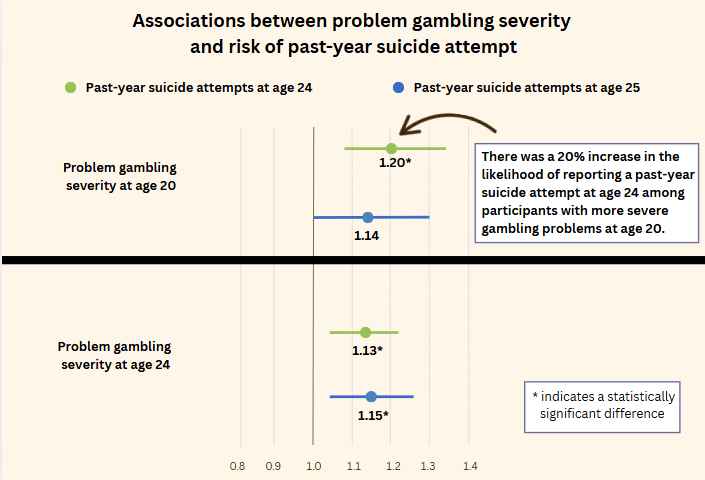 Figure. Displays the odds of reporting past year suicidality at ages 24 and 25 by problem gambling severity at ages 20 and 24. Odds ratios can be interpreted as having X times higher odds of reporting an event. For example, a one-point increase in problem gambling severity (e.g., answering “most of the time” instead of “sometimes” on one question) at age 24 was associated with having 1.13 times higher odds of reporting past year suicidality at age 24.
Why do these findings matter?
These findings provide more support for the idea that problem gambling contributes to future suicidality, because in this study, problem gambling preceded suicide attempts. Because problem gambling can be detected and managed at an early stage, it is essential to spread the word about brief gambling screening to healthcare providers and anyone else in a position to intervene, such as college health services staff and debt counselors. Furthermore, public health advocates can use this information to more effectively advocate for preventive tools like mandatory cool-off periods, which can disrupt gambling flow states and discourage long sessions, or tighter regulations on gambling and gambling advertising.
Every study has limitations. What are the limitations in this study?
The relationship between problem gambling and suicidality is probably more complicated than a single study can reveal. For instance, this study did not explore the possibility that suicidality predicted future problem gambling (i.e., reverse causality), which might happen if people develop gambling problems while trying to escape from painful suicidal thoughts. Another complication is that problem gambling tends to occur alongside depression, anxiety, and illicit drug use, which the researchers were unable to control for, and which might have partly accounted for the relationships with suicide attempts.
Figure. Displays the odds of reporting past year suicidality at ages 24 and 25 by problem gambling severity at ages 20 and 24. Odds ratios can be interpreted as having X times higher odds of reporting an event. For example, a one-point increase in problem gambling severity (e.g., answering “most of the time” instead of “sometimes” on one question) at age 24 was associated with having 1.13 times higher odds of reporting past year suicidality at age 24.
Why do these findings matter?
These findings provide more support for the idea that problem gambling contributes to future suicidality, because in this study, problem gambling preceded suicide attempts. Because problem gambling can be detected and managed at an early stage, it is essential to spread the word about brief gambling screening to healthcare providers and anyone else in a position to intervene, such as college health services staff and debt counselors. Furthermore, public health advocates can use this information to more effectively advocate for preventive tools like mandatory cool-off periods, which can disrupt gambling flow states and discourage long sessions, or tighter regulations on gambling and gambling advertising.
Every study has limitations. What are the limitations in this study?
The relationship between problem gambling and suicidality is probably more complicated than a single study can reveal. For instance, this study did not explore the possibility that suicidality predicted future problem gambling (i.e., reverse causality), which might happen if people develop gambling problems while trying to escape from painful suicidal thoughts. Another complication is that problem gambling tends to occur alongside depression, anxiety, and illicit drug use, which the researchers were unable to control for, and which might have partly accounted for the relationships with suicide attempts.

Jan 29, 2026 | PROBLEM GAMBLING, RESEARCH, SPORTS BETTING, YOUTH GAMBLING
Read the original article on The BASIS here.
By John Slabczynski
As legalized sports betting grows in popularity, public health experts have raised concerns about its potential harms. As advertisers and sports leagues continue to make gambling a key part of spectatorship, this could normalize betting as a natural part of sports fandom. Previous research suggests that these practices are contributing to an increase in gambling problems, particularly among young adults. To better address these concerns, public health advocates need to understand the specific problems associated with young adult sports betting. This week, The WAGER reviews a study by Nerilee Hing and colleagues that explored young adult sports bettors’ experiences of gambling harm and their perspectives on changing their gambling behavior.
What were the research questions?
(1) How do young adult sports bettors experience gambling harms? (2) How do they conceptualize and engage in changing harmful gambling?
What did the researchers do?
The researchers recruited 50 Australians between the ages of 18 and 25 who reported experiencing moderate or severe harm from sports betting in the past year. Participants completed interviews with the research team that asked about the nature of sports betting-related harms they experienced, perceived barriers and facilitators of gambling behavior change, and strategies they used to change their gambling. The researchers then coded the transcribed interviews to identify relevant themes.
What did they find?
The interviews revealed five distinct types of sports betting-related harm: 1) financial harm, 2) harm to mental health, 3) harm to work or study, 4) relationship harm, and 5) harm to physical health. Participants reported that many of these harms built up over time and intersected with one another. For example, several participants indicated that financial harms grew over time, and that these harms worsened their mental health. At the time of interviews, some participants were unwilling to change their gambling behavior. Others, however, pointed to improved knowledge of gambling disorder and an awareness of gambling harms as key factors in choosing to change their harmful behavior (see Figure).
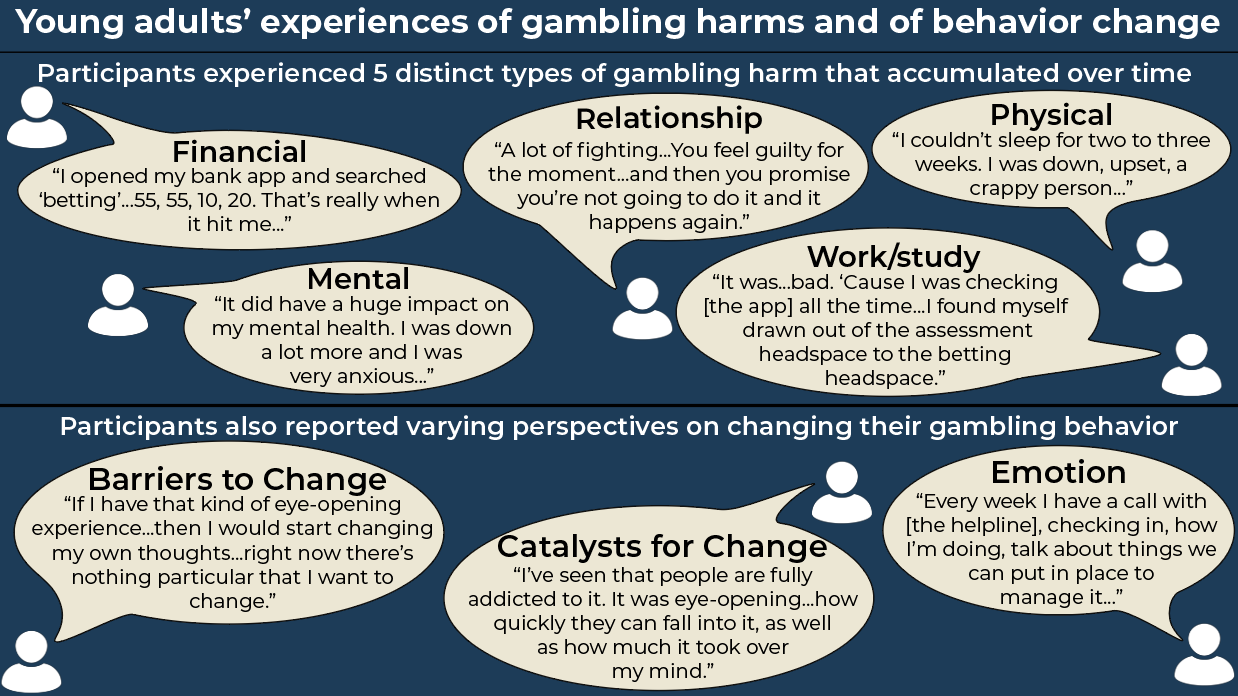 Figure. Displays participant quotes representing each theme identified through thematic analysis. Click image to enlarge.
Why do these findings matter?
Information on the types of harm experienced by young adult sports gamblers can help public health practitioners identify potential gambling problems quickly and accurately, allowing for timely intervention and support before more significant harms happen. This study’s findings on behavior change are especially important. Many participants emphasized the value of awareness of gambling as an addiction as a catalyst for behavior change. Initiatives such as The Faces of Gambling that highlight how gambling problems develop from the perspective of people with lived experience may be especially effective in reducing the prevalence of gambling harms.
Every study has limitations. What are the limitations in this study?
This study screened participants for a history of experiencing gambling harms using a list of previously researched harms, which may have primed the sample to report these very same types of harm. Similarly, because the study focused on moderate to severe cases of gambling disorder among young adults, the results of this study may not be generalizable to those who experience less severe forms of the condition, or the wider gambling population.
Figure. Displays participant quotes representing each theme identified through thematic analysis. Click image to enlarge.
Why do these findings matter?
Information on the types of harm experienced by young adult sports gamblers can help public health practitioners identify potential gambling problems quickly and accurately, allowing for timely intervention and support before more significant harms happen. This study’s findings on behavior change are especially important. Many participants emphasized the value of awareness of gambling as an addiction as a catalyst for behavior change. Initiatives such as The Faces of Gambling that highlight how gambling problems develop from the perspective of people with lived experience may be especially effective in reducing the prevalence of gambling harms.
Every study has limitations. What are the limitations in this study?
This study screened participants for a history of experiencing gambling harms using a list of previously researched harms, which may have primed the sample to report these very same types of harm. Similarly, because the study focused on moderate to severe cases of gambling disorder among young adults, the results of this study may not be generalizable to those who experience less severe forms of the condition, or the wider gambling population.

Dec 17, 2025 | RESEARCH, RESOURCES
The National Council on Problem Gambling (NCPG) has released new findings from its National Survey on Gambling Attitudes and Gambling Experiences (NGAGE 3.0), offering an updated picture of how Americans are gambling—and what they believe about gambling.
The first NGAGE survey was conducted in 2018, just as states began legalizing sports betting following a landmark Supreme Court decision that opened the door for rapid expansion across the country. A follow-up survey in 2021 revealed a sharp increase in risky gambling behavior. At the time, researchers weren’t sure whether the spike reflected the spread of sports betting or the stress and isolation from the COVID-19 pandemic.
The 2024 survey, conducted after pandemic restrictions had largely lifted, shows that gambling-related risks have stabilized. About 8% of U.S. adults—nearly 20 million people—reported experiencing at least one sign of potentially problematic gambling “many times” in the past year. That number is down from 11% in 2021 but still higher than the 7% reported before sports betting became widely available.
“While it’s reassuring that the increases in problematic gambling behavior we saw in the 2021 survey seem to have abated along with the easing of the COVID-19 pandemic, maladaptive gambling remains a significant public health problem,” says Don Feeney, who helped design the NGAGE surveys. “Increased efforts at prevention and education are essential if we are to reduce gambling-related harm.”
The survey also sheds light on who is most at risk. Younger adults, men, online gamblers and sports bettors were among the groups most likely to report signs of risky play. Those who gamble frequently or participate in many different gambling activities are especially vulnerable.
“The best predictors of a gambling problem aren’t participation in any particular form of gambling,” explains Don. “Instead, the best predictors are the intensity of gambling involvement—how frequently someone is gambling—and the breadth of involvement—how many different forms of gambling someone is involved with.”
Even as legalized sports betting has expanded to 39 states, Washington, D.C. and Puerto Rico, the overall share of Americans placing sports bets has remained steady at about 23%. However, the ways people are betting are changing. The number of sports bettors making parlay bets—wagers that combine multiple outcomes for the chance of a large payout—has nearly doubled since 2018. Researchers note that these types of bets can be especially appealing to those trying to “win back” losses quickly, a pattern often associated with risky play.
Another key finding involves public attitudes toward gambling addiction. While nearly three in four adults agree that gambling addiction is similar to drug or alcohol addiction, fewer than 40% consider its consequences “very severe.” Many still believe gambling problems stem from a lack of willpower or moral weakness rather than recognizing them as treatable health conditions.
There is, however, some encouraging progress. Awareness of problem gambling helplines has increased, and most people understand that helplines exist to help people struggling with gambling problems.
“We’ve learned that we can improve awareness that there’s help for a gambling problem, and that awareness is greatest among those most in need of receiving services,” says Don. “However, these are the same people who are most skeptical that treatment works. We need to make the effectiveness of treatment an integral part of our message.”
Despite the progress, challenges remain. Public funding for problem gambling services has increased—from about $80 million in 2018 to $134 million in 2023—but seven states still provide no funding at all. On average, states spend just 35 cents per resident on prevention, education and treatment programs.
Continued investment and public awareness are critical to preventing gambling-related harm. Prevention and education work, but more people need to understand that help works too—and that recovery from gambling problems is possible.
The survey underscores that even as gambling becomes more common, many people still misunderstand the risks. Open discussion about gambling addiction, promoting the effectiveness of treatment and making help easy to find is necessary to keep gambling a form of entertainment rather than a source of harm.

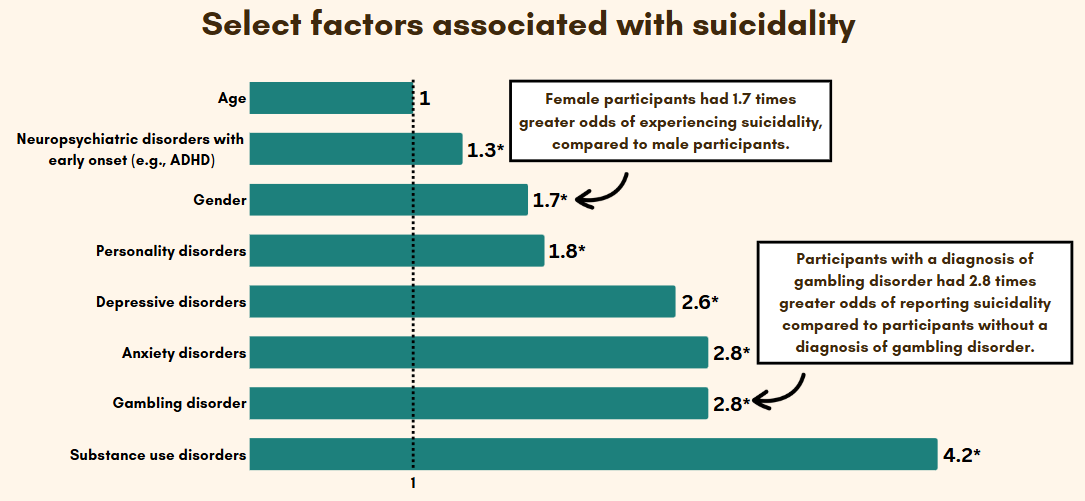 Figure. Displays the odds of suicidality as a function of several potential risk factors among the total sample (N = 10,782). Odds ratios can be interpreted as having X times higher odds of reporting an outcome. * denotes a statistically significant relationship.
Why do these findings matter?
These findings indicate that gambling disorder is associated with increased risk for suicidality even when the researchers accounted for other conditions that might independently create risk for suicide. This underscores the need for routine suicide risk-assessment and safety planning among those experiencing gambling disorder.
Every study has limitations. What are the limitations in this study?
This study was a secondary analysis of existing datasets, so it is limited by how the original data were collected. The NPR, for example, only identifies cases for which a formal diagnosis was made. Most people with gambling disorder do not seek help, so those who do get formally diagnosed might have more severe cases compared to the general population.
For more information:
Individuals who are concerned about their gambling may benefit from engaging with Gamblers Anonymous. Others who are concerned that they may hurt themself may benefit from visiting the CDC webpage on suicide prevention. Additional resources can be found at the BASIS Addiction Resources page.
—John Slabczynski
Figure. Displays the odds of suicidality as a function of several potential risk factors among the total sample (N = 10,782). Odds ratios can be interpreted as having X times higher odds of reporting an outcome. * denotes a statistically significant relationship.
Why do these findings matter?
These findings indicate that gambling disorder is associated with increased risk for suicidality even when the researchers accounted for other conditions that might independently create risk for suicide. This underscores the need for routine suicide risk-assessment and safety planning among those experiencing gambling disorder.
Every study has limitations. What are the limitations in this study?
This study was a secondary analysis of existing datasets, so it is limited by how the original data were collected. The NPR, for example, only identifies cases for which a formal diagnosis was made. Most people with gambling disorder do not seek help, so those who do get formally diagnosed might have more severe cases compared to the general population.
For more information:
Individuals who are concerned about their gambling may benefit from engaging with Gamblers Anonymous. Others who are concerned that they may hurt themself may benefit from visiting the CDC webpage on suicide prevention. Additional resources can be found at the BASIS Addiction Resources page.
—John Slabczynski

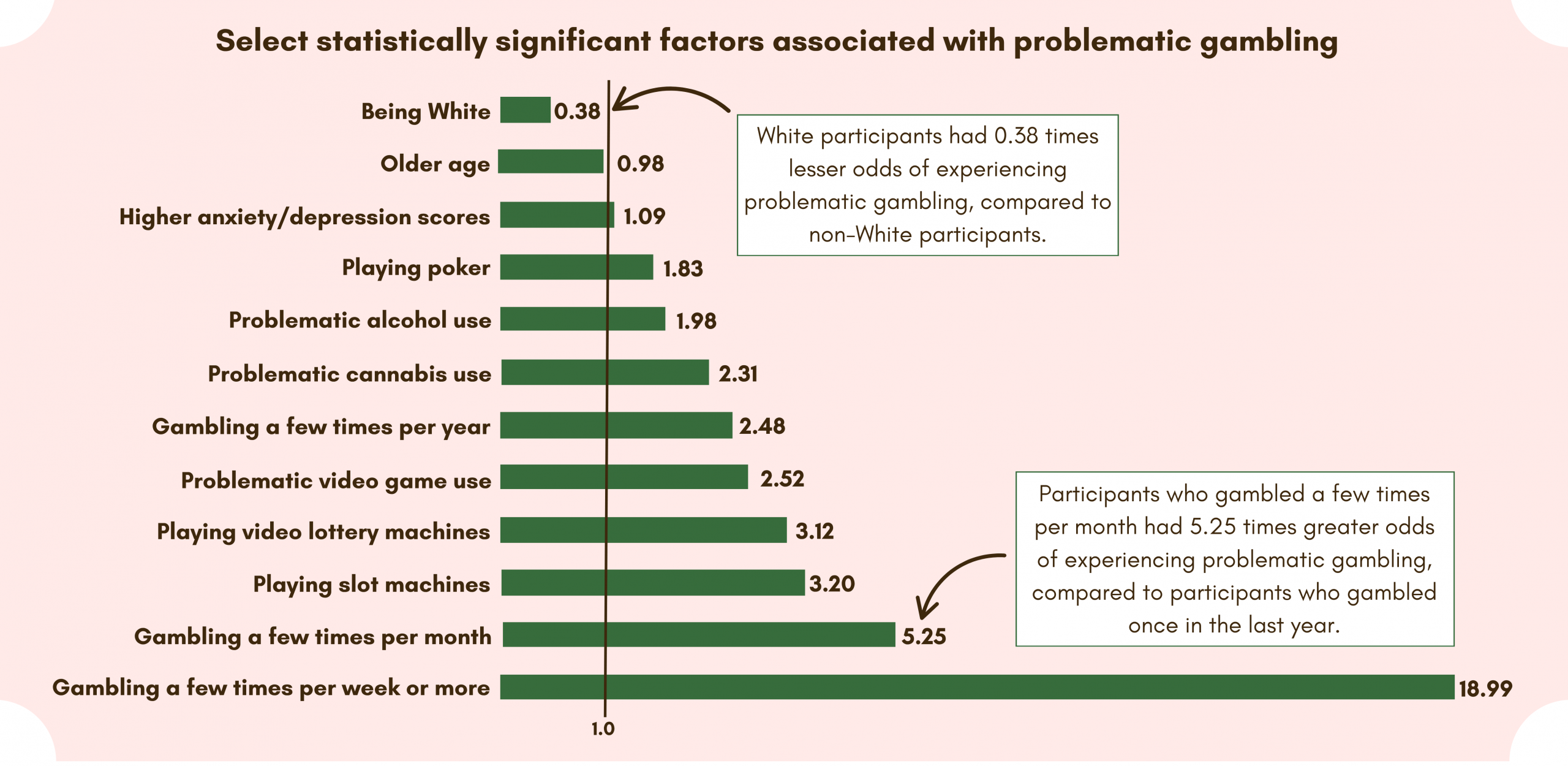 Figure. Displays the odds ratios of select factors associated with problematic gambling among LGBTQ+ participants that were found to be statistically significant. Click image to enlarge.
Why do the findings matter?
The findings indicate that problematic substance use and poor mental health, along with gambling patterns, are associated with problem gambling symptoms among LGBTQ+ individuals. In doing so, they support the role of minority stress in problematic gambling. Connecting clients to community support organizations like Boston GLASS might help relieve minority stress while providing resources and offering opportunities to engage in activities that do not involve gambling. Additionally, providers should apply an intersectional lens to understand how other marginalized identities, such as non-White race, may influence a person’s vulnerability to addictive behaviors, like gambling.
Every study has limitations. What are the limitations in this study?
This study was cross-sectional, which means we cannot conclude that the identified factors caused problematic gambling. Additionally, the sample sizes for some of the subgroups was small, which might make prevalence estimates inflated or unstable, so those particular results should be interpreted with caution. Finally, qualitative studies could provide a deeper understanding of the role that identity and minority stress play in the LGBTQ+ population’s relationship with gambling.
1. More specifically, the researchers surveyed LGBTQIA2S+ individuals. This acronym stands for Lesbian, Gay, Bisexual, Transgender, Queer/Questioning, Intersex, Asexual, 2-Spirit, and other gender identities/sexual orientations not explicitly listed.
Figure. Displays the odds ratios of select factors associated with problematic gambling among LGBTQ+ participants that were found to be statistically significant. Click image to enlarge.
Why do the findings matter?
The findings indicate that problematic substance use and poor mental health, along with gambling patterns, are associated with problem gambling symptoms among LGBTQ+ individuals. In doing so, they support the role of minority stress in problematic gambling. Connecting clients to community support organizations like Boston GLASS might help relieve minority stress while providing resources and offering opportunities to engage in activities that do not involve gambling. Additionally, providers should apply an intersectional lens to understand how other marginalized identities, such as non-White race, may influence a person’s vulnerability to addictive behaviors, like gambling.
Every study has limitations. What are the limitations in this study?
This study was cross-sectional, which means we cannot conclude that the identified factors caused problematic gambling. Additionally, the sample sizes for some of the subgroups was small, which might make prevalence estimates inflated or unstable, so those particular results should be interpreted with caution. Finally, qualitative studies could provide a deeper understanding of the role that identity and minority stress play in the LGBTQ+ population’s relationship with gambling.
1. More specifically, the researchers surveyed LGBTQIA2S+ individuals. This acronym stands for Lesbian, Gay, Bisexual, Transgender, Queer/Questioning, Intersex, Asexual, 2-Spirit, and other gender identities/sexual orientations not explicitly listed.