Apr 10, 2026 | PROBLEM GAMBLING, RESOURCES, SPORTS BETTING, YOUTH GAMBLING
We come across numerous articles about problem gambling and problem gaming. Here are a few:
The article reports that Washington State has sued the makers of the Bingo Blitz app, alleging it operates as illegal gambling and uses child-appealing content, weak age controls and aggressive in-app purchases that expose minors and other users to addiction risks and significant financial harm.
https://gamblingharm.org/bingo-blitz-app-illegal-gambling-children/
The column argues that the growing ubiquity and normalization of gambling—especially through sports betting and youth exposure—risks fostering addiction, financial harm and a cultural shift toward chasing quick wealth through luck rather than stable, meaningful paths.
https://www.startribune.com/brown-when-betting-is-everywhere-we-gamble-with-our-future/601567918
NPR's A Martinez speaks with journalist and author Danny Funt about his new book, "Everybody Loses: The Tumultuous Rise of American Sports Gambling."
https://www.npr.org/2026/01/19/nx-s1-5602138/everybody-loses-chronicles-the-rise-of-americas-sports-betting-boom
A piece by PBS on How Sports Betting is changing our Brains and Behavior, features Danny Funt and Dr. Tim Fong.
https://www.pbs.org/newshour/video/horizons/2026/02/how-sports-betting-is-changing-our-brains-and-behavior
This Teach-Out is open to anyone interested in learning more about the sports betting industry and its effects on the general population, but it is particularly relevant for young adults and their parents, athletes, educators, and policymakers looking to mitigate the effects of sports betting.
https://online.umich.edu/teach-outs/sports-betting-risks-and-ripple-effects-teach-out/

Apr 10, 2026 | RECOVERY, SPORTS BETTING, YOUTH GAMBLING
When I quit using alcohol and drugs, I thought that was the hard part. What I didn’t realize was that I had created a huge void in my life. I wasn’t getting those instant dopamine hits anymore, and I didn’t know what to do with myself. That’s when gambling quietly slipped in.
My gambling didn’t start in a casino or with sports betting like it does with a lot of people. It started, oddly enough, with clothes.
When I was in college, streetwear was big. There were online raffles for limited-edition clothing. You’d throw in $10 or $25 for a chance to win something worth a lot more. I started doing those raffles all the time. If I won, I’d try to resell the item. Before long, I was doing this every single day—including watching the raffle videos—while having basically no money. That should’ve been a red flag, but I didn’t see it that way at the time.
I did the clothing raffles for about two years and then stopped gambling for about a year. Then I started playing fantasy football with friends and things gradually progressed. I started doing future bets, like whether a team would win the championship or how it would do for the whole season. Then it became point spreads and over/unders for individual games. Then it became in-game live betting. That all felt “manageable,” at least compared to what came next.
My sports betting got worse. DraftKings wasn’t what it is today, so I used an illegal offshore site. It started small with $5 and $10 bets, but gradually turned into betting every day, multiple times a day. I was betting on games I didn’t even watch or know anything about, like baseball games in a league on the other side of the world. That made it harder to lie to myself that this was just for fun.
What really pushed me over the edge was online casino gambling. While watching sports, I started clicking into online casinos on my phone for fun. I quickly went through five-dollar slots and started chasing my losses. Then I’d lose $100 trying to get it back on roulette or blackjack. I started using money I didn’t have—dipping into credit cards and debit cards. I wasn’t paying rent and was barely eating. I had a decent job and still couldn’t afford to live.
I was living with my girlfriend at the time, as gambling slowly took over my life. I’d get home from work and watch games from 4 p.m. until midnight instead of spending time with her. She had no idea how bad it was. When she eventually broke up with me and moved out—taking the dog—I couldn’t afford the apartment on my own because of gambling.
I had only been to one or two GA meetings at that point, so I didn’t really have a GA program. I asked someone in AA if they knew anyone who had been to GA, and I got connected with someone who offered to take me to a meeting. He became my GA sponsor. I thought it would be just like AA—and at a high level it is—but it’s clearly different because I couldn’t manage my gambling addiction as well as I managed my alcohol addiction.
I was surprised how few young people were in the GA rooms. Given how much I know younger people are gambling, particularly on sports, I’d expected more people in their 20s and 30s. I found that many of the people went to live casinos and played a lot of scratch-offs, activities I think are less common in my age group.
As I look back on my gambling, I wasn’t really chasing wins; I was chasing a feeling. I don’t even remember having many big wins. No win ever felt that good and every loss felt awful. I just wanted to feel something, or avoid being present in my own life.
After I stopped gambling almost two years ago, I couldn’t watch sports for a long time. I’d always think, “I would’ve won that if I’d bet.” Eventually, I was able to watch again, but the ads are everywhere now. I honestly can’t imagine trying to quit for the first time today with all those reminders.
I just turned 30. I still get urges to gamble more than I ever get urges to drink. Gambling ads hit me in a way alcohol ads don’t. I also see how normalized betting has become, especially for younger people. My little brother is in college, and betting is just part of the culture—everyone seems to be doing it. I try to keep the door open so he knows he can talk to me if it ever becomes a problem.
Thankfully, life today is much more manageable. I know my brain is always going to look for something, so I try to channel that energy into healthier things—running, relationships, being present. I’m not perfect, but I’m honest now. And that makes all the difference.
If any of this sounds familiar, I promise you’re not alone—and that there is hope. Help is out there. Recovery doesn’t make life perfect, but it does make it livable—and for me, that’s more than enough.

Apr 7, 2026 | PROBLEM GAMBLING, RESOURCES, YOUTH GAMBLING
As legalized sports betting and digital wagering continue to expand, gambling has become a routine part of life for many young adults. For colleges and universities, this shift raises an important question: how can campuses help students make informed choices and avoid gambling-related harm?
Dr. Michelle L. Malkin, assistant professor at East Carolina University, is working to answer that question through The Betting Blueprint, a wellness-oriented curriculum designed specifically for students ages 18–24. Her approach combines screening, education, financial wellness and early intervention to reduce risk and support healthier decision-making.
Start with awareness and screening
One of the key messages from Dr. Malkin’s work is that screening should be ongoing, not limited to a single awareness campaign. While March’s Problem Gambling Awareness Month provides an important opportunity for outreach, students engage in gambling year-round. Ideally, campuses host multiple screening efforts, including events early in the fall semester and again in March when March Madness increases betting activity.
Peer-led outreach has proven especially effective. Students are more likely to participate when encouraged by their peers and when screening is quick and accessible, such as through a QR code completed on a phone. Brief screening tools that use clear language like “betting and/or gambling” help identify students who may be experiencing harm and connect them with resources before problems escalate.
Redefining what gambling looks like
The curriculum challenges students’ assumptions about gambling, as many young adults associate gambling only with casinos or money-based games. In reality, gambling includes any activity involving something of value and an element of chance.
Today’s gambling landscape includes, but is not limited to, sports wagering, fantasy sports, prediction markets, loot boxes, esports, cryptocurrency speculation, in-play betting and social gaming features. By broadening students’ understanding, the curriculum helps them recognize behaviors they might not otherwise identify as gambling.
The curriculum also explores why some individuals struggle to gamble responsibly. For certain people, brain responses to rewards can lead to chasing losses, overconfidence or difficulty stopping. Students learn to recognize warning signs such as borrowing money, hiding gambling or continuing despite negative consequences.
Importantly, the focus is not prohibition. Instead, the curriculum promotes lower-risk strategies for those who choose to gamble: setting time and money limits, avoiding gambling when stressed or emotional, understanding the odds and using responsible gambling tools available on many platforms. Students also learn that gambling harms extend beyond the individual, affecting roommates, partners, family members and others.
Financial wellness at the center
Another important aspect of The Betting Blueprint is connecting gambling decisions to financial health. Many students have limited experience managing money, making them particularly vulnerable to overspending on entertainment, including betting.
Through budgeting exercises and real-life scenarios, students explore what financial wellness means and how to give every dollar a purpose. They learn to identify priorities, track income and expenses, and distinguish between appropriate entertainment spending and high-risk funding sources such as borrowed money, financial aid or credit card debt.
A key point is that gambling winnings should never be treated as income. Activities encourage students to track results over time, understand variability and consider how unexpected wins or loses affect long-term goals. The emphasis is on building habits that support stability and reduce financial stress.
Students as problem solvers
A distinctive feature of the curriculum is its interactive design. Small-group activities ask students to respond to common beliefs, such as “I can win back my losses” or “My gambling is under control.” By researching data and developing peer-focused messages, students generate their own solutions rather than being lectured.
This collaborative approach increases engagement and helps shift campus norms around gambling.
Meeting Students at a Critical Time
College campuses provide a unique environment to reach emerging adults during a formative period. Dr. Malkin’s work highlights the importance of integrating gambling awareness into broader wellness efforts, including mental health, substance use prevention and financial education.
As gambling opportunities continue to grow, so does the need for practical, student-centered prevention. With ongoing screening, peer engagement and a focus on financial and personal well-being, The Betting Blueprint offers campuses a proactive way to help students make informed choices and avoid harm—long before problems take hold.
The information in this article was taken from Dr. Malkin’s presentation at the MNAPG conference last November. For more information about the curriculum, please contact Dr. Malkin at malkinm20@ecu.edu.

Feb 21, 2026 | RESEARCH, YOUTH GAMBLING
Read the original article on The BASIS.
By John Slabczynski
Gambling can create financial, social, psychological, and physical harms. Of particular concern is suicidality, which recent research has identified as a potential gambling harm. As we undergo worldwide gambling expansion, it is imperative that public health experts and the gamblers themselves know more about this link, including whether problem gambling predicts future suicidality. This week The WAGER reviews a study by Oliver Bastiani and colleagues that explored the relationship between problem gambling and suicidality among the same participants over time.
What were the research questions?
Do gambling problems predict future suicidality?
What did the researchers do?
The researchers used data from the Avon Longitudinal Study of Parents and Children, a United Kingdom-based birth cohort study. They limited their analysis to data collected from 2,801 participants who completed assessments between the ages of 16 and 25. During these years, participants provided information on their suicidality and gambling problems. The researchers used logistic regression to examine whether having gambling problems at age 20 or 24 increased the odds of reporting past-year suicide attempts at age 24 or 25, controlling for some known risk factors such as sex, alcohol consumption/harms, and previous suicide attempts.
What did they find?
Most participants reported no problem gambling at both age 20 (70.4%) and age 24 (76.5%). Approximately 2.6% reported a past-year suicide attempt at age 24 and 1.9% did so at age 251. Problem gambling severity at age 24 was associated with increased odds of past-year suicide attempt at the same age. Longitudinal analyses revealed that problem gambling at age 20 was predictive of past-year suicide attempts at age 24 but not at age 25. On a shorter timespan, problem gambling at age 24 predicted past-year suicide attempts at age 25. (See Figure.)
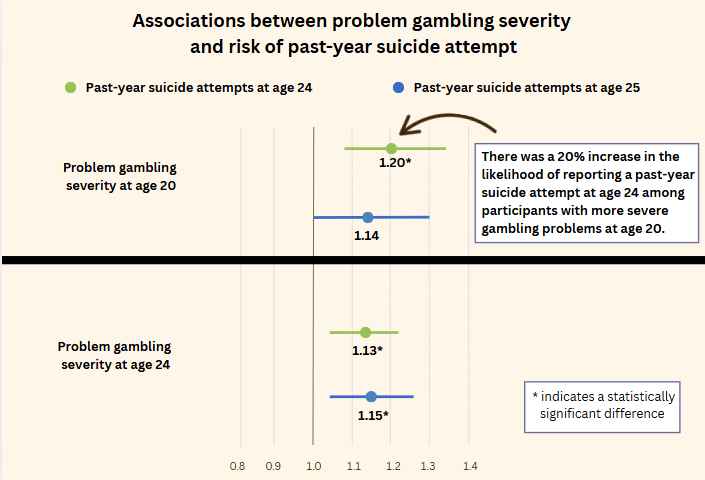 Figure. Displays the odds of reporting past year suicidality at ages 24 and 25 by problem gambling severity at ages 20 and 24. Odds ratios can be interpreted as having X times higher odds of reporting an event. For example, a one-point increase in problem gambling severity (e.g., answering “most of the time” instead of “sometimes” on one question) at age 24 was associated with having 1.13 times higher odds of reporting past year suicidality at age 24.
Why do these findings matter?
These findings provide more support for the idea that problem gambling contributes to future suicidality, because in this study, problem gambling preceded suicide attempts. Because problem gambling can be detected and managed at an early stage, it is essential to spread the word about brief gambling screening to healthcare providers and anyone else in a position to intervene, such as college health services staff and debt counselors. Furthermore, public health advocates can use this information to more effectively advocate for preventive tools like mandatory cool-off periods, which can disrupt gambling flow states and discourage long sessions, or tighter regulations on gambling and gambling advertising.
Every study has limitations. What are the limitations in this study?
The relationship between problem gambling and suicidality is probably more complicated than a single study can reveal. For instance, this study did not explore the possibility that suicidality predicted future problem gambling (i.e., reverse causality), which might happen if people develop gambling problems while trying to escape from painful suicidal thoughts. Another complication is that problem gambling tends to occur alongside depression, anxiety, and illicit drug use, which the researchers were unable to control for, and which might have partly accounted for the relationships with suicide attempts.
Figure. Displays the odds of reporting past year suicidality at ages 24 and 25 by problem gambling severity at ages 20 and 24. Odds ratios can be interpreted as having X times higher odds of reporting an event. For example, a one-point increase in problem gambling severity (e.g., answering “most of the time” instead of “sometimes” on one question) at age 24 was associated with having 1.13 times higher odds of reporting past year suicidality at age 24.
Why do these findings matter?
These findings provide more support for the idea that problem gambling contributes to future suicidality, because in this study, problem gambling preceded suicide attempts. Because problem gambling can be detected and managed at an early stage, it is essential to spread the word about brief gambling screening to healthcare providers and anyone else in a position to intervene, such as college health services staff and debt counselors. Furthermore, public health advocates can use this information to more effectively advocate for preventive tools like mandatory cool-off periods, which can disrupt gambling flow states and discourage long sessions, or tighter regulations on gambling and gambling advertising.
Every study has limitations. What are the limitations in this study?
The relationship between problem gambling and suicidality is probably more complicated than a single study can reveal. For instance, this study did not explore the possibility that suicidality predicted future problem gambling (i.e., reverse causality), which might happen if people develop gambling problems while trying to escape from painful suicidal thoughts. Another complication is that problem gambling tends to occur alongside depression, anxiety, and illicit drug use, which the researchers were unable to control for, and which might have partly accounted for the relationships with suicide attempts.

Jan 29, 2026 | PROBLEM GAMBLING, RESEARCH, SPORTS BETTING, YOUTH GAMBLING
Read the original article on The BASIS here.
By John Slabczynski
As legalized sports betting grows in popularity, public health experts have raised concerns about its potential harms. As advertisers and sports leagues continue to make gambling a key part of spectatorship, this could normalize betting as a natural part of sports fandom. Previous research suggests that these practices are contributing to an increase in gambling problems, particularly among young adults. To better address these concerns, public health advocates need to understand the specific problems associated with young adult sports betting. This week, The WAGER reviews a study by Nerilee Hing and colleagues that explored young adult sports bettors’ experiences of gambling harm and their perspectives on changing their gambling behavior.
What were the research questions?
(1) How do young adult sports bettors experience gambling harms? (2) How do they conceptualize and engage in changing harmful gambling?
What did the researchers do?
The researchers recruited 50 Australians between the ages of 18 and 25 who reported experiencing moderate or severe harm from sports betting in the past year. Participants completed interviews with the research team that asked about the nature of sports betting-related harms they experienced, perceived barriers and facilitators of gambling behavior change, and strategies they used to change their gambling. The researchers then coded the transcribed interviews to identify relevant themes.
What did they find?
The interviews revealed five distinct types of sports betting-related harm: 1) financial harm, 2) harm to mental health, 3) harm to work or study, 4) relationship harm, and 5) harm to physical health. Participants reported that many of these harms built up over time and intersected with one another. For example, several participants indicated that financial harms grew over time, and that these harms worsened their mental health. At the time of interviews, some participants were unwilling to change their gambling behavior. Others, however, pointed to improved knowledge of gambling disorder and an awareness of gambling harms as key factors in choosing to change their harmful behavior (see Figure).
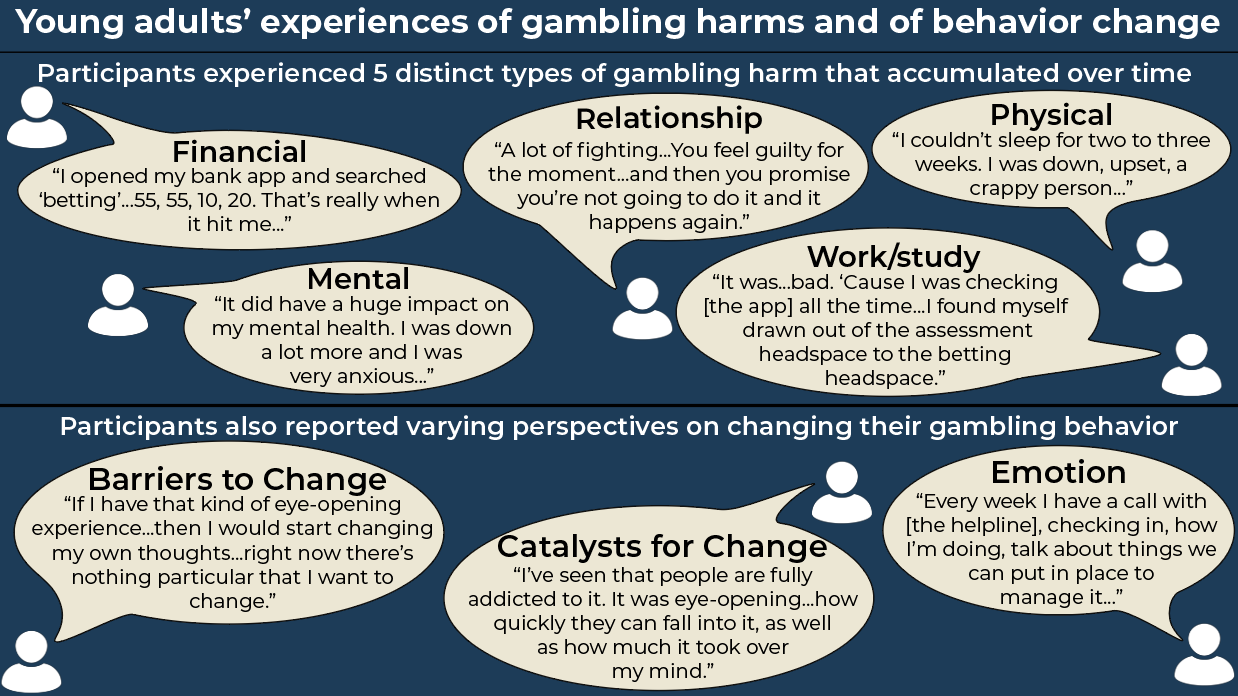 Figure. Displays participant quotes representing each theme identified through thematic analysis. Click image to enlarge.
Why do these findings matter?
Information on the types of harm experienced by young adult sports gamblers can help public health practitioners identify potential gambling problems quickly and accurately, allowing for timely intervention and support before more significant harms happen. This study’s findings on behavior change are especially important. Many participants emphasized the value of awareness of gambling as an addiction as a catalyst for behavior change. Initiatives such as The Faces of Gambling that highlight how gambling problems develop from the perspective of people with lived experience may be especially effective in reducing the prevalence of gambling harms.
Every study has limitations. What are the limitations in this study?
This study screened participants for a history of experiencing gambling harms using a list of previously researched harms, which may have primed the sample to report these very same types of harm. Similarly, because the study focused on moderate to severe cases of gambling disorder among young adults, the results of this study may not be generalizable to those who experience less severe forms of the condition, or the wider gambling population.
Figure. Displays participant quotes representing each theme identified through thematic analysis. Click image to enlarge.
Why do these findings matter?
Information on the types of harm experienced by young adult sports gamblers can help public health practitioners identify potential gambling problems quickly and accurately, allowing for timely intervention and support before more significant harms happen. This study’s findings on behavior change are especially important. Many participants emphasized the value of awareness of gambling as an addiction as a catalyst for behavior change. Initiatives such as The Faces of Gambling that highlight how gambling problems develop from the perspective of people with lived experience may be especially effective in reducing the prevalence of gambling harms.
Every study has limitations. What are the limitations in this study?
This study screened participants for a history of experiencing gambling harms using a list of previously researched harms, which may have primed the sample to report these very same types of harm. Similarly, because the study focused on moderate to severe cases of gambling disorder among young adults, the results of this study may not be generalizable to those who experience less severe forms of the condition, or the wider gambling population.

Dec 17, 2025 | ABOUT MNAPG, ADVOCACY, PROFESSIONALS, YOUTH GAMBLING
MNAPG attended two conferences in October: the mid-year Indian Gaming Association (IGA) conference and the International Center for Responsible Gaming (ICRG) conference. Here are some takeaways.
Indian Gaming Association Conference
At the IGA, the focus was on the growing concern about prediction markets and casino sweepstakes—and the impact these unregulated, untaxed platforms could have on tribal revenues. Legalized gambling, whether you agree with it or not, has allowed Minnesota tribal nations to expand and diversify their economies and provide a wide range of services to their communities. These market disrupters are viewed as existential threats to tribal sustainability and independence. (Editor’s note: As of November 5, 2025, the Minnesota Attorney General’s office sent cease-and-desist letters to 14 illegal gambling operators—sports betting and casino sweepstakes.)
The American Gaming Association also recognizes the threats these new platforms pose—not only to gambling revenue but also to consumer protection. Our current federal anti-regulatory environment could significantly change how people engage with gambling. By redefining gambling as a commodity and placing it under the Commodity Futures Trading Commission (CFTC), these platforms may create a stronger illusion of control—skill rather than luck. This illusion is a common fallacy among gamblers, especially sports bettors. Mislabeling gambling products as “trading” blurs the line between investing and gambling, putting consumers at risk. The way these platforms target young adults is particularly troubling. They are designed for continuous, habit-forming engagement, with no guardrails or risk warnings.
The discussions were sobering and, for MNAPG, highlighted yet another area where we need to pay close attention and raise awareness within the community and among policymakers.
International Center for Responsible Gaming Conference
The ICRG conference, a day and a half of research reveals, provided an opportunity to hear firsthand the latest findings in responsible gambling, explore emerging tools and regulatory practices, and discuss the growing integration of responsible gambling principles into the broader gambling landscape. While much work remains, I’m encouraged by the shift among some operators to place greater emphasis on consumer protection. Our advocacy efforts at the national and state levels are having a positive impact, and we need to continue being the thorn in operators’ sides.
One session examined the connection between gambling literacy and financial literacy and the need to evolve both so that users understand how risky behaviors can develop through new mediums like digital finance, investment platforms and social media.
Another session focused on artificial intelligence and emphasized that AI should amplify human insight, not replace it. Advances in AI may eventually enhance early risk detection and enable personalized responsible gambling interventions—but only if we eliminate bias and uphold the highest standards of privacy protection.
Finally, researchers studying youth emphasized the need to create relatable prevention materials and deliver them in the spaces where young people actually spend their time, rather than where we think they should be. They also highlighted the importance of developing prevention programs that account for gender, age and cultural identity.