Dec 6, 2021 | HEALTHY PLAY, PROBLEM GAMBLING, YOUTH GAMBLING
HOLIDAY SEASON REMINDER:
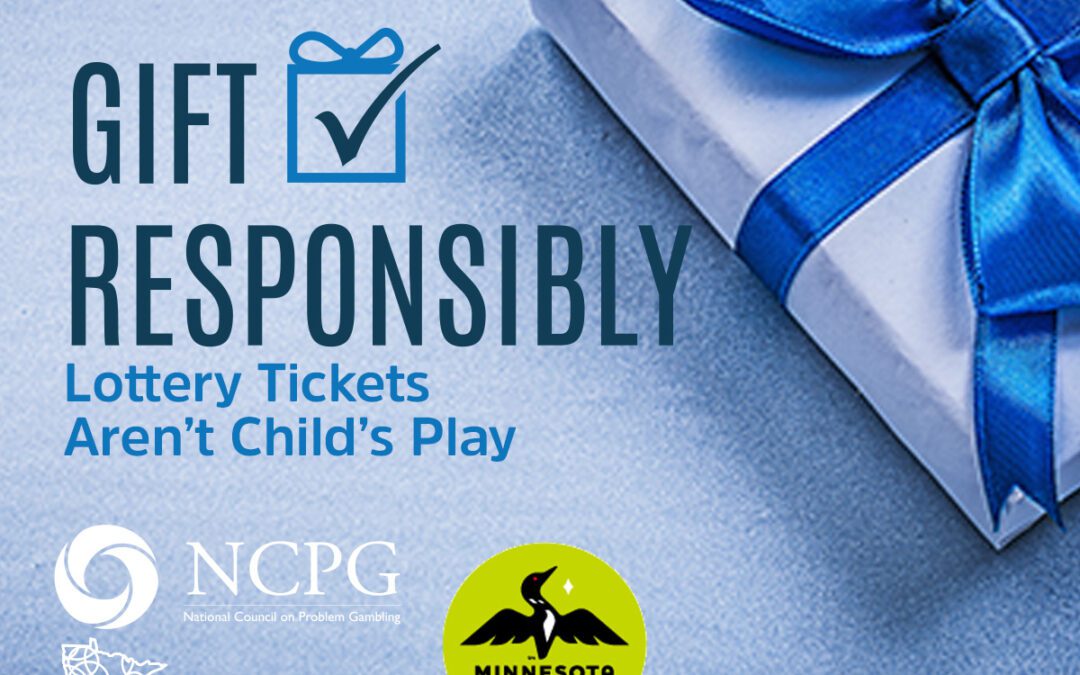
LOTTERY TICKETS ARE NOT APPROPRIATE GIFTS FOR MINORS
(ROSEVILLE, MN (Dec. 1, 2020) – The Minnesota Lottery and the Minnesota Alliance on Problem Gambling (MNAPG) announced today they are continuing their annual participation in an international responsible gambling campaign to raise awareness about the risks of underage lottery play during the holiday season. Both organizations will promote the importance of responsible gambling through various media channels, joining a growing effort to raise awareness about this issue around Minnesota, the United States and North America.
December is a time when many cultures share in gift giving, and some may consider giving scratch tickets to young people as gifts. “A scratch-off ticket may provide momentary excitement, but underage recipients don’t have the cognitive development to discern the potential risks of gambling,” says Susan Sheridan Tucker, MNAPG executive director. “This is why tickets sales are limited to adults.” When a trusted adult provides a ticket to a minor, it normalizes the activity as an acceptable practice.
In the most recent Minnesota Student Survey (2019) .05 percent of students indicated possible disordered gambling and another 2 percent indicated having problems with their gambling. This may seem like a small number, but it translates into 10,000 students. We know that a young person’s gambling starts as early as 10 years old. 30 percent surveyed indicated they had gambled in the last year and 7 percent said they gambled frequently (at least once a week or more). Youth gambling is particularly concerning because researchers have established a link between the age at which a person first gambles and the occurrence of excessive or problem gambling later in life. Studies have also shown that many adolescents gamble at least occasionally, and that lottery products, particularly scratch tickets, often serve as an introduction to gambling activities for youth.
“While we think lottery tickets make for fun gifts for adults, they are not appropriate as a gift for minors,” says Adam Prock, executive director of the Minnesota Lottery. “The commitment of the Minnesota Lottery and so many other lotteries around the country demonstrates our interest in ensuring that lottery participation is both fun and safe.” Both Tucker and Prock feel that responsible gambling is a positive approach to minimizing gambling-related harm and maximizing public benefit.
About Minnesota Alliance on Problem Gambling
Minnesota Alliance on Problem is a nonprofit, gambling-neutral organization dedicated to improving the lives of Minnesotans affected by problem gambling. A 501 (c)(3) nonprofit, MNAPG is funded by membership fees, financial and in-kind donations, and state and private grants. MNAPG serves as Minnesota’s affiliate to the National Council on Problem Gambling.
About Minnesota State Lottery
The Minnesota Lottery raises money for programs that positively impact the lives of Minnesotans. It offers uniquely Minnesotan games of chance that are held to the highest standard of integrity and security. Since 1990, the Lottery has returned more than $3.1 billion to programs that benefit all Minnesotans, including the state’s most precious natural resources, education, health care and more.
If someone you know needs help with a gambling problem, call (800) 333-HOPE. Treatment is available free of charge for qualifying individuals throughout Minnesota.

Dec 1, 2021 | ADVOCACY, HEALTHY PLAY, YOUTH GAMBLING
Read the original article on The BASIS website.
By: Karen Amichia
 Approximately 155 million Americans play video games - just under half the population of the United States. Video game players are commonly stereotyped as a pre-pubescent or teenage boy who stays up too late on a school night indulging in gameplay. However, the average age of a gamer in the United States is 35, and only 29% of all gamers are younger than 18. Over time, video games have become more and more “adult” themed to match the consumer base. Unfortunately this “adultification” has led to increased presence of alcohol, tobacco, and other substance use and gambling content in video games, all of which are usually related to character development or impact gameplay. The pervasiveness and portrayal of substance use and gambling in video games may have implications for video game industry stakeholders and consumers - especially children.
Video Games & Alcohol
Some prominent video game characters seem particularly inclined to drink, and they drink to excess more often than not. Grand Theft Auto, Red Dead Redemption, and Sea of Thieves feature prominent characters consuming alcohol excessively. These characters are often unable to control themselves, act belligerent, and are shown stumbling around. Games sometimes mimic the effects of being intoxicated by slowing character movement and blurring the edges of the gameplay screen.
Some video games go so far as to reward gamers for their virtual drinking activity. In the game The Red Strings Club, players are able to use alcohol (e.g., pouring other characters drinks) in order to manipulate other characters’ moods. In other games - Fallout, This War of Mine, Prey - drinking alcohol can actually give brief boosts to stats (e.g., strength and charisma), make characters less sad, and reduce a player’s fear status to enable better vision and accuracy. Drinking is often central to a character’s personality or superpowers. For example, video games like Stardew Valley, Bioshock Infinite, and Firewatch each have main characters who show signs of alcohol use disorders. Mortal Kombat X boasts a character whose entire fighting style is the “drunken master” - his special moves include chugging the drink he carries around, belching, farting, and even vomiting on the opponent.
Alcohol content is common in video games that adolescents play. A study based in the United Kingdom found that 17 of the 32 best-selling video games featured alcohol or tobacco content during gameplay. Sixty percent of adolescents surveyed had played at least one of these games. However, the Pan European Game Information (PEGI) system did not report any alcohol content within the games. The PEGI creates accurate, age-appropriate ratings for video games in Europe and informs consumers about the adult content contained within each game. If the PEGI is failing to accurately report this adult content, more children are able to access it. This is concerning because this study also found that adolescents who played at least one of these games were more likely to have ever used alcohol or tobacco than their peers who had not engaged with any of these games.
Video Games & Tobacco
The tobacco industry has a long history of partnering with video game companies for promotional purposes. Even after the implementation of several restrictions limiting the use of video games as marketing tools for the tobacco industry, there still remain countless depictions of tobacco throughout modern-day video games.
Approximately 155 million Americans play video games - just under half the population of the United States. Video game players are commonly stereotyped as a pre-pubescent or teenage boy who stays up too late on a school night indulging in gameplay. However, the average age of a gamer in the United States is 35, and only 29% of all gamers are younger than 18. Over time, video games have become more and more “adult” themed to match the consumer base. Unfortunately this “adultification” has led to increased presence of alcohol, tobacco, and other substance use and gambling content in video games, all of which are usually related to character development or impact gameplay. The pervasiveness and portrayal of substance use and gambling in video games may have implications for video game industry stakeholders and consumers - especially children.
Video Games & Alcohol
Some prominent video game characters seem particularly inclined to drink, and they drink to excess more often than not. Grand Theft Auto, Red Dead Redemption, and Sea of Thieves feature prominent characters consuming alcohol excessively. These characters are often unable to control themselves, act belligerent, and are shown stumbling around. Games sometimes mimic the effects of being intoxicated by slowing character movement and blurring the edges of the gameplay screen.
Some video games go so far as to reward gamers for their virtual drinking activity. In the game The Red Strings Club, players are able to use alcohol (e.g., pouring other characters drinks) in order to manipulate other characters’ moods. In other games - Fallout, This War of Mine, Prey - drinking alcohol can actually give brief boosts to stats (e.g., strength and charisma), make characters less sad, and reduce a player’s fear status to enable better vision and accuracy. Drinking is often central to a character’s personality or superpowers. For example, video games like Stardew Valley, Bioshock Infinite, and Firewatch each have main characters who show signs of alcohol use disorders. Mortal Kombat X boasts a character whose entire fighting style is the “drunken master” - his special moves include chugging the drink he carries around, belching, farting, and even vomiting on the opponent.
Alcohol content is common in video games that adolescents play. A study based in the United Kingdom found that 17 of the 32 best-selling video games featured alcohol or tobacco content during gameplay. Sixty percent of adolescents surveyed had played at least one of these games. However, the Pan European Game Information (PEGI) system did not report any alcohol content within the games. The PEGI creates accurate, age-appropriate ratings for video games in Europe and informs consumers about the adult content contained within each game. If the PEGI is failing to accurately report this adult content, more children are able to access it. This is concerning because this study also found that adolescents who played at least one of these games were more likely to have ever used alcohol or tobacco than their peers who had not engaged with any of these games.
Video Games & Tobacco
The tobacco industry has a long history of partnering with video game companies for promotional purposes. Even after the implementation of several restrictions limiting the use of video games as marketing tools for the tobacco industry, there still remain countless depictions of tobacco throughout modern-day video games.
 Tobacco use is often an important part of gameplay. For example, Red Dead Redemption 2 includes a scene where a cowboy meets a man smoking a cigarette. The cowboy learns an important objective of the game - he must smoke premium cigarettes in exchange for trading cards (these are in-game markers of progress). He can win the game only when he has smoked enough cigarettes to complete his sets of trading cards. Using tobacco products can also fill the “dead eye” meter which slows down time so the character can make more precise and accurate shots with their weapons. This meter depletes quickly but can be easily refilled by chewing tobacco, or smoking cigars or cigarettes. Other games, like the Metal Gear Solid series and the Bioshock series, include similar tobacco power-ups.
Video games often glamorize tobacco use by depicting characters who use these products as edgy or cool. In terms of functionality, the use of tobacco products tends to focus and steady the character, often boosting the outcomes of their action. It’s easy to imagine that ‘cool’ characters who use tobacco to center and focus themselves will be influential to adolescents. Adolescents who play video games are more likely to have tried alcohol and tobacco products than those who do not. This is particularly concerning as a 2015 survey from the University of California San Francisco found that 42% of video games played by the study participants contained tobacco-related content. However, only 8% of those games received tobacco warnings from the Entertainment Software Rating Board (ESRB) - the American version of the PEGI. This is another example of the rating system failing to accurately detect and warn consumers about the adult-themed content found in video games.
Video Games & Other Substances
It may be surprising (or not surprising at this point) to learn that video games have been making implicit and explicit references to illicit substances almost since their conception. Miyamoto, the game designer for Nintendo, deliberately chose a mushroom as Mario’s power-up in reference to psychedelics. The world of Mario is a fantasy land that you can only get into and remain in by constant ingestion of these mushrooms. Similarly, the creator of Pac-Man refers to the dots that Pac-Man eats as “power pills.”
Archstone Behavioral Health completed a study examining the top 100 best-selling games per gaming console and analyzed each ESRB rating for substance use in order to investigate the types of drug use present per game. They found that 61% of games featured real drugs (e.g., cocaine, heroin, marijuana) and 38% featured fictional drugs found in-game only. Forty percent of the games featured drugs that caused the user to become disoriented in some way. However, ingesting these substances also had benefits. Thirty-two percent of drugs boosted a character’s power and 28% actually increased the character’s health. Nearly a quarter of the video games featured multiple drugs - most of them stimulants to stay awake, gain energy and get high. These tended to also be extremely addictive.
It’s interesting to note that outside of medicinal uses or energy boosts, drugs and the characters who use them are often portrayed as ‘shady.’ Characters who use or sell substances in video games are not as popular as those who use tobacco products. Drug purchasing and use is often reserved for the unsavory or criminal characters in the game’s storyline (e.g., The Elder Scroll, Fallout). In these games, drugs are often vague, untitled substances that are traded by criminals. This poses some interesting questions to gamemakers: what makes tobacco cool and edgy? Why are drugs used by criminals and ‘shady’ characters?
Unfortunately, the portrayal of other substances in video games and its impact on adolescents has yet to be researched in depth. But, research about alcohol and tobacco content in video games suggests that the portrayal of other substances might be related to use initiation in adolescents.
Video Games & Gambling
Gambling in video games has become a hot topic in recent years, especially following the introduction of loot boxes during gameplay. Loot boxes can be purchased with real-world money. Their randomized contents usually benefit the player (e.g., boost the gamer’s character or skills) and aid in gameplay. Games like NBA 2k20 have taken loot boxes a step further to include other gambling-like features, such as slot machines, pachinko machines, and a wheel of fortune. There are concerns that the loot boxes and other gambling-like features found in video games may lead to problem gambling among gamers. A survey of over 7,000 video game players found an association between problem gambling severity and money spent on loot boxes. Players with more severe problem gambling spent more money on loot boxes. Other gambling-like video game features (e.g., token wagering, real-money gaming, and social casino spending) are also linked to problem gambling.
In addition to loot boxes, there are concerns over the use of skins in video games. Skins are items that a player can win during the game, such as weapons, outfits, or particular football players. Counter-Strike: Global Offensive, a popular video game, drew attention from the UK Gambling Commission in recent years after game developers added weapon skins to the game. These skins allowed players to win customizations for their weapons. The random nature and rarity of skin drops made them valuable and they became a form of currency within the game.
Tobacco use is often an important part of gameplay. For example, Red Dead Redemption 2 includes a scene where a cowboy meets a man smoking a cigarette. The cowboy learns an important objective of the game - he must smoke premium cigarettes in exchange for trading cards (these are in-game markers of progress). He can win the game only when he has smoked enough cigarettes to complete his sets of trading cards. Using tobacco products can also fill the “dead eye” meter which slows down time so the character can make more precise and accurate shots with their weapons. This meter depletes quickly but can be easily refilled by chewing tobacco, or smoking cigars or cigarettes. Other games, like the Metal Gear Solid series and the Bioshock series, include similar tobacco power-ups.
Video games often glamorize tobacco use by depicting characters who use these products as edgy or cool. In terms of functionality, the use of tobacco products tends to focus and steady the character, often boosting the outcomes of their action. It’s easy to imagine that ‘cool’ characters who use tobacco to center and focus themselves will be influential to adolescents. Adolescents who play video games are more likely to have tried alcohol and tobacco products than those who do not. This is particularly concerning as a 2015 survey from the University of California San Francisco found that 42% of video games played by the study participants contained tobacco-related content. However, only 8% of those games received tobacco warnings from the Entertainment Software Rating Board (ESRB) - the American version of the PEGI. This is another example of the rating system failing to accurately detect and warn consumers about the adult-themed content found in video games.
Video Games & Other Substances
It may be surprising (or not surprising at this point) to learn that video games have been making implicit and explicit references to illicit substances almost since their conception. Miyamoto, the game designer for Nintendo, deliberately chose a mushroom as Mario’s power-up in reference to psychedelics. The world of Mario is a fantasy land that you can only get into and remain in by constant ingestion of these mushrooms. Similarly, the creator of Pac-Man refers to the dots that Pac-Man eats as “power pills.”
Archstone Behavioral Health completed a study examining the top 100 best-selling games per gaming console and analyzed each ESRB rating for substance use in order to investigate the types of drug use present per game. They found that 61% of games featured real drugs (e.g., cocaine, heroin, marijuana) and 38% featured fictional drugs found in-game only. Forty percent of the games featured drugs that caused the user to become disoriented in some way. However, ingesting these substances also had benefits. Thirty-two percent of drugs boosted a character’s power and 28% actually increased the character’s health. Nearly a quarter of the video games featured multiple drugs - most of them stimulants to stay awake, gain energy and get high. These tended to also be extremely addictive.
It’s interesting to note that outside of medicinal uses or energy boosts, drugs and the characters who use them are often portrayed as ‘shady.’ Characters who use or sell substances in video games are not as popular as those who use tobacco products. Drug purchasing and use is often reserved for the unsavory or criminal characters in the game’s storyline (e.g., The Elder Scroll, Fallout). In these games, drugs are often vague, untitled substances that are traded by criminals. This poses some interesting questions to gamemakers: what makes tobacco cool and edgy? Why are drugs used by criminals and ‘shady’ characters?
Unfortunately, the portrayal of other substances in video games and its impact on adolescents has yet to be researched in depth. But, research about alcohol and tobacco content in video games suggests that the portrayal of other substances might be related to use initiation in adolescents.
Video Games & Gambling
Gambling in video games has become a hot topic in recent years, especially following the introduction of loot boxes during gameplay. Loot boxes can be purchased with real-world money. Their randomized contents usually benefit the player (e.g., boost the gamer’s character or skills) and aid in gameplay. Games like NBA 2k20 have taken loot boxes a step further to include other gambling-like features, such as slot machines, pachinko machines, and a wheel of fortune. There are concerns that the loot boxes and other gambling-like features found in video games may lead to problem gambling among gamers. A survey of over 7,000 video game players found an association between problem gambling severity and money spent on loot boxes. Players with more severe problem gambling spent more money on loot boxes. Other gambling-like video game features (e.g., token wagering, real-money gaming, and social casino spending) are also linked to problem gambling.
In addition to loot boxes, there are concerns over the use of skins in video games. Skins are items that a player can win during the game, such as weapons, outfits, or particular football players. Counter-Strike: Global Offensive, a popular video game, drew attention from the UK Gambling Commission in recent years after game developers added weapon skins to the game. These skins allowed players to win customizations for their weapons. The random nature and rarity of skin drops made them valuable and they became a form of currency within the game.
 As Global Offensive grew in popularity as an e-sport with professional players and teams, so did sites like the Steam Marketplace. Here, consumers can gamble on the outcome of matches and use their skin inventory to place bets. European law only bans cash-betting on e-sports, so these actions are not legally classified as gambling. Gamemakers exploited this legal loophole that has allowed consumers – including children and adolescents – to participate in gambling-like activities. Loot boxes, skins, and other gambling-like activities found in video games have become normalized and may increase the likelihood of young players developing problem gambling or experiencing gambling-related harms.
Conclusion
Video games are a popular form of media and entertainment in the United States and many parts of the world. Drinking, smoking, using other drugs, and gambling have become common content within video games and are often directly linked to character development and gameplay. However, video game review boards like the ESRB and PEGI are not accurately identifying and reporting this adult content. The presence of this content has been shown to increase the likelihood of initiation and problematic behavior in consumers, especially among children. It is essential that review boards ensure that their content warnings are correctly identifying the presence of substances and gambling in games. Educational campaigns should consider targeting gamers, like the Truth Initiative’s anti-tobacco ads on Twitch streams. Parents should take an active role in checking the content of the video games used by their children.
-- Karen Amichia
As Global Offensive grew in popularity as an e-sport with professional players and teams, so did sites like the Steam Marketplace. Here, consumers can gamble on the outcome of matches and use their skin inventory to place bets. European law only bans cash-betting on e-sports, so these actions are not legally classified as gambling. Gamemakers exploited this legal loophole that has allowed consumers – including children and adolescents – to participate in gambling-like activities. Loot boxes, skins, and other gambling-like activities found in video games have become normalized and may increase the likelihood of young players developing problem gambling or experiencing gambling-related harms.
Conclusion
Video games are a popular form of media and entertainment in the United States and many parts of the world. Drinking, smoking, using other drugs, and gambling have become common content within video games and are often directly linked to character development and gameplay. However, video game review boards like the ESRB and PEGI are not accurately identifying and reporting this adult content. The presence of this content has been shown to increase the likelihood of initiation and problematic behavior in consumers, especially among children. It is essential that review boards ensure that their content warnings are correctly identifying the presence of substances and gambling in games. Educational campaigns should consider targeting gamers, like the Truth Initiative’s anti-tobacco ads on Twitch streams. Parents should take an active role in checking the content of the video games used by their children.
-- Karen Amichia
Aug 31, 2021 | YOUTH GAMBLING
Youth sports organizations that manage the complexities and the risks of gambling see rewards that include lower participation fees, enhancements to their programs and more kids playing sports.
Story by CHIP SCOGGINS • Photos by CARLOS GONZALEZ • Star Tribune
Every table inside Jimmy’s Food and Drink is taken by 7 p.m. on a Thursday in late spring. This is bingo night, always a full house. The crowd is so large patrons sit in an overflow section near the door.
The bingo game is being broadcast over the speakers, with large TVs flashing numbers as they are announced. At table after table, customers at the Vadnais Heights establishment alternate between ripping open cardboard pull-tabs and dotting numbers on their bingo cards.
“O-74” comes over the speaker, a woman shouts “Bingo!” and an echo of groans follows.
The big winner, though, is someone else: youth sports in Minnesota. In this case, kids who participate in the White Bear Lake Hockey Association.
The money generated by pulltabs and bingo at Jimmy’s on this night and every night is crucial to hockey in that northern suburb. Similar arrangements are playing out all across Minnesota, as youth sports organizations in the state combined to generate nearly $100 million in net receipts on lawful gambling in 2020, a figure more than double the 2010 total.
Play pull-tabs at your favorite bar? There is a decent chance that game is being operated by a community sports entity and that you’re contributing to what now serves as an essential fundraising source for many youth sports organizations in the state.
Charitable gambling is booming business in Minnesota, to the tune of $2.1 billion in total sales in the 2020 fiscal year. The pandemic shutdown disrupted steady annual growth in sales, but gambling operators are reporting a bounce-back in wagering since the state lifted restrictions.
In 2020, 183 youth sports associations held a gambling license, according to the state’s Gambling Control Board, and they make up the largest percentage of total sales of any subsection of Minnesota nonprofits, 30%.
This money has long been a fundraising source for youth activities, but a surge in revenue during the past decade has bonded lawful gambling and youth sports in many Minnesota cities.
That increase can be attributed to several factors, including the arrival of electronic pull-tabs, and comes despite ever-present risks of theft and addiction problems.
Organizations have matched increased popularity with their own raised aggressiveness and sophistication. They don’t get to pocket all of their gambling revenue, of course; taxes, expenses and administrative costs strip away a sizable chunk. What is left over enables associations to lighten the cost-of-play burden on families and fund enhancements or new opportunities.
Gambling proceeds in many organizations dwarf traditional fundraising methods such as 50-50 raffles at football games and selling candy bars or frozen pizzas door-to-door.
Christine Olson, gambling manager for the White Bear Lake Hockey Association, put it simply: “It’s a big business.”
Where the money goes
A lot of the money coming in goes out just as quickly.
Organizations pay for extra training, cover costs of fees and equipment, fund capital improvement projects, award scholarships and donate money to high school programs and other charities in their communities. Some hockey associations use gambling proceeds to pay ice rental bills, which can run as high as $700,000 per year.
“It goes straight back to the kids,” said Chad Marquardt, president of the White Bear Lake Hockey Association.
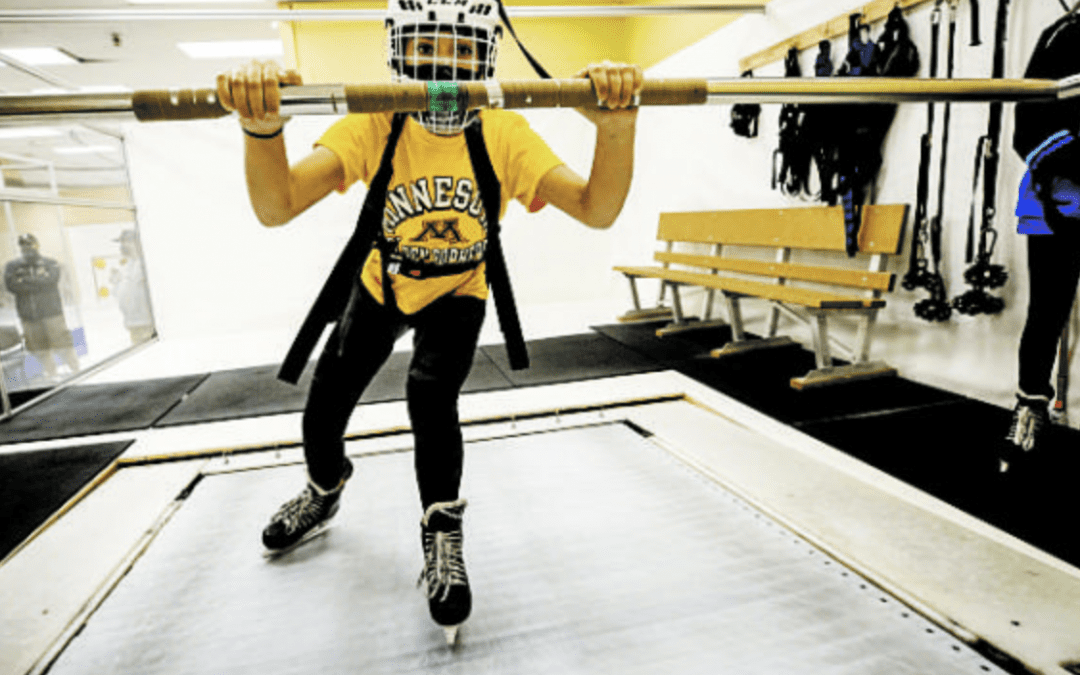
The Apple Valley Hockey Association used gambling revenue to outfit a dryland training facility with high-end equipment available to its 200 youth players. The facility includes a skating treadmill and a RapidShot system that alone cost $100,000.
On a spring evening, middle schoolers Leila Korkowski and Makayla Gore went through workouts on the skating treadmill, which measures stride, power and skating form. A certified trainer ran the controls and monitored their data at a computer.
A few feet away, sixth-grader Padraig Spencer jumped into the RapidShot booth. The system tracks players’ shooting accuracy, speed and reaction time in firing a shot off their stick.
White Bear Lake’s hockey association, which has 800 kids, is in the process of opening a new facility that will feature two skating treadmills, two RapidShot machines, a weight room and a plyometrics area. The project was financed 100% by gambling proceeds.
The association already helped save its city-owned rink by committing $2.5 million in gambling revenue to pay for a new refrigeration system when the old one had to be replaced.
Blaine Youth Hockey Association uses gambling funds to help subsidize costs. Anything to lower the “sticker shock” of playing hockey, association president Jeff Meister said. They also donate money to Blaine’s girls’ and boys’ varsity programs as well as homeless shelters, other youth sports programs and local organizations.
Youth sports officials say they shudder to think what would happen if they didn’t have gambling revenue to cover the costs of big projects or offset participation.
“That would crush a lot of sports,” said Coon Rapids wrestling coach Bob Adams, who oversees charitable gambling for a club program.
This sense of reliance didn’t exist in the early days of the relationship between charitable gambling and youth sports. Minnesota legalized pull-tabs in 1981, and sports associations already were involved when Gary Danger joined the Gambling Control Board in the late 1980s.
Paper pull-tabs — nicknamed “cardboard crack” — have historically been the primary attraction for bar gamblers, and the arrival of electronic pull-tabs in the last decade helped trigger double-digit annual growth.
“There’s an appetite out there,” Danger said.
Danger, a compliance officer, uses a dollar bill to illustrate how the gambling pie gets divided. On average, 85 cents of a wager returns to the player in winnings. Of the remaining 15 cents, roughly half goes toward expenses (payroll, rent, accounting, etc.). The other half gets split between taxes and the association’s take.
About 3 cents per dollar multiplied many, many times over can pay for a dryland training center, ice time and reduced costs for families.
Inside the operations
By law, every nonprofit with a gambling license must employ a gambling manager. Olson has held that job for White Bear Lake Hockey for 10 years, though she has worked in the pull-tabs industry for 23 years.
Her association runs gambling operations in seven establishments and registered total sales of $24.1 million last year, with pre-tax net receipts of $3.5 million. That put the association No. 2 in total sales among all 1,144 licensed organizations in Minnesota, according to state data. Five of the top 10 organizations in total sales were youth hockey associations.
WBL Hockey’s net profit last year was $479,035, trailing Blaine YHA ($697,473), which was No. 2 among all organizations. Seven hockey associations ranked in the top 10 in profit.
Youth sports associations that operate a pull-tabs booth in a bar are responsible for staffing it with their own workers. They also pay the establishment rent — a maximum of $1,750 per month — and buy the inventory (pull-tab tickets and other gaming material).
“It’s a lot of work and regulation so you better be ready to manage that well,” Blaine’s Meister said.
Olson manages 65 employees who primarily cover shifts at pull-tabs booths in those seven establishments. She uses an accounting firm to handle bookkeeping, and her operation gets audited at least once every year and some years experiences multiple audits by different agencies.
Her association paid nearly $100,000 in taxes per month last year. The state received $27.5 million in tax revenue from all youth sports associations combined.
“If you say that the gambler is a willing participant and not a victim in any way,” said Daniel Harrison, president of the Cottage Grove Athletic Association, “then the state wins, the association wins and the bar wins.”
Running the shows
Gambling manager typically is a paid position, and experience in doing the work is critical. Former Apple Valley Hockey Association president Chris Link described the thought of a newcomer starting up a gambling operation from scratch as “almost impossibly daunting.”
That reality has stopped the Chanhassen Athletic Association from proceeding beyond periodic conversations. The association, which oversees baseball, softball, basketball and soccer, relies on other forms of revenue: participation fees, tournament hosting proceeds, sponsorships and more.
CAA president Jaxon Lang, a parent volunteer, said the “burden of compliance complexity” in charitable gambling is too much of a hurdle to overcome for his association.
“We don’t have a moral compass that says we shouldn’t do it,” Lang said. “We have a sense that it takes work and there is a complexity in it that we just haven’t had the motivation to create the position or recruit the position. Nor have we had someone step up and say, ‘I want this.’ We talk about it and then we just kind of back away when nobody says, ‘I want to own it.’ “
That is where an experienced gambling manager proves invaluable. Olson started working in a bingo hall at age 18 and later sold pull-tabs at White Bear Bar before taking over as her association’s gambling manager.
Olson created custom pulltabs tickets for each bar, along with a White Bear Lake Hockey ticket. Her association also runs night bingo, morning bingo, raffles and Tri-Wheels. Olson takes out advertising in suburban newspapers to promote their games.
“Since the beginning, I said we’re going to do everything we can and let’s see how much we can earn,” she said. “Let’s help the bar owners.”
Risks, rewards
The state requires meticulous oversight in this cash-only business. Multiple gambling managers and association presidents referred to charitable gambling as “the most regulated” entity in the state.
Diligent management is twofold: Handling cash transactions appropriately, and then making sure gambling revenue is being spent legally on its intended purpose.
One gambling manager likened the arrangement between sports associations and charitable gambling to two families living in one house. There is a gambling side and an association side.
The state mandates that gambling funds be held separately from an association’s general account, and any expenditure using gambling revenue requires approval from the association’s board. Gambling managers must present monthly reports to their association to show detailed bookkeeping.
“You need transparency, especially when you’re dealing with cash,” Danger said.
Embezzlement happens, but those involved believe strict regulation of the industry provides a safety net and some peace of mind.
“If you steal from gambling of any substantive amount, you will get caught,” Harrison said. “It’s just a matter of when.”
Most associations use independent accounting firms to keep gambling finances in order. The Gambling Control Board conducts regular compliance reviews, and occasionally the Department of Revenue audits associations as well.
“We stress that it can’t be a one-person show,” Danger said. “With that kind of volume, somebody could get in there and if they’re doing something [illegal] and no one is watching, it could get away from people pretty fast.”
That happened in Little Falls when the treasurer of the youth hockey association was charged with embezzling $92,000 over a 3½-year span. Association president Carmen Johnson said the theft did not come from its gambling account but rather from the organization’s general operating account. The association had been setting aside money for improvements to its arena.
The treasurer altered bank balances and the association’s board did not double-check statements.
“None of us ever thought that would happen,” said Johnson, who discovered the theft.
Insurance and donations helped the association replenish a portion of what was stolen, but the ordeal served as a cautionary tale.
“You need to have checks and balances,” she said.
Danger said the governing body has expanded its oversight and educational messaging as gambling has grown. A case of theft can not only send a person into the criminal justice system but it also could cost the organization its gambling license, thus eliminating a critical fundraising source.
“It’s heavily regulated,” Danger said, “but that also provides for integrity.”
Theft is not the only potential problem. Susan Sheridan Tucker, executive director of the Northstar Problem Gambling Alliance, is concerned about addiction as a byproduct of gambling’s everincreasing popularity. Her organization advocates for “hardcore guardrails” in gambling controls beyond hotline numbers posted at pull-tabs booths.
“I’m not against gambling, but I am against creating situations where the player is not going to be protected,” Sheridan Tucker said, while noting 220,000 Minnesotans fall somewhere on the problem gambling spectrum.
Sheridan Tucker said she understands the benefits that charitable gambling provides youth sports but finds it “very unfortunate that we have set up a system that kids are dependent on a gambling game to be able to play sports.”
The impact of that revenue source — however each individual views it — is hard to overstate. It is evident in new sheets of ice at hockey arenas, in new dugouts at baseball fields, in lower participation fees, in extra training, in scholarships and in more kids able to play sports.
“Associations have a lot of kids and a lot of people involved,” Cottage Grove’s Harrison said. “The charitable gambling gets to the grassroots.”
Daily Delivery discussion
Listen as Chip Scoggins and Michael Rand discuss this issue on our Daily Delivery podcast this week. Find the episodes at startribune.com/dailydelivery.
Your take
In addition to commenting on this story on startribune.com, readers can express opinions on this issue by e-mailing sports@ startribune.com. A collection of submissions will be republished for continued discussion on a topic that affects many Minnesota communities.
HOW MUCH GOES TO SUPPORT YOUTH SPORTS?
For every $1 in gross receipts that youth sports organizations earned in 2020 through gambling, here's where that money went . . .
GAMBLING SALES BY YOUTH SPORTS GROWS
The gross receipts generated by charitable gambling programs run by youth sports organizations in Minnesota have nearly tripled since 2010. About 85% of that is paid out in prize winnings.
SHERIDAN TUCKER SAID SHE UNDERSTANDS THE BENEFITS THAT CHARITABLE GAMBLING PROVIDES YOUTH SPORTS BUT FINDS IT “VERY UNFORTUNATE THAT WE HAVE SET UP A SYSTEM THAT KIDS ARE DEPENDENT ON A GAMBLING GAME TO BE ABLE TO PLAY SPORTS.”
WHITE BEAR LAKE’S HOCKEY ASSOCIATION IS IN THE PROCESS OF OPENING A NEW FACILITY THAT WILL FEATURE TWO SKATING TREADMILLS, TWO RAPIDSHOT MACHINES, A WEIGHT ROOM AND A PLYOMETRICS AREA. THE PROJECT WAS FINANCED 100% BY GAMBLING PROCEEDS.
183
Youth sports associations that held a gambling license in Minnesota in 2020.
$100.7 mill.
Total charitable gambling net revenue for Minnesota youth sports associations in 2019, a state record.
3 cents
Profit estimate from every dollar wagered for associations.
chip.scoggins@startribune.com cgonzalez@startribune.com

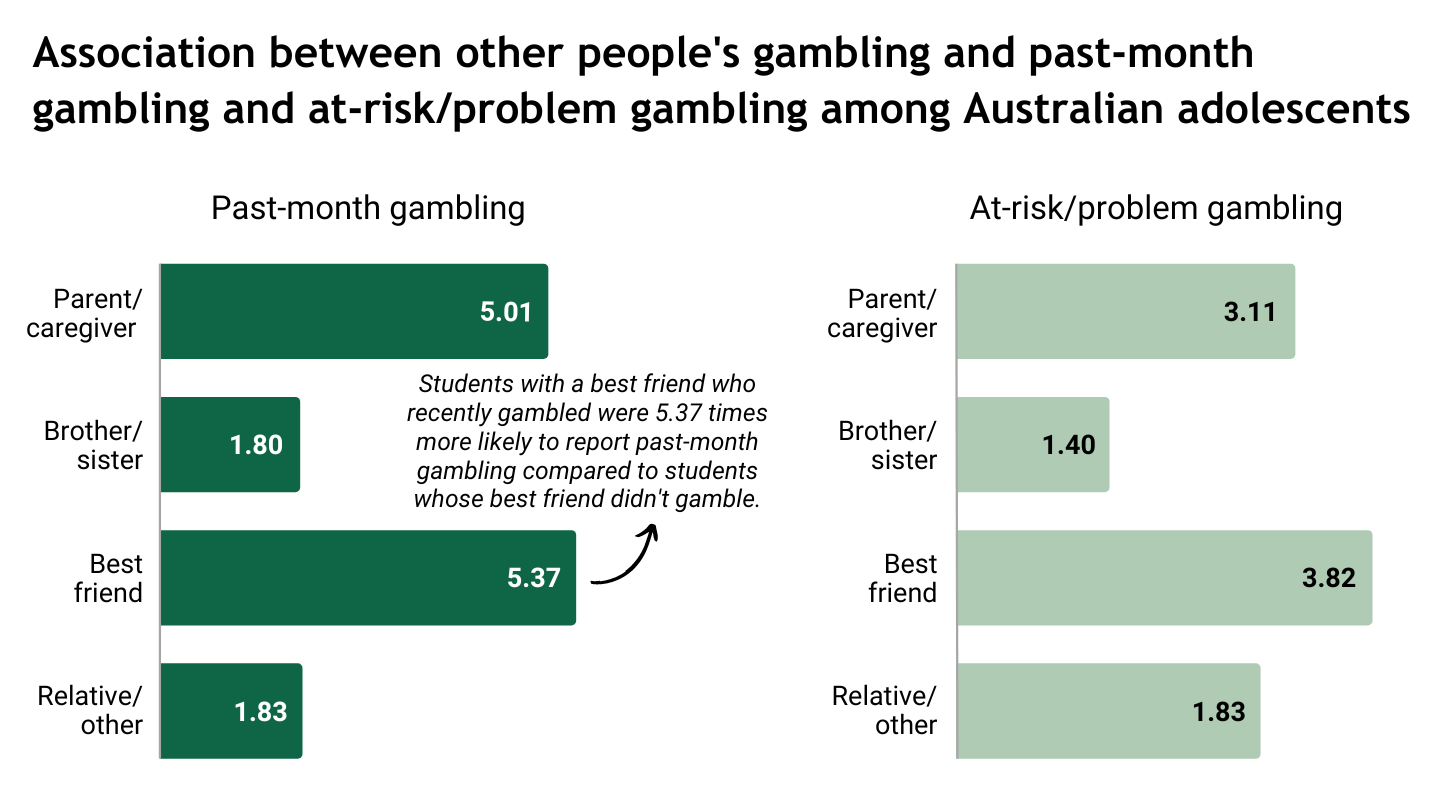 Figure. Odds ratios of the association between other people’s gambling (parent/caregiver, brother/sister, best friend, other relative/someone else) and past-month gambling and at-risk/problem gambling among a sample of Australian secondary students (n = 6,377).
Why do these findings matter?
These findings confirm the association between exposure to gambling in family and friends and gambling behaviors among adolescents. Young people with a parent/caregiver or close friend who gambled were most likely to have gambled recently, engaged in hard gambling activities, and to have experienced at-risk or problem gambling. These findings should inform future problem gambling prevention and education initiatives for young people, such as family-focused initiatives. Successful initiatives might also include skill development for young people, such as how to resist peer pressure to gamble.
Every study has limitations. What are the limitations of this study?
Data were self-reported, so the results might be subject to recall bias and social desirability bias. Because the study was based on a sample of adolescents and was conducted in Australia, the findings might not be generalizable to people in other places with different gambling landscapes.
For more information:
Do you think you or someone you know has a gambling problem? Visit the National Council on Problem Gambling for screening tools and resources. For additional resources, including gambling and self-help tools, visit our Addiction Resources page.
— Kira Landauer, MPH
1. Hard gambling activities are generally defined as having higher stakes or a more rapid pace of play (e.g., poker, casino games, sports betting) compared to soft gambling activities (e.g., lottery tickets, scratch cards).
Figure. Odds ratios of the association between other people’s gambling (parent/caregiver, brother/sister, best friend, other relative/someone else) and past-month gambling and at-risk/problem gambling among a sample of Australian secondary students (n = 6,377).
Why do these findings matter?
These findings confirm the association between exposure to gambling in family and friends and gambling behaviors among adolescents. Young people with a parent/caregiver or close friend who gambled were most likely to have gambled recently, engaged in hard gambling activities, and to have experienced at-risk or problem gambling. These findings should inform future problem gambling prevention and education initiatives for young people, such as family-focused initiatives. Successful initiatives might also include skill development for young people, such as how to resist peer pressure to gamble.
Every study has limitations. What are the limitations of this study?
Data were self-reported, so the results might be subject to recall bias and social desirability bias. Because the study was based on a sample of adolescents and was conducted in Australia, the findings might not be generalizable to people in other places with different gambling landscapes.
For more information:
Do you think you or someone you know has a gambling problem? Visit the National Council on Problem Gambling for screening tools and resources. For additional resources, including gambling and self-help tools, visit our Addiction Resources page.
— Kira Landauer, MPH
1. Hard gambling activities are generally defined as having higher stakes or a more rapid pace of play (e.g., poker, casino games, sports betting) compared to soft gambling activities (e.g., lottery tickets, scratch cards).

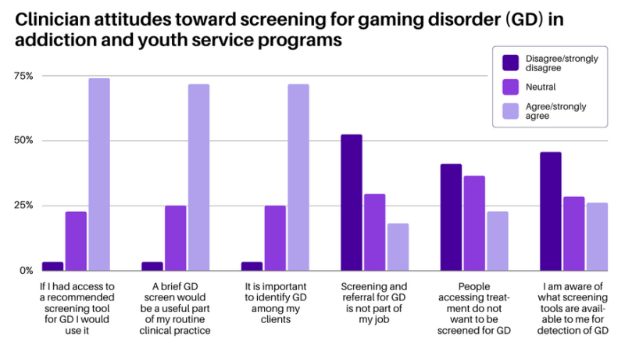 Figure. Clinician attitudes toward screening for GD in addiction and youth service programs, with the percentage of clinicians (n = 88) who agreed/strongly agreed, felt neutral, or disagreed/strongly disagreed with each statement.
Most clinicians agreed that if a client disclosed a gaming problem they would administer a screen, conduct further assessment, or help address immediate gaming-related harms. About one-third of clinicians indicated they often or always refer the client to another agency. Clinicians reported they generally felt confident in delivering behavioral change techniques, including motivational interviewing, relapse prevention, problem-solving, and skill-building. They felt less confident in using behavioral change techniques that require gaming-specific knowledge, such as exposure therapy, social comparison, and imaginal desensitization. Finally, 58% of clinicians had attended a general information session about GD, yet few reported receiving training on screening or treatment for GD.
Why do these findings matter?
This study found that clinicians in addiction and youth service settings were largely supportive of providing SBIRT for gaming-related problems, but that challenges and barriers exist. Challenges, including lack of awareness of appropriate screening tools and low-to-moderate confidence in applying treatment techniques that require gaming-specific knowledge, might be addressed through training. Clinicians might benefit from increased education around gaming, such as the 15-hour
Figure. Clinician attitudes toward screening for GD in addiction and youth service programs, with the percentage of clinicians (n = 88) who agreed/strongly agreed, felt neutral, or disagreed/strongly disagreed with each statement.
Most clinicians agreed that if a client disclosed a gaming problem they would administer a screen, conduct further assessment, or help address immediate gaming-related harms. About one-third of clinicians indicated they often or always refer the client to another agency. Clinicians reported they generally felt confident in delivering behavioral change techniques, including motivational interviewing, relapse prevention, problem-solving, and skill-building. They felt less confident in using behavioral change techniques that require gaming-specific knowledge, such as exposure therapy, social comparison, and imaginal desensitization. Finally, 58% of clinicians had attended a general information session about GD, yet few reported receiving training on screening or treatment for GD.
Why do these findings matter?
This study found that clinicians in addiction and youth service settings were largely supportive of providing SBIRT for gaming-related problems, but that challenges and barriers exist. Challenges, including lack of awareness of appropriate screening tools and low-to-moderate confidence in applying treatment techniques that require gaming-specific knowledge, might be addressed through training. Clinicians might benefit from increased education around gaming, such as the 15-hour