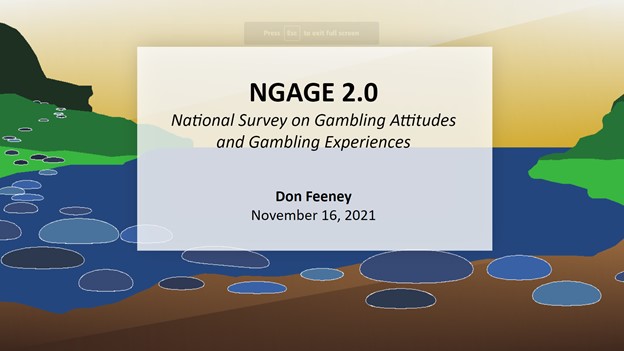
NGAGE 2.0 and the 2021 MN State Lottery, Gambling Participation Rates of Minnesota Adults.
Don Feeney, co-founder of Northstar Problem Gambling Alliance and research policy consultant to the National Council on Problem Gambling shares the national data collected in April 2021 to measure the attitudes and experiences of gambling in the U.S. This is a follow-up study to the one conducted in November 2018, just after the lifting of the ban for states to legalize gambling. Todd Maki, research analyst with the Minnesota State Lottery, presents the findings of their annual survey (2020 was not conducted due to COVID). Presented at the Minnesota Conference on Problem Gambling. Watch the presentation.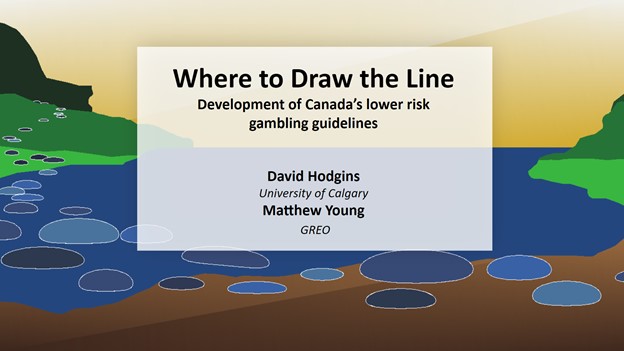
Where to Draw the Line
David Hodgins, Ph.D. University of Calgary and Matthew Young, Ph.D. of GREO present on their development of Canada’s lower risk gambling guidelines. Presented at the Minnesota Conference on Problem Gambling, November 16, 2021. Watch the presentation.
The WAGER: What are the cognitive behavioral therapy (CBT) outcomes among women with Gambling Disorder?
The WAGER, Vol. 26(10)
Written By Taylor Lee
Read the original article on The BASIS website. Problem gambling occurs more frequently among men, but it is still present among women and is understudied in this population. Gambling Disorder (GD) refers to persistent and problematic gambling behavior leading to distress, and that causes financial, relationship, and psychological harm. The effectiveness of GD treatment has received limited attention in the scientific literature. Common factors that might influence treatment effectiveness include discontinuing treatment and relapse. This week, The WAGER reviews a study by Marta Baño and colleagues that examined the short-term therapy outcomes of group CBT among women with Gambling Disorder. What were the research questions? What is the short-term effectiveness of group standardized cognitive behavioral therapy (CBT) among women with GD? Also, what are the most important predictors of primary therapy outcomes (discontinuing treatment and relapse)? What did the researchers do? The researchers assigned 214 women seeking treatment for Gambling Disorder at the Pathological Gambling and Behavioral Addictions Unit at the Bellvitge University Hospital in Barcelona, Spain to a group CBT program. Participants attended weekly 90-minute sessions for 16 weeks and learned CBT strategies to recondition cognitive distortions and improve emotional regulation, with the ultimate goal of absolute and continued abstinence from all gambling behavior. These CBT strategies included education on vulnerability factors, ways to avoid possible triggers, and how to respond to urges with alternative healthier behaviors. The researchers used logistic regression, negative binomial regression, and survival analysis to assess predictors of discontinuing treatment and relapse. What did they find? During the course of treatment in the study, 90 women (42%) skipped three consecutive treatment sessions and 77 women (36%) had at least one relapse. Women with relatively less severe Gambling Disorder, and experiencing greater psychological distress, were more likely to discontinue treatment. On the other hand, relapse risk was higher among women with lower education levels, those without gambling-related debt, and divorced women. Drug use (other than smoking), placing more maximum bets per gambling-episode1, preferring gambling games that rely on chance alone such as bingo or slot machines2, and lower socioeconomic status were also associated with higher relapse rates during CBT (see Figure).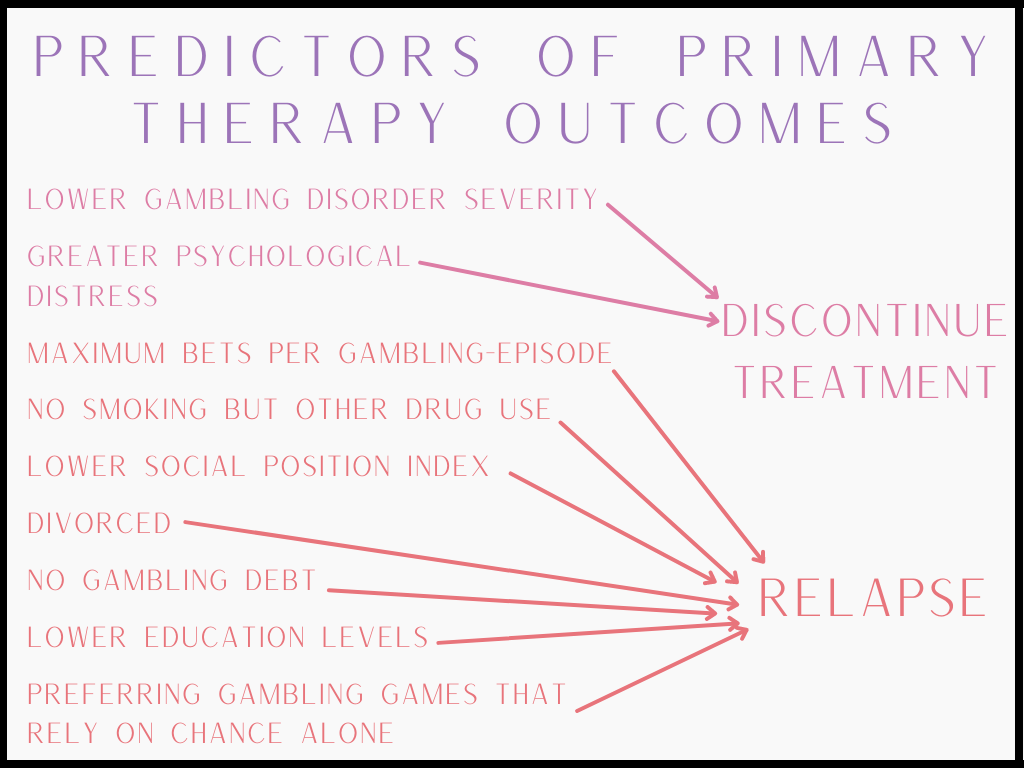 Figure. Statistically significant predictors of primary therapy outcomes—discontinuing treatment and relapses— among women in CBT treatment for Gambling Disorder (n = 214). Arrows indicate significant predictors of either discontinuing treatment or relapse.
Why do these findings matter?
Learning more about female gambling behavior and identifying specific predictors of discontinuing treatment and relapse can help clinicians provide better GD treatment. For example, severe emotional distress may indicate a need for greater emphasis on emotional regulation techniques (e.g., through mindfulness meditation) or healthy coping mechanisms. CBT might also need to be adapted for those with lower education levels to be more engaging and comprehensible. These findings also demonstrate a clear need for future research on women with GD to understand their unique lived experiences.
Every study has limitations. What are the limitations of this study?
As a study with only female participants, the findings can not be generalized to men. Additionally, measures such as amount bet per gambling episode relied on self-reported data, in which participants may have over- or underestimated their actual gambling behavior.
For more information:
Do you think you or someone you know has a gambling problem? Visit the National Council on Problem Gambling for screening tools and resources.
________________
[1] In this context, “maximum bets per gambling-episode” refers to most bets placed during any single past gambling experience.
[2] As opposed to games like poker, which include both chance and skill.
Figure. Statistically significant predictors of primary therapy outcomes—discontinuing treatment and relapses— among women in CBT treatment for Gambling Disorder (n = 214). Arrows indicate significant predictors of either discontinuing treatment or relapse.
Why do these findings matter?
Learning more about female gambling behavior and identifying specific predictors of discontinuing treatment and relapse can help clinicians provide better GD treatment. For example, severe emotional distress may indicate a need for greater emphasis on emotional regulation techniques (e.g., through mindfulness meditation) or healthy coping mechanisms. CBT might also need to be adapted for those with lower education levels to be more engaging and comprehensible. These findings also demonstrate a clear need for future research on women with GD to understand their unique lived experiences.
Every study has limitations. What are the limitations of this study?
As a study with only female participants, the findings can not be generalized to men. Additionally, measures such as amount bet per gambling episode relied on self-reported data, in which participants may have over- or underestimated their actual gambling behavior.
For more information:
Do you think you or someone you know has a gambling problem? Visit the National Council on Problem Gambling for screening tools and resources.
________________
[1] In this context, “maximum bets per gambling-episode” refers to most bets placed during any single past gambling experience.
[2] As opposed to games like poker, which include both chance and skill.

Pandemic, technology and gambling expansion are perfect storm for problem gamblers — Opinion
By Susan Sheridan Tucker, Executive Director of Northstar Problem Gambling. As seen on Minnesota Reformer We’re living in a perfect storm of an emerging gambling addiction problem. The COVID-19 pandemic left people trapped at home. Legal gambling is expanding at an unprecedented clip. And, technological advances are making games more attractive than ever. A 2018 U.S. Supreme Court ruling allowing states to legalize sports betting set off a frenzy of legislative activity. States around the country pushed through legislation to permit sports gambling and online gaming as a way to compensate for economic losses created by COVID-19, as well as to claim revenues previously collected by unregulated, offshore betting sites. Some states set some funding aside to help problem gamblers, but not all. At the same time, electronic access to gambling is easier than ever. And, game and app designers are furiously creating ways to absorb participants into the digital world rather than being present in the physical world. The massive amounts of data being collected from each player helps to inform the next iteration of game design. Designers want to figure out what will keep players playing just a bit longer, so that they’ll wage another bet or continue to engage in “microtransactions” (real money spent for virtual prizes). We also know that during stressful times, people seek escape. A pandemic is a global stressor. When isolated, people may enjoy the easy access to thousands of sites. This can begin as a mere balm for stress or anxiety, but for more than 200,000 adults and over 10,000 children in Minnesota — according to a recent study — the use of gambling or gaming sites can evolve into problem gambling or even an addiction. All of these developments set a trap for anyone who may have a family history of addiction or mental health issues. Three quarters of gamblers have a co-morbidity, which means the existence of one or more additional conditions that often co-occur with a primary condition. As it relates to gambling, this means that if someone is being treated for depression, anxiety or other addictions, treatment providers need to ask whether a gambling addiction may be also in the mix. Surveys conducted by the National Council on Problem Gambling in November 2018 and April 2021 show there’s been a recent increase in gambling. Among the findings:- The number of Americans who bet on sports grew by 30%. This represents an increase of 15.3 million bettors in 18 months.
- Online gambling on sporting events or internet games grew even more, with an additional 25.5 million adults who now gamble this way.
- There was an increase in problematic play among groups who were already at high risk — younger gamblers (those aged 18 to 44 years old), sports bettors and those who play daily fantasy sports.
- Those who gambled more during the pandemic also showed more problematic play.