Aug 13, 2021 | ADVOCACY
Minnesota Sports Betting
The 2021 Minnesota legislative session saw three sports betting bills introduced. None made any significant progress, as Minnesota tribes were not currently supportive of negotiating a new compact.
Charitable Gambling
Near session-ending legislation was introduced by the Minnesota Indian Gaming Association (MIGA) to ensure electronic pull-tab and bingo games comply with the intent of the 2012 authorizing statute, which permitted electronic versions to mimic the paper games. However, MIGA contests that over time, pull-tab and bingo game design has evolved closer to mimicking games that are supposed to be exclusive to tribal gaming. Additionally, these charitable gambling games have grown quite popular and have significantly increased generated revenue for the state, charitable entities and for the bars and restaurants that offer them. The bill’s intent is to respect the intent of the original 2012 statute. The bill did not pass this session. (Full disclosure: NPGA receives ½ of 1% of the tax revenue generated from pull-tabs. Representatives from MIGA and Allied Charities are both members of our board of directors.)

Aug 13, 2021 | ADVOCACY
The following legislative update regarding sports betting developments across the country was prepared by Patrick Willard, Director of Policy and Advocacy for the National Council on Problem Gambling.
As lawmakers headed into the Memorial Day holiday, Connecticut, Florida, and Nebraska passed sports betting proposals and boosted the total number of states with gambling expansions to 30 since the Supreme Court’s decision in Murphy v. NCAA three years ago.
At the Buzzer
The Nutmeg State completed action just before midnight on May 25 when the Connecticut Senate adopted the sports betting proposal that was hammered out between Gov. Ned Lamont and the Mashantucket Pequot tribe and the Mohegan tribe earlier in the year. The legislation included an additional $1 million in funding from the state lottery for the state’s Chronic Gamblers Fund, and codified the $500,000 contribution from the tribes to the fund.
The agreement must be approved by the U.S. Department of Interior pursuant to the Indian Gaming Regulatory Act before it will be official. The Connecticut plan is the third passed in this year’s legislative sessions involving an agreement between a governor and state tribes. The other agreements were in Arizona and Florida.
Cornhusker college games won’t be on the board, but Nebraska ended up including sports betting in implementing the referendums adopted by voters in 2020. There will not be online sports betting, but it will be allowed in brick and mortar casinos. The legislation also included dedicated funding of 2.5 percent of revenues for the Compulsive Gamblers Assistance Fund, which is estimated to generate $1.2 million per year beginning in fiscal year 2022.
In Overtime
Florida lawmakers were nearing the end of their regular session just as Gov. Ron DeSantis announced a new compact with the Seminole Tribe that would open up sports betting and online gaming to the Sunshine State. Legislators decided to take up ratification of the compact in a special session rather than try to cram it into the final week of the session.
The new compact makes no apparent changes in the current level of funding for problem gambling funds for the state despite greatly expanding gambling opportunities. As presented, it would maintain the annual donation by the Seminole Tribe to the Florida Council on Compulsive Gambling of $250,000 per facility. The compact will now need approval from the U.S. Department of Interior.
On the northern end of the East Coast, Maine’s legislature is also in a special session. Lawmakers hope to avoid the outcome in 2019 when a proposal was vetoed by Gov. Janet Mills. If no agreement is reached in the next week the measure may move to the legislature’s 2022 session.
The Clock Ran Out
Three states that began sessions with momentum for sports betting proposals ran out of steam before adjournment. Alabama, Missouri and Kansas all ended their sessions with bills looking for votes. In Alabama and Kansas the legislation passed in one chamber, but was unable to move in the other. That brings to nine the number of states (AL, GA, HI, KS, KY, MO, ND, SC, VT) where bills were introduced but failed to pass this year. It is expected that Texas will join this list when it adjourns at the end of the month.
No Picnic
Meanwhile, one state was experiencing a belly ache after gobbling up its first gambling expansion in 2019. The Volunteer State passed its sports betting law without the benefit of any experience with casinos, racetracks or other brick and mortar gambling experience. This year, some Tennessee lawmakers thought the state bit off more than it could chew. They decided to turnover regulation of its sports betting laws to an advisory council after hiccups in the oversight of operators by the state lottery earlier in the year.
Still In-Play
Legislative sessions are wrapping up, but will continue into June for Louisiana, Massachusetts and Ohio. Louisiana lawmakers are moving forward with sports betting legislation that was approved by voters in a 2020 referendum. A measure setting tax rates for the operators has passed both chambers and a second bill putting the wagering regulations in place is awaiting adoption in the House to move to the governor.
In Ohio, a comprehensive expansion of gambling options from the Select Gaming Committee is running into opposition from sports teams and others who feel the requirements of the legislation would limit their ability to take part. The Problem Gambling Network of Ohio continues to speak out on responsible gambling issues before the panel as it heads to consideration by the end of June.
Massachusetts lawmakers are looking at budget amendments that may include additional sports betting revenue. More than a dozen sports betting bills have been filed, but no hearings have been held on the legislation in the Bay State on specifics of gambling expansions. Gov. Charlie Baker supports sports betting, but lawmakers have been unable to agree on how it could be implemented.

Aug 9, 2021 | ADVOCACY
For the next several issues of Northern Light, we’ll profile organizations that have received grants from Minnesota’s Department of Human Services (DHS) and detail how they are using them to increase awareness about problem gambling. Our first feature focuses on the Minneapolis Neighborhood Youth Academy.
The Minneapolis Neighborhood Youth Academy (MNYA) is taking a three-pronged approach to their efforts to raise awareness about gambling to youth of color in North Minneapolis.
The first part is the creation of a video, released on Memorial Day weekend, that focuses on the concept of risk and making good choices. The video is viewable on https://justaskmn.org/ and was produced in collaboration with Danami, Russell Herder, Minnesota Prep Academy and the Minnesota DHS.
The second phase involves distributing the video through social media so that it reaches youth in the way they access information using their devices — everything from TikTok to Facebook. In addition to raising awareness, the goal is to start a conversation about gambling and related choices.
The third phase of the work will be the creation of a curriculum that goes with the video and for MNYA to become the entity that connects people to the help they need. This is in response to the fact that many websites detail problem gambling from an adult perspective rather than a youth perspective. This will include a youth-led focus group so that more information can be gained about what youth are doing with sports betting. The perspective will not be just with casinos, shooting dice, dominos, etc., but will also include how youth are accessing sites such as FanDuel.
“The grant has been wonderful for us as a starter,” says Donnell Bratton, founder and executive director of Minnesota Preparatory Academy. (The Minnesota Preparatory Academy is partnering with the Minneapolis Neighborhood Youth Academy.) It’s really allowed us to raise awareness about gambling to youth of color in North Minneapolis.
An unexpected benefit has been that the work has helped educate adults about what young people are experiencing. “We didn’t know it would turn out like this, so we’re really excited. This has given us a much deeper appreciation for how gambling can affect young people for the future,” says Donnell. “We heard so many stories we didn’t really expect, such as some kids thinking about gambling to provide money for their mother.”
One important eye-opener for youth was learning that they jeopardize sports scholarships if they participate in sports betting. Some can also lose jobs if they are caught gambling.
In partnership with other community organizations, the information learned from MNYA’s gambling awareness efforts is also being communicated to other at-risk groups, including Asian Americans through Asia Media Access.

Aug 9, 2021 | PROFESSIONALS
In Nevada, there’s a new alternative for individuals who commit crimes — such as theft or fraud — that are motivated by their gambling addiction. The state has the nation’s only Gambling Treatment Diversion Court (GTDC), which gives these individuals an option to pursue treatment if they plead guilty to nonviolent crimes.
The GTDC is modeled after drug treatment courts, which have proven successful around the country and are now in approximately half the nation’s counties. The Nevada court follows a pilot project in Amherst, New York.
The idea of specialty courts dates back to the 1960s during the Kennedy administration when prisons were getting too crowded, the cost of incarceration was high and rates of recidivism were significant. The theory behind the GTDC is that individuals can get the treatment they need, cease gambling, pay restitution to the aggrieved party, and go on to become productive members of society.
The process for enrolling in the GTDC system begins with a guilty plea in a criminal court. An assessment is then performed to confirm the existence of a gambling addiction and that the crime or crimes committed ultimately stemmed from the gambling addiction. Once the request to enroll is accepted, the applicant must pay a fee and commit to attending the GTDC at a prescribed frequency for a period of up to three years.
During this period of time, the individual must also wear a GPS device to ensure they don’t visit casinos or other places where gambling activity takes place. They must also consent to random drug tests. While many gambling addicts may not be drug users, the drug tests help ward off any “addiction switching” that may occur as a result of ending the gambling addiction.
Court sessions ensure accountability and provide opportunities for support group meetings. Program participants must also work one-on-one with a mental health practitioner specializing in gambling addiction. The participant must pay for this counseling, although loans and grants are available for those who can’t afford it. Should participants fail to meet the requirements or drop out early, they must serve the original sentence for their crime.
Judge Cheryl Moss has been the driving force in establishing the GTDC in Nevada. On the podcast “All In: The Addicted Gambler’s Podcast,” Judge Moss noted that she historically had about a dozen cases a year in family court that related to gambling addiction. As a result, she decided to get gambling assessments in certain custody and divorce cases.
According to Judge Moss, it’s been proven that specialty courts, such as the gambling diversion court, work. And it also saves the cost of incarceration, which in Nevada is approximately $24,000 per year per individual.
While the success of a gambling court is apparent, the challenge is getting judges to learn about it and appreciate its benefits to both the individual and the state. In addition to educating judges, it’s also important that criminal defense attorneys learn about the court so their clients know it’s an option.
The reception to the specialty court among those in the gambling industry and casinos seems favorable according to Judge Moss. She notes that some of the court’s participants have been casino employees, so the possibility for restitution rather than prison means the casinos will recoup at least some of their losses.
But in the end, more than financial restitution, it seems the option provided by the GTDC fulfills a moral imperative to demonstrate compassion and understanding. As Judge Moss says, “It gives people from all walks of life a second chance to be productive citizens.”
The State of New Jersey currently has two bills being considered to introduce gambling courts similar to the Nevada model. Action is expected on the bills later this year.
To help generate interest and awareness for such a court in Minnesota, Judge Moss suggests asking your congressman, senator or assemblyman to amend the state statute. It’s also helpful to spread the word to judges and help them realize that it’s possible to create such a court — and that it can be successful.

Jul 27, 2021 | PROFESSIONALS, RESEARCH
Read the original article from The BASIS website.
Written by: Taylor Lee
Various in-person and online games allow players to purchase randomized packs of rewards, such as collectible card packs and virtual items. Some places are imposing regulations on video games offering loot boxes—purchasable virtual containers with randomized items—as they seem to fit traditional definitions of gambling. Indeed, people who report more problem gambling symptoms tend to spend more on loot boxes. Due to some similarities with loot boxes, collectible card game ‘booster packs’ have come under scrutiny as well. Collectible card games (CCGs) allow for the purchasing of physical booster packs containing cards that are sealed and random in game value. This week, The WAGER reviews a study by David Zendle and colleagues that examined the association between problem gambling symptoms and the amount of money spent on physical booster packs of trading cards.
What was the research question?
What is the relationship between the severity of problem gambling symptoms and the quantity of money spent on collectible card game booster packs in real-world and digital stores?
What did the researchers do?
The researchers used a cross-sectional survey advertised on the online message board Reddit, and obtained 726 usable responses from participants 18 and older. About 60% of respondents were from the U.S., but many different countries were represented. The survey asked participants about CCG physical booster pack spending in (1) real-world stores and (2) digital stores within the past month. It also assessed problem gambling using the Problem Gambling Severity Index (PGSI). The researchers used PGSI scores to classify respondents as non-problem gamblers (n = 429), low-risk gamblers (n = 244), moderate-risk gamblers (n = 35), and people experiencing gambling problems (n = 18). They then used Kruskal–Wallis tests to examine if respondents in different PGSI groups differed in terms of how much money they spent on physical booster packs in real-world stores and digital stores.1
What did they find?
Zendle and colleagues did not find evidence for an association between problem gambling and quantity spent on booster packs in real-world stores (see Figure). Even though there was a statistically significant relationship for problem gambling and the quantity of money spent on booster packs in digital stores, the effect was too small to be considered clinically significant. There was also no significant difference in quantity spent on booster packs between people with and without gambling problems.
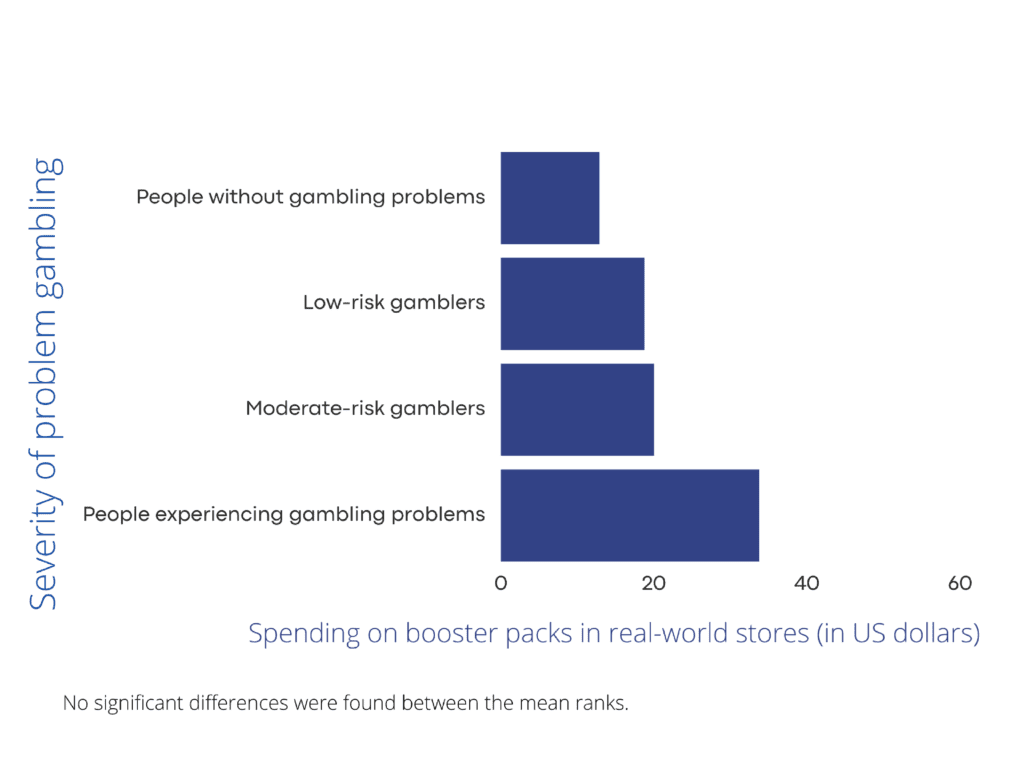 Figure. Problem gambling severity and spending (in US dollars) on booster packs in real-world stores among survey respondents (total n = 726). Although the authors performed their statistical tests on mean ranks, we provide medians to illustrate the trends across PGSI categories. The interquartile range (IQR) around each median was $39 for people without gambling problems (n = 429), $50 for low-risk gamblers (n = 244), $69 for moderate-risk gamblers (n = 35), and $119 for people experiencing gambling problems (n = 18).
Why do these findings matter?
This study suggests that while booster packs in collectible card games may appear similar to gambling in some ways, users do not seem to engage with them in ways comparable to traditional gambling activities. Thus, regulations—like those developed for loot boxes—might not be necessary for booster packs. This suggests that there is likely a difference in the ways that players interact with physical booster packs and digital loot boxes. Ultimately, the findings were cross-sectional, so the researchers could not establish causality; additional longitudinal and/or experimental research would help better illuminate the specific factor that accounts for the difference in loot box and booster packs’ relationship with problem gambling symptoms.
Every study has limitations. What are the limitations of this study?
Participants were recruited from Reddit’s online message boards targeting fervent players of collectible card games. An over-representation of enthusiastic players in the study’s sample may lead to findings that are not representative of more casual players. Social desirability bias through self-reporting may also contribute to participants misrepresenting their true spending or gambling behaviors. The most severe PGSI category had only 18 people in it, which likely limited the chances that the authors would statistically detect a difference among groups.
For more information:
Do you think you or someone you know has a gambling problem? Visit the National Council on Problem Gambling for screening tools and resources. For additional resources, including gambling and self-help tools, please visit The BASIS Addiction Resources page.
-- Taylor Lee
______________
[1] The authors used rank transformations and Kruskal–Wallis tests to replicate past research in this area, and because they could not be sure if their spending data would meet the normality distribution assumptions of ANOVA.
Figure. Problem gambling severity and spending (in US dollars) on booster packs in real-world stores among survey respondents (total n = 726). Although the authors performed their statistical tests on mean ranks, we provide medians to illustrate the trends across PGSI categories. The interquartile range (IQR) around each median was $39 for people without gambling problems (n = 429), $50 for low-risk gamblers (n = 244), $69 for moderate-risk gamblers (n = 35), and $119 for people experiencing gambling problems (n = 18).
Why do these findings matter?
This study suggests that while booster packs in collectible card games may appear similar to gambling in some ways, users do not seem to engage with them in ways comparable to traditional gambling activities. Thus, regulations—like those developed for loot boxes—might not be necessary for booster packs. This suggests that there is likely a difference in the ways that players interact with physical booster packs and digital loot boxes. Ultimately, the findings were cross-sectional, so the researchers could not establish causality; additional longitudinal and/or experimental research would help better illuminate the specific factor that accounts for the difference in loot box and booster packs’ relationship with problem gambling symptoms.
Every study has limitations. What are the limitations of this study?
Participants were recruited from Reddit’s online message boards targeting fervent players of collectible card games. An over-representation of enthusiastic players in the study’s sample may lead to findings that are not representative of more casual players. Social desirability bias through self-reporting may also contribute to participants misrepresenting their true spending or gambling behaviors. The most severe PGSI category had only 18 people in it, which likely limited the chances that the authors would statistically detect a difference among groups.
For more information:
Do you think you or someone you know has a gambling problem? Visit the National Council on Problem Gambling for screening tools and resources. For additional resources, including gambling and self-help tools, please visit The BASIS Addiction Resources page.
-- Taylor Lee
______________
[1] The authors used rank transformations and Kruskal–Wallis tests to replicate past research in this area, and because they could not be sure if their spending data would meet the normality distribution assumptions of ANOVA.
Page 7 of 15« First«...56789...»Last »