
The Gaming Industry’s Thoughts on Responsible Gaming
Here are some common themes we noted from the gaming industry during Responsible Gaming Education Month, led by the American Gaming Association. 1. There is a widening consensus within the gaming industry acknowledging their role in minimizing gambling harms. Increasingly advanced technology is providing opportunities to create tools that could help better inform players of the risks they are taking in real time. If operators wish to sustain their business, adopting effective responsible gambling tools will be necessary. Customers will be expecting it. 2. The current thinking is that collecting a wide swath of information from every player will provide greater insights into their behavior and suggest how tools can be designed to minimize harms. Most commonly sited tools are money and time limits. Giving the player tools to set before play begins will offer a line of defense to prevent an individual from taking too many risks. As technology advances, tools are available that learn how players use the machines. The information helps the operator better understand their customers’ behavior. Software already exists that allows an operator to provide a personalized message to each player based on their patterns of play. 3. Responsible gambling must also be raised for those who design games. If the gambling industry wants to continue being categorized as entertainment, games cannot be designed to be predatory. Stricter regulations must be developed to ensure the games that arrive on the floor of a casino or in an app are not designed to create harm. 4. Some in the gaming industry see the embracing of responsible gambling as a threat. It will take more time to convince certain operators that adopting effective responsible gambling tools will lead to greater sustainability of their operations. Partnerships between advocates of problem gambling, regulators, game developers and operators will be key to ensuring effective ways to minimize harm.
Helpline Adds Motivational Texting
Needless to say, we live in a world where texting seems the preeminent form of communication. So why shouldn’t it play an important role in helping someone with a gambling problem. Now, in Minnesota, it does. LifeWorks, which manages the Minnesota Problem Gambling Helpline, now offers a service called Encourage Me that consists of motivational text messaging. Encourage Me motivational text messaging is offered to both gamblers and affected others in both English and Spanish. Messages are sent twice each week for three months and are tailored to fit into the client’s stage of change, as clients require a different type of information and support in each stage. The messages provide both information about gambling and problem gambling, encouragement to change, and tips and suggestions on how to make the changes they want to make. “We realize that some people may just be thinking about changing, while others need maintenance during the recovery period,” says Ashley Trantham, Manager of Customer Success at LifeWorks. Motivational messaging is offered as a supplemental treatment tool and isn’t meant to be a substitute for counseling. Here are some questions and answers about Encourage Me: Why Texting? · The program was developed using research from successful healthcare-related texting programs such as smoking cessation, weight loss, and medication management. · Text messages have a 98% open rate vs. a 20% open rate for emails. · Text messages can be opened at any time that is most convenient to the user. · Available on almost every model of mobile phone. · Provides a reminder that someone cares. · Reminds the user that help is available. Is it effective? Yes! Outcome surveys are conducted at the conclusion of the texts and in the first year, 86% of survey responses indicated that receiving a text message every week helped keep them focused and working on their goals about gambling. Example comment: “I have not gambled since calling the helpline and found the text messages helpful for reinforcement, reminding me to focus on my goal of not gambling.” Examples of textsContemplation: Consider changing your thoughts from “I have to stop gambling” to “I want to stop gambling” Preparation: You have made significant progress by just acknowledging that gambling is no longer fun. You’re on the right path. Action: Today is the day to be good to yourself. Take a walk, enjoy the warmth of the sun, or give yourself the gift of feeling good about managing your gambling. Maintenance: Take the time to review and modify your goals and plans for recovering from problem gambling. Stay active in your recovery!
Can a person enroll more than once? Yes
How do I enroll a client? Clients are offered Encourage Me messages as a standard part of their call to the Problem Gambling Helpline. If your client has not yet enrolled, you can enroll them by calling the helpline together or recommending that they contact the Helpline themselves. Curious? You can call and sign yourself up, too!
Crypto Trading – Is It Gambling?
While it’s not there yet, cryptocurrency trading is gradually approaching mainstream adoption. It’s a phenomenon in the investing world, but its safety is questionable. While some people have made millions buying cryptocurrency, others have lost everything.
Is cryptocurrency trading a form of gambling and, if it is, can one become addicted? There’s a strong argument to be made that the answers to both questions are yes.
According to Kevin Davis, a leading financial expert in Australia, when one buys a cryptocurrency like Bitcoin, chances are they’re doing it not to make a payment but because they believe someone will be willing to pay more for the Bitcoin in the future (Sydney Morning Herald, July 1, 2022). While Davis says that it’s different from other forms of gambling, where the outcome of a horse race or a sports contest determines the gain or loss, he still sees it as gambling.
With excessive cryptocurrency trading, an individual risks money on a highly volatile commodity in hopes of making a substantial return. It is similar to gambling on high-risk stocks like margins and options.
Surging prices of cryptocurrency can bring a rush of dopamine. Regular “hits” of dopamine stemming from the volatility of cryptocurrency – as well as the fact that it can be traded at any time – can produce addiction more easily than stock trading, which has a market that’s less volatile and has limited trading hours.
Indeed, there are specific signs of cryptocurrency addiction according to Family Addiction Specialist (familyaddictionspecialist.com). These include, but are not limited to, the following:
1. Taking on increased risk without much strategy or needing to make bigger wagers in order to receive satisfaction or excitement.
2. Obsession with researching and trading cryptocurrencies or having a preoccupation or compulsion to constantly check prices.
3. Losing interest in social and leisure activities once found pleasurable at the expense of engaging in trading.
4. Trading for an adrenaline rush or to induce pleasure.
5. Unsuccessful attempts at reducing time spent on trading and trading-related activities, or unsuccessful attempts from taking a break or abstaining from trading-related activities.
6. Trading compulsively or experiencing strong urges and cravings to engage in trading-related activities.
7. Experiencing stress, anxiety, a low mood, irritability, insomnia, anger or other unwanted and unhealthy mental health symptoms when trading or when unable to trade.
8. Lying or hiding trading or trading-related activities from loved ones.
9. Stealing, taking loans, selling assets or using money that should be spent on bills or necessities in order to make trades.
10. Continuing to trade despite adverse consequences to financial stability, relationships, physical and mental wellbeing, or other important life areas.
If you or a loved one is struggling with cryptocurrency addiction, call the Minnesota Problem Gambling Helpline at 1-800-333-4673 (HOPE) for free confidential help.

The Wager: Negative Recovery Capital and Gambling Disorder: Examining obstacles to recovery through a holistic conceptual model
Read the original article on The Basis website HERE. By Kira Landauer, MPH Recovery capital refers to the internal and external resources that an individual can access to start and sustain recovery from an addictive disorder. Existing along a continuum, recovery capital can be negative and impede an individual from enacting change and overcoming their addiction, or positive and help to enhance the recovery experience. This week, The WAGER reviews a study by Belle Gavriel-Fried and Niva Lev-el that identified and modeled elements of negative recovery capital (NRC) that might impede recovery from Gambling Disorder. What was the research question? What are the NRC elements that impede recovery from Gambling Disorder? What did the researchers do? The researchers conducted semi-structured interviews with 133 individuals with a self-reported lifetime history of Gambling Disorder. Participants were currently in treatment or had recently been treated in five gambling treatment centers in Israel and reported no co-occurring substance use disorder within the past year. The authors asked the research participants to describe factors that impeded or made their recovery process from Gambling Disorder more challenging. Next, the researchers analyzed the interviews using deductive and inductive qualitative content analyses. They categorized factors that impeded recovery into the four domains of recovery capital and then assessed their frequencies: (1) Human Capital (skills, personal traits, and knowledge); (2) Social Capital (family and friends, social networks); (3) Financial Capital (financial assets, such as money); and (4) Community Capital (community resources that promote social norms of a recovery lifestyle). What did they find? Fourteen elements of NRC were identified and categorized across the four domains of recovery capital. The majority of participants (82%) reported at least one NRC element in the domain of Negative Human Capital as a barrier to their recovery. This domain included negative emotional, cognitive, and behavioral states and negative life circumstances, including cognitive distortions, which were cited by 36% of participants (see Figure). Of the 14 NRC elements, the most frequently cited obstacle to recovery was conflictual or dangerous social networks, cited by 56% of participants. This NRC element is within the Negative Social Capital domain, which includes lack of support from family and friends. Sixty-three percent of participants cited at least one element in this domain as an obstacle to their recovery. An environment that encourages gambling and financial distress and debts were frequently cited NRC elements, and belong to the Negative Community Capital and Negative Financial Capital domains, respectively.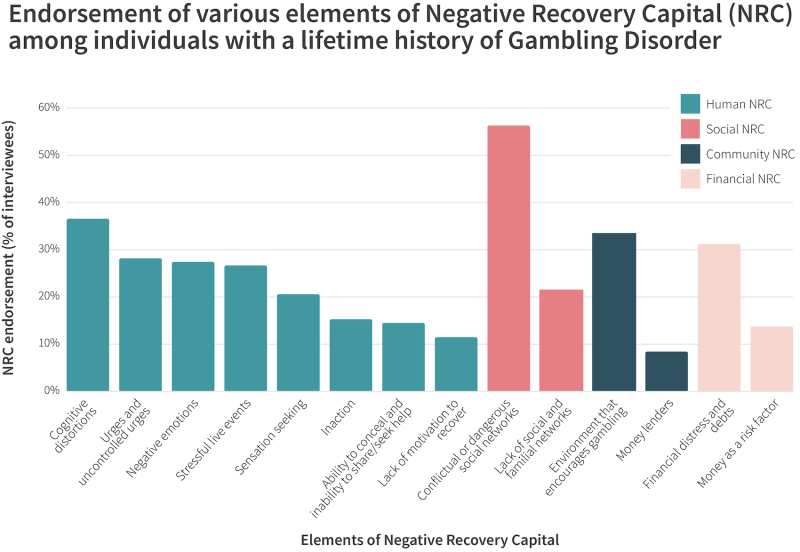 Figure. Frequencies for negative recovery capital elements that impede recovery from Gambling Disorder across the four domains of negative recovery capital (n = 133). Adapted from Gavriel-Fried & Lev-el (2022).
Why do these findings matter?
These findings illustrate the many challenges and obstacles that might impede or hinder an individual’s recovery from Gambling Disorder, and this study is the first effort to map these elements across various domains pertinent to the recovery process. This study found that many elements that challenge the recovery process fall within the Human Capital domain, suggesting a focus be placed on addressing factors within this domain during recovery (e.g., addressing cognitive distortions through cognitive behavioral therapy or motivational interviewing). Findings from this study reinforce the importance of social networks in the recovery process, and highlight that unsupportive or conflictual relationships can hinder the recovery process. Clinicians should consider including family members into the treatment process and help clients manage relationships within their social networks. While it may be beneficial to prioritize these more common NRC elements, these results suggest that a holistic approach be taken to treatment and recovery. A tailored approach should address the full range of obstacles or challenges that might impede recovery across social, financial, personal, and community domains.
Every study has limitations. What are the limitations of this study?
This study used data from individuals without an active substance use disorder who sought help for their gambling. Findings might not be generalizable to individuals with an active substance use disorder, individuals who have not sought treatment for their Gambling Disorder, or to those residing in other countries.
For more information:
Do you think you or someone you know has a gambling problem? Visit the National Council on Problem Gambling for screening tools and resources.
Figure. Frequencies for negative recovery capital elements that impede recovery from Gambling Disorder across the four domains of negative recovery capital (n = 133). Adapted from Gavriel-Fried & Lev-el (2022).
Why do these findings matter?
These findings illustrate the many challenges and obstacles that might impede or hinder an individual’s recovery from Gambling Disorder, and this study is the first effort to map these elements across various domains pertinent to the recovery process. This study found that many elements that challenge the recovery process fall within the Human Capital domain, suggesting a focus be placed on addressing factors within this domain during recovery (e.g., addressing cognitive distortions through cognitive behavioral therapy or motivational interviewing). Findings from this study reinforce the importance of social networks in the recovery process, and highlight that unsupportive or conflictual relationships can hinder the recovery process. Clinicians should consider including family members into the treatment process and help clients manage relationships within their social networks. While it may be beneficial to prioritize these more common NRC elements, these results suggest that a holistic approach be taken to treatment and recovery. A tailored approach should address the full range of obstacles or challenges that might impede recovery across social, financial, personal, and community domains.
Every study has limitations. What are the limitations of this study?
This study used data from individuals without an active substance use disorder who sought help for their gambling. Findings might not be generalizable to individuals with an active substance use disorder, individuals who have not sought treatment for their Gambling Disorder, or to those residing in other countries.
For more information:
Do you think you or someone you know has a gambling problem? Visit the National Council on Problem Gambling for screening tools and resources.