
Minnesota Senate Finance Hearing Highlights Socioeconomic Impacts of Online Sports Gambling
While about 30 Minnesota Senate and House hearings have focused on sports betting and other forms of gambling over the last few years, none have focused on the negative impacts of sports betting. Until now. On January 8, the state legislature heard about the socioeconomic impacts of problem gambling and gambling addiction. Several speakers provided expert testimony from a variety of perspectives, including MNAPG executive director Susan Sheridan Tucker. The hearing included the following speakers and perspectives: Les Bernal, national director for Stop Predatory Gambling, spoke of concerns with proponents of expanded gambling trying to portray sports gambling companies as regular businesses when, in fact, he sees them as often using predatory practices to attract gamblers and encourage heavy gamblers to keep making bets. “It’s an adversarial relationship,” he said. “That’s true for all forms of commercialized gambling that is being done for profit.” Matt Litt, a New Jersey-based attorney who specializes in litigation against sports books and gaming companies, spoke of the interactions he’s reviewed between gamblers and VIP hosts. He said that hosts send users trophies and offer all-expenses paid trips to users who spend a certain amount of money, enticing them to keep spending money. Brett Hollenbeck, associate professor at the UCLA Anderson School of Management, highlighted the financial consequences of legalized sports gambling by presenting an analysis of credit scores, debt consolidation and collections data, bankruptcies and car loan delinquencies. He demonstrated that across nearly every metric, residents of states where sports betting was legal had worse outcomes than those in states that still prohibit sports gambling. Similarly, Scott Baker, associate professor of Finance at Kellogg School of Management, and his colleagues found that people who bet on sports are more likely to overdraw their accounts, have higher credit card balances and invest less than those who do not gamble on sports. Emily Arnesen, professor in the Economics department at the University of Oregon, and Kyutaro Matsuzawa, doctoral student in Economics at the University of Oregon, noted that the legalization of sports betting has increased certain types of intimate partner violence. They cited studies that have long documented that domestic violence increases when a local sports team loses. Arnesen and Matsuzawa estimated that sports betting legalization increased incidents of intimate partner violence by around 9%. Susan Sheridan Tucker explained MNAPG’s neutral stance on gambling but emphasized its desire to advocate on behalf of those impacted by problem gambling, to ensure that appropriate consumer protections are incorporated into any legalization of gambling, and to secure adequate funding is set aside to advance prevention and treatment efforts. Craig Johnson, a Minnesota certified gambling treatment provider with Club Recovery, spoke of the harms he has witness from his clients with gambling problems. “The effect of this disease on individuals is as profound as any addiction you can encounter,” he said. In addition to the experts, several individuals with lived experience spoke of their personal struggles with gambling addiction and the impact it has had on their life and the lives of others. The complete hearing can be viewed at https://www.youtube.com/watch?v=1RBsKS2BRTU.
Betting on Safety: How AI can Power Responsible Gambling Programs
Artificial intelligence–commonly known as AI—is increasingly becoming a part of everyday life. We may think of its use in facial recognition apps, health care applications and even in a routine Google search, but what about its potential in problem gambling prevention and diagnosis? Phil Sherwood, senior director of Responsible Gambling at PrizePicks, feels that AI can be a boon to responsible gambling programs and shared his perspective in a presentation to the MNAPG board in January. What is AI? AI is defined as the simulation of human intelligence in machines. It employs machine learning and language processing to automate tasks, enhance decision-making and boost efficiency. Historic Use of AI Gambling operators have been using AI for a long time to boost profits. It’s been used to improve marketing and to produce emotional appeals to specific customers, ultimately getting players to play more and more aggressively. AI has also been used to help gambling operators poach business from other operators. Why use AI in Responsible Gambling Programs? There are many reasons to employ AI in responsible gambling programs. Perhaps most importantly, AI can detect early signs of problem gambling, especially considering that more gambling and gaming is being done online. There is more data to access, such as time spent gambling, amount of money spent and other forms of gambling an individual might be involved in. AI also enables personalized, real-time interventions. For example, if a player is exhibiting specific symptoms of problem gambling, the platform can send a personalized notification alerting them to risky behaviors or simply to make them more aware of their play. This notification might also suggest the responsible gambling tools that are available. Another advantage of AI is that it reduces reliance on manual monitoring of a gambler’s behavior and allows for 24/7 oversight. With so many transactions available for analysis, a properly programmed AI system can identify potentially harmful behavior much better than humans. AI-Driven Tools for Player Protection AI can be used to protect players in several ways. It can identify risk behaviors such as loss-chasing and binge gambling. It can provide real-time alerts when it flags sudden changes that suggest immediate review. And it can also empower players gauge their own risk through gamified self-assessments in which they complete questionnaires. The gamified aspect may make players more receptive to the information that’s provided to them. Interventional Levels Based on AI Insights AI can suggest interventions commensurate with risk levels it assesses. For example, a system could address low-risk behaviors with basic pop-up reminders or session time limits. When a player exhibits moderate risk behavior, such as using different credit cards to gamble, the system can provide more tailored advice or impose or suggest temporary timeouts. When AI detects behaviors considered high-risk, it can instigate personalized care calls, exclusion options or even refer a customer to online behavioral counseling. The U.S. is Behind in Use of AI Phil noted that some operators, particularly those outside of the U.S. and those subject to regulations requiring the use of AI to monitor behavior, are incorporating AI to monitor player behavior and encourage player safety. However, he expressed concern that the U.S. is fearful of AI and that it’s use is discouraged, something he says would be an egregious mistake. Challenges and Considerations in AI Implementation While AI appears to hold considerable promise in protecting players from harm, there are challenges in its implementation. Some of those include privacy concerns (ensuring responsible use of player data), regulatory compliance (aligning AI tools with different jurisdictional standards) and the need for continuous improvement (models need regular updates based on evolving behaviors and research). The Future of AI in Responsible Gaming and Problem Gambling Looking ahead, Phil sees increased realization of the potential of AI with additional automation of support options for at-risk players, more predictive modeling for early intervention and standardization across operators for greater impact “There will be so much innovation that comes from AI,” says Phil. “It’s evolved so much, even in the last year. I think the biggest things that will come from AI are things that we haven’t even thought of yet.”
In Their Own Words – Judy’s Story
When I look back on the ups and downs of my struggle with compulsive gambling, I sometimes think back to the first time I was bailed out of my debt. When my parents learned about my gambling problem, they asked how much I owed. They subsequently paid off my debts, and while that solved the immediate anxiety I had about money, it did nothing to help me with a gambling problem that I would struggle with for the next 20 years.
There was no history of gambling in my family. While I remember cake walks as a kid, when you might win something, and the times my grandmother would let me deposit a ticket for a raffle, that wasn’t anything serious. I also remember my father placing minimal bets on horses at Ascot, but I was just thrilled to be there and couldn't have cared less about betting.
My compulsive gambling started after I went with my friends to casinos around 1990. This was when gambling became more available as casinos opened on reservations. It was probably about three years later — when I’d taken time off for surgery, didn’t want to be home for any work calls and started going to casinos for an escape —that I started to gamble compulsively, though I didn’t recognize it as that at the time.
At first, at the casinos, I generally played cards but at some point I moved to playing the machines. They were faster paced and I found them more exciting. Eventually, I started going to the casinos more often, usually alone, and would gamble more each time.
This was also at a time when it was easy to get credit cards and I quickly racked up a lot of debt taking cash advances on credit cards. Eventually, it became difficult to pay my bills. Shortly thereafter, I became depressed and started to have suicidal thoughts. As I drove around the Twin Cities, I’d look at a bridge abutment and think that I could drive into it and that nobody would ever know about my gambling behavior. But I figured if I didn’t kill myself, things would just be worse.
The suicidal thoughts spurred me to seek help. I met with a behavior health professional, who suggested I attend a Gamblers Anonymous (GA) meeting. At the time, I had no idea there was such a thing as a compulsive gambler. I remember breaking down and crying at my first GA meeting appreciating how sympathetic and empathetic everyone was. They encouraged me to keep coming to meetings.
It was at this time when my parents learned of my gambling problem — and gave me money to settle outstanding debts. Yet even with the bailout, my getting professional help and attending GA meetings on and off, I continued to gamble — and continued to rack up more and more debt.
By 2007, my employer became wise to my manipulation of expense reports so that I could pay off my increasing debt. It was embarrassing to confess what I’d done, particularly given that I was an expert at my job and had a reputation for being responsible and never doing anything wrong. I ultimately quit my job in lieu of being fired. A friend drove me to Vanguard Center for Gambling Recovery two days later. I went back to GA for a year and participated in monthly meetings at Vanguard. I stayed away from gambling for a year.
But by the next year, I was back to gambling and not going to GA meetings. Over the next few years, things worsened. I kited funds until the banks caught up with me. Creditors came after me and, along with the IRS and the state of Minnesota, garnished my wages. My townhouse was foreclosed in 2012, and I began dipping into my 401K to make ends meet.
By 2015, I’d lost track of who I owed what, and I wrote a bad check at a casino. Rather than being prosecuted I was ordered to attend a budgeting class. I remember really wanting to tell the judge that I didn’t have a budgeting problem, but a gambling problem!
MNAPG Partners with LSS Financial Counseling
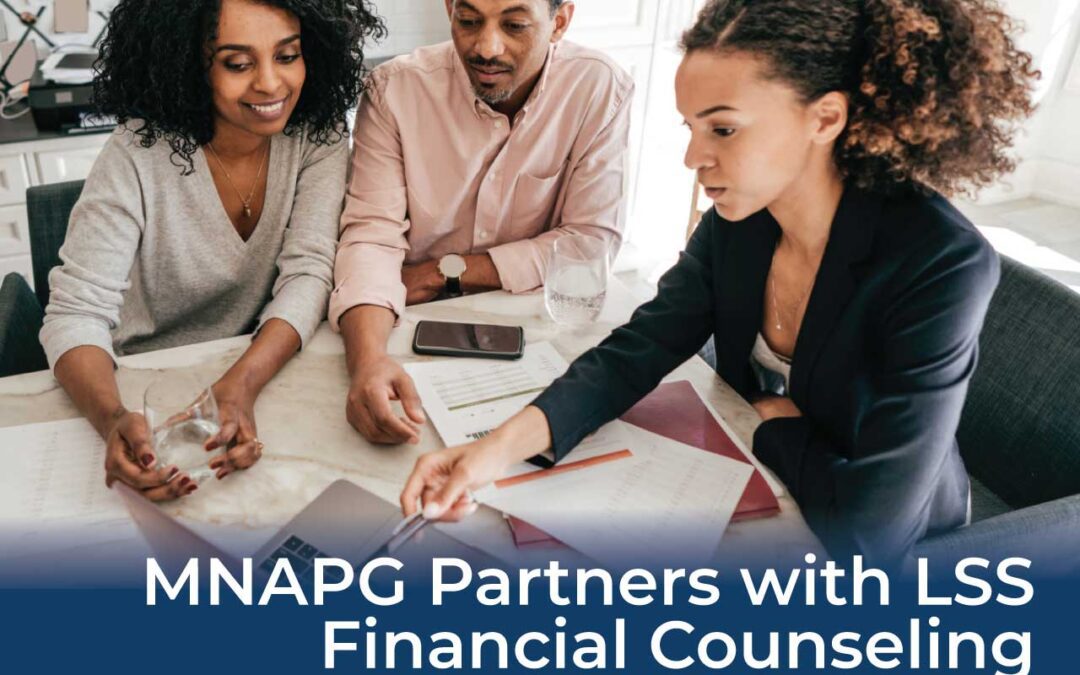
Perhaps no other addiction damages one’s financial resources as much as gambling disorder. Indeed, the ability to regain financial health is a critical aspect of recovery from the addiction. Recognizing the unique interplay between financial discipline and gambling recovery, MNAPG is excited to share a new and valuable resource for those experiencing issues from gambling — whether for the gambler or a family member affected by the gambler’s behavior. Starting in October, MNAPG began offering specialized financial counseling through the Financial Choice services of LSS Financial Counseling. This joint effort pairs the financial expertise of LSS counselors with the problem gambling awareness training offered by MNAPG. Those who take advantage of this service will meet with a financial counselor who understands how gambling can negatively impact an individual or family’s finances. This benefit provides access to six free and confidential financial counseling sessions. These sessions provide the guidance and support needed to address financial challenges brought on by problem gambling and to chart a path forward to financial stability. The experienced and non-judgmental counselors at LSS Financial Counseling can help: · Assess one’s current financial situation · Create a personalized budget and debt management plan · Develop strategies to avoid future financial pitfalls · Set and achieve long-term financial goals Sessions are available in person, by phone or online — whichever is most comfortable. Those interested in taking advantage of this free service should contact LSS Financial Counseling at 800-528-2926 and mention assistance for problem gambling to schedule an appointment. LSS Financial Counseling is an experienced nonprofit, full-service credit counseling agency.
Upcoming Conference Opportunities — Save the Date
Minnesota Conference The Minnesota Conference on Problem Gambling takes place on Thursday, Sept. 19 at the Hilton Minneapolis/Bloomington. While we’re still finalizing the day’s sessions, here are some topics we plan to cover:- The intersection of gambling and suicide
- Financial counseling for families
- The impact of gambling on families
- Community leader panel discussion about gambling
- Update on sports betting legislation
- National gambling attitudes survey results