Apr 7, 2026 | PROBLEM GAMBLING, RESOURCES
Sweepstakes casinos have grown rapidly in recent years, offering online slot machines, poker and other casino-style games without describing themselves as traditional gambling. While they are often marketed as “free-to-play entertainment,” their structure has raised questions among regulators, public health professionals and policymakers.
How sweepstakes casinos work
At first glance, sweepstakes casinos look similar to real-money online casinos. Players sign up, choose games and spin reels or play table games. The key difference is the use of a dual-currency system.
Most platforms offer two types of virtual coins:
- Gold Coins – used only for entertainment play and have no cash value
- Sweeps Coins – used for promotional games and can be redeemed for cash or prizes
Players typically receive Sweeps Coins as a bonus when they purchase Gold Coin packages. They may also obtain Sweeps Coins through free methods such as daily login bonuses, promotions or mail-in requests (often called an Alternate Method of Entry). Because there is always a free way to participate, operators argue that no purchase is required.
This structure is designed to avoid the legal definition of gambling, which generally requires three elements: prize, chance and consideration (payment). By offering a free entry option, sweepstakes casinos attempt to remove the “consideration” element.
Why many view them as gambling
Despite the legal framing, critics argue that sweepstakes casinos function much like traditional gambling for these reasons:
- Games rely on chance and offer real-world prizes.
- Players often purchase virtual currency in practice, even if technically optional.
- The purchase of Gold Coins frequently includes bonus Sweeps Coins, which can be redeemed for cash, creating a financial incentive to spend.
Regulators have described the two-currency model as a way to disguise paid gambling activity. In Minnesota, officials noted that consumers who appear to be buying entertainment currency are effectively purchasing access to prize-eligible play.
Research and surveys also indicate that many users participate with the intention of winning money, reinforcing concerns that the experience mirrors gambling behavior.
Legal and regulatory concerns in Minnesota
Minnesota has taken a particularly strong stance. In 2025, the Attorney General ordered multiple sweepstakes casino operators to stop offering services in the state, stating that such platforms may violate gambling and consumer protection laws.
State officials emphasized several risks, claiming:
- These sites operate outside Minnesota’s regulated gambling system
- Most are based out of state or overseas, limiting oversight
- Players lack protections such as fair-play audits, reliable payouts or dispute resolution
Because the activity is unregulated, it also generates no state tax revenue and does not contribute to programs typically funded by legal gambling, such as public services or problem gambling prevention.
Why the issue matters
Sweepstakes casinos exist in a legal gray area nationwide, but Minnesota’s actions reflect growing concern. When casino-style gambling operates outside regulatory frameworks, states lose both consumer safeguards and public revenue, while residents face potential financial and behavioral risks.
For policymakers and prevention professionals, sweepstakes casinos highlight a broader challenge: as gambling-like products evolve online, the line between entertainment and wagering becomes increasingly blurred. Clear regulation, consumer education and ongoing monitoring will be critical to ensure that emerging gaming models do not bypass the protections and public benefits that accompany legal, regulated gambling.

Apr 7, 2026 | PROBLEM GAMBLING, RESOURCES, YOUTH GAMBLING
As legalized sports betting and digital wagering continue to expand, gambling has become a routine part of life for many young adults. For colleges and universities, this shift raises an important question: how can campuses help students make informed choices and avoid gambling-related harm?
Dr. Michelle L. Malkin, assistant professor at East Carolina University, is working to answer that question through The Betting Blueprint, a wellness-oriented curriculum designed specifically for students ages 18–24. Her approach combines screening, education, financial wellness and early intervention to reduce risk and support healthier decision-making.
Start with awareness and screening
One of the key messages from Dr. Malkin’s work is that screening should be ongoing, not limited to a single awareness campaign. While March’s Problem Gambling Awareness Month provides an important opportunity for outreach, students engage in gambling year-round. Ideally, campuses host multiple screening efforts, including events early in the fall semester and again in March when March Madness increases betting activity.
Peer-led outreach has proven especially effective. Students are more likely to participate when encouraged by their peers and when screening is quick and accessible, such as through a QR code completed on a phone. Brief screening tools that use clear language like “betting and/or gambling” help identify students who may be experiencing harm and connect them with resources before problems escalate.
Redefining what gambling looks like
The curriculum challenges students’ assumptions about gambling, as many young adults associate gambling only with casinos or money-based games. In reality, gambling includes any activity involving something of value and an element of chance.
Today’s gambling landscape includes, but is not limited to, sports wagering, fantasy sports, prediction markets, loot boxes, esports, cryptocurrency speculation, in-play betting and social gaming features. By broadening students’ understanding, the curriculum helps them recognize behaviors they might not otherwise identify as gambling.
The curriculum also explores why some individuals struggle to gamble responsibly. For certain people, brain responses to rewards can lead to chasing losses, overconfidence or difficulty stopping. Students learn to recognize warning signs such as borrowing money, hiding gambling or continuing despite negative consequences.
Importantly, the focus is not prohibition. Instead, the curriculum promotes lower-risk strategies for those who choose to gamble: setting time and money limits, avoiding gambling when stressed or emotional, understanding the odds and using responsible gambling tools available on many platforms. Students also learn that gambling harms extend beyond the individual, affecting roommates, partners, family members and others.
Financial wellness at the center
Another important aspect of The Betting Blueprint is connecting gambling decisions to financial health. Many students have limited experience managing money, making them particularly vulnerable to overspending on entertainment, including betting.
Through budgeting exercises and real-life scenarios, students explore what financial wellness means and how to give every dollar a purpose. They learn to identify priorities, track income and expenses, and distinguish between appropriate entertainment spending and high-risk funding sources such as borrowed money, financial aid or credit card debt.
A key point is that gambling winnings should never be treated as income. Activities encourage students to track results over time, understand variability and consider how unexpected wins or loses affect long-term goals. The emphasis is on building habits that support stability and reduce financial stress.
Students as problem solvers
A distinctive feature of the curriculum is its interactive design. Small-group activities ask students to respond to common beliefs, such as “I can win back my losses” or “My gambling is under control.” By researching data and developing peer-focused messages, students generate their own solutions rather than being lectured.
This collaborative approach increases engagement and helps shift campus norms around gambling.
Meeting Students at a Critical Time
College campuses provide a unique environment to reach emerging adults during a formative period. Dr. Malkin’s work highlights the importance of integrating gambling awareness into broader wellness efforts, including mental health, substance use prevention and financial education.
As gambling opportunities continue to grow, so does the need for practical, student-centered prevention. With ongoing screening, peer engagement and a focus on financial and personal well-being, The Betting Blueprint offers campuses a proactive way to help students make informed choices and avoid harm—long before problems take hold.
The information in this article was taken from Dr. Malkin’s presentation at the MNAPG conference last November. For more information about the curriculum, please contact Dr. Malkin at malkinm20@ecu.edu.

Mar 31, 2026 | ABOUT MNAPG, ADVOCACY
March is Problem Gambling Awareness Month, and this year MNAPG staff spent the month sharing information about problem gambling as a public health issue across Minnesota and beyond. From radio and TV interviews to newspaper features and podcast appearances, we reached communities statewide with resources, warning signs and support options.
Here is a recap of our media appearances throughout the month:
Radio
WCCO Radio (Appearance 1) — March 3, 2026
WCCO Radio (Appearance 2) — March 16, 2026
WDKE — March 16, 2026
MPR — March 23, 2026
Television
KVRR — March 4, 2026
St. Cloud Live — March 7, 2026
WCCO-TV — March 9, 2026
KAAL-TV— March 19, 2026
KTTC-TV— March 20, 2026
FOX — March 20, 2026 (segment begins at 12:10)
Online and Print
WCCO Online — March 19, 2026
Grand Rapids Herald
Duluth News Tribune (Letter to the Editor) — March 26, 2026
Podcasts
StribSports Daily Delivery, Star Tribune — March 19, 2026 Susan Sheridan Tucker joined host Michael Rand to discuss prediction markets and why platforms operating like sports betting sites are accessible even in states where sports betting is not yet legalized.
MPR News Presents — March 23, 2026 Host Catharine Richert and guests explored the impact of online sports betting and prediction markets on Minnesotans.

Feb 21, 2026 | RESEARCH, YOUTH GAMBLING
Read the original article on The BASIS.
By John Slabczynski
Gambling can create financial, social, psychological, and physical harms. Of particular concern is suicidality, which recent research has identified as a potential gambling harm. As we undergo worldwide gambling expansion, it is imperative that public health experts and the gamblers themselves know more about this link, including whether problem gambling predicts future suicidality. This week The WAGER reviews a study by Oliver Bastiani and colleagues that explored the relationship between problem gambling and suicidality among the same participants over time.
What were the research questions?
Do gambling problems predict future suicidality?
What did the researchers do?
The researchers used data from the Avon Longitudinal Study of Parents and Children, a United Kingdom-based birth cohort study. They limited their analysis to data collected from 2,801 participants who completed assessments between the ages of 16 and 25. During these years, participants provided information on their suicidality and gambling problems. The researchers used logistic regression to examine whether having gambling problems at age 20 or 24 increased the odds of reporting past-year suicide attempts at age 24 or 25, controlling for some known risk factors such as sex, alcohol consumption/harms, and previous suicide attempts.
What did they find?
Most participants reported no problem gambling at both age 20 (70.4%) and age 24 (76.5%). Approximately 2.6% reported a past-year suicide attempt at age 24 and 1.9% did so at age 251. Problem gambling severity at age 24 was associated with increased odds of past-year suicide attempt at the same age. Longitudinal analyses revealed that problem gambling at age 20 was predictive of past-year suicide attempts at age 24 but not at age 25. On a shorter timespan, problem gambling at age 24 predicted past-year suicide attempts at age 25. (See Figure.)
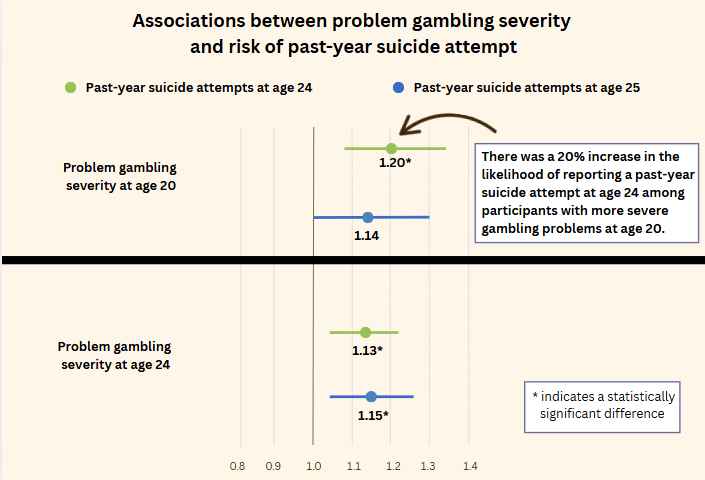 Figure. Displays the odds of reporting past year suicidality at ages 24 and 25 by problem gambling severity at ages 20 and 24. Odds ratios can be interpreted as having X times higher odds of reporting an event. For example, a one-point increase in problem gambling severity (e.g., answering “most of the time” instead of “sometimes” on one question) at age 24 was associated with having 1.13 times higher odds of reporting past year suicidality at age 24.
Why do these findings matter?
These findings provide more support for the idea that problem gambling contributes to future suicidality, because in this study, problem gambling preceded suicide attempts. Because problem gambling can be detected and managed at an early stage, it is essential to spread the word about brief gambling screening to healthcare providers and anyone else in a position to intervene, such as college health services staff and debt counselors. Furthermore, public health advocates can use this information to more effectively advocate for preventive tools like mandatory cool-off periods, which can disrupt gambling flow states and discourage long sessions, or tighter regulations on gambling and gambling advertising.
Every study has limitations. What are the limitations in this study?
The relationship between problem gambling and suicidality is probably more complicated than a single study can reveal. For instance, this study did not explore the possibility that suicidality predicted future problem gambling (i.e., reverse causality), which might happen if people develop gambling problems while trying to escape from painful suicidal thoughts. Another complication is that problem gambling tends to occur alongside depression, anxiety, and illicit drug use, which the researchers were unable to control for, and which might have partly accounted for the relationships with suicide attempts.
Figure. Displays the odds of reporting past year suicidality at ages 24 and 25 by problem gambling severity at ages 20 and 24. Odds ratios can be interpreted as having X times higher odds of reporting an event. For example, a one-point increase in problem gambling severity (e.g., answering “most of the time” instead of “sometimes” on one question) at age 24 was associated with having 1.13 times higher odds of reporting past year suicidality at age 24.
Why do these findings matter?
These findings provide more support for the idea that problem gambling contributes to future suicidality, because in this study, problem gambling preceded suicide attempts. Because problem gambling can be detected and managed at an early stage, it is essential to spread the word about brief gambling screening to healthcare providers and anyone else in a position to intervene, such as college health services staff and debt counselors. Furthermore, public health advocates can use this information to more effectively advocate for preventive tools like mandatory cool-off periods, which can disrupt gambling flow states and discourage long sessions, or tighter regulations on gambling and gambling advertising.
Every study has limitations. What are the limitations in this study?
The relationship between problem gambling and suicidality is probably more complicated than a single study can reveal. For instance, this study did not explore the possibility that suicidality predicted future problem gambling (i.e., reverse causality), which might happen if people develop gambling problems while trying to escape from painful suicidal thoughts. Another complication is that problem gambling tends to occur alongside depression, anxiety, and illicit drug use, which the researchers were unable to control for, and which might have partly accounted for the relationships with suicide attempts.

Jan 29, 2026 | PROBLEM GAMBLING, RESEARCH, SPORTS BETTING, YOUTH GAMBLING
Read the original article on The BASIS here.
By John Slabczynski
As legalized sports betting grows in popularity, public health experts have raised concerns about its potential harms. As advertisers and sports leagues continue to make gambling a key part of spectatorship, this could normalize betting as a natural part of sports fandom. Previous research suggests that these practices are contributing to an increase in gambling problems, particularly among young adults. To better address these concerns, public health advocates need to understand the specific problems associated with young adult sports betting. This week, The WAGER reviews a study by Nerilee Hing and colleagues that explored young adult sports bettors’ experiences of gambling harm and their perspectives on changing their gambling behavior.
What were the research questions?
(1) How do young adult sports bettors experience gambling harms? (2) How do they conceptualize and engage in changing harmful gambling?
What did the researchers do?
The researchers recruited 50 Australians between the ages of 18 and 25 who reported experiencing moderate or severe harm from sports betting in the past year. Participants completed interviews with the research team that asked about the nature of sports betting-related harms they experienced, perceived barriers and facilitators of gambling behavior change, and strategies they used to change their gambling. The researchers then coded the transcribed interviews to identify relevant themes.
What did they find?
The interviews revealed five distinct types of sports betting-related harm: 1) financial harm, 2) harm to mental health, 3) harm to work or study, 4) relationship harm, and 5) harm to physical health. Participants reported that many of these harms built up over time and intersected with one another. For example, several participants indicated that financial harms grew over time, and that these harms worsened their mental health. At the time of interviews, some participants were unwilling to change their gambling behavior. Others, however, pointed to improved knowledge of gambling disorder and an awareness of gambling harms as key factors in choosing to change their harmful behavior (see Figure).
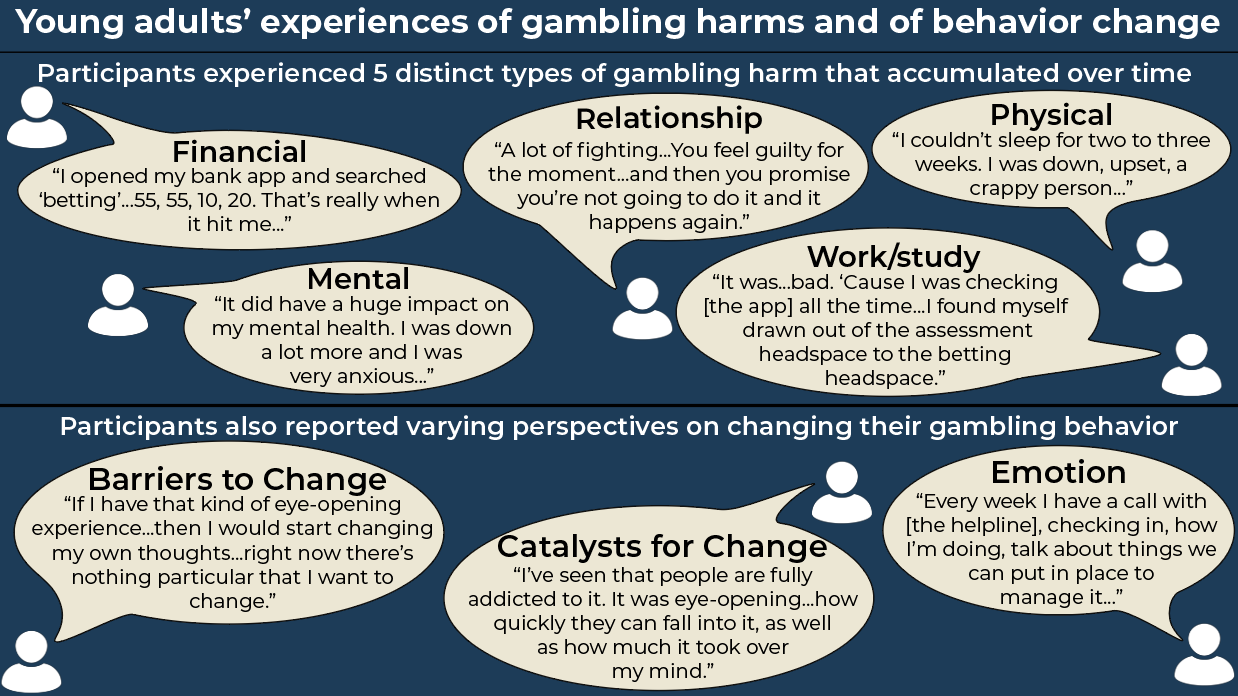 Figure. Displays participant quotes representing each theme identified through thematic analysis. Click image to enlarge.
Why do these findings matter?
Information on the types of harm experienced by young adult sports gamblers can help public health practitioners identify potential gambling problems quickly and accurately, allowing for timely intervention and support before more significant harms happen. This study’s findings on behavior change are especially important. Many participants emphasized the value of awareness of gambling as an addiction as a catalyst for behavior change. Initiatives such as The Faces of Gambling that highlight how gambling problems develop from the perspective of people with lived experience may be especially effective in reducing the prevalence of gambling harms.
Every study has limitations. What are the limitations in this study?
This study screened participants for a history of experiencing gambling harms using a list of previously researched harms, which may have primed the sample to report these very same types of harm. Similarly, because the study focused on moderate to severe cases of gambling disorder among young adults, the results of this study may not be generalizable to those who experience less severe forms of the condition, or the wider gambling population.
Figure. Displays participant quotes representing each theme identified through thematic analysis. Click image to enlarge.
Why do these findings matter?
Information on the types of harm experienced by young adult sports gamblers can help public health practitioners identify potential gambling problems quickly and accurately, allowing for timely intervention and support before more significant harms happen. This study’s findings on behavior change are especially important. Many participants emphasized the value of awareness of gambling as an addiction as a catalyst for behavior change. Initiatives such as The Faces of Gambling that highlight how gambling problems develop from the perspective of people with lived experience may be especially effective in reducing the prevalence of gambling harms.
Every study has limitations. What are the limitations in this study?
This study screened participants for a history of experiencing gambling harms using a list of previously researched harms, which may have primed the sample to report these very same types of harm. Similarly, because the study focused on moderate to severe cases of gambling disorder among young adults, the results of this study may not be generalizable to those who experience less severe forms of the condition, or the wider gambling population.