Dec 17, 2025 | HELP, PROBLEM GAMBLING, RECOVERY, STORIES
I’m 42 years old, and I never thought gambling would take over my life the way it did. Growing up, I played lotto tickets occasionally, but it was harmless, nothing more than a little game. I could walk away without a second thought. Gambling didn’t become a real problem until about 10 years ago, and even then it wasn’t because I suddenly developed a taste for it. It was because of a medication.
I was diagnosed with bipolar disorder and put on a drug called Latuda. At the time, I didn’t know that one of its rare side effects was compulsive gambling. It’s right there in the warnings, but no one ever told me. Looking back, it feels like a switch flipped in my brain. All of a sudden, I couldn’t stop.
Poker and electronic machines became my games of choice. Omaha, Hold ’Em, slots and electronic pulltabs, which were a real curse for me. I could be up thousands of dollars, but by midnight it was gone. Friends and family would urge me to cash out, but I couldn’t.
The first time I realized I was addicted to gambling was in 2016. But I didn’t talk to a therapist about it until years later. By then, gambling had already destroyed so much of my life. It pushed me into doing things I never imagined myself capable of. I borrowed money I couldn’t repay, stole from people I loved and even stole credit card information from a friend on her deathbed.
My addiction led me to commit aggravated armed robbery. I was preparing to go to treatment at Project Turnabout, waiting for medical records to clear, and in the middle of that chaos I made a bad decision. I got caught and went to prison for 33 months. I asked the judge to send me to treatment instead, but he wouldn’t.
There are no real gambling programs in the prison system, and I struggled in there. Gambling is everywhere—sports bets, high-stakes spades games, etc.—with considerable money moving through canteen accounts. The system hides it from the outside world, but it’s real. I even talked with a chaplain about starting a GA group inside the prison. He told me, “If you can find a volunteer, we’ll do it.” But no one ever stepped up.
Since getting out, I’ve been working with a counselor through Club Recovery. I’ve had stretches of abstinence—four months clean at one point—but I’ve struggled too. I even put Gamban on my phone to block gambling apps, but then I bought a new phone so I could gamble again. That’s how strong the pull can be. But I’ve realized I can’t be a hypocrite. If I want to help others, I have to stay clean myself.
I’m starting a new Gamblers Anonymous group in Little Falls. Zoom meetings didn’t work for me—they didn’t feel personal enough. I wanted a place where people could sit down face-to-face, look each other in the eye and admit what’s really going on. There’s an epidemic of gambling up there. People buy pulltabs by the box, yet most don’t think of gambling as a real addiction.
That’s bullshit. I know firsthand how destructive it is.
Starting the GA group wasn’t easy. I had to call GA International, get a starter kit, work with the library to secure space, put flyers up in hospitals, bars, even in the local paper and radio. But it matters. These programs hold me accountable, and hopefully they’ll give others the same chance.
I’ve thought about suicide from time to time. But one day, a driver told me about his best friend who killed himself because of gambling. Hearing that cracked me open. I teared up in the car and knew it was time for me to step up—for myself, for others and for my family.
Thanks to gambling, I’ve lost a lot—money, relationships, trust. Some of those losses I’ll never get back. But I’m trying to move forward. I want to bring GA into prisons. I want to write a blog about addiction and suicide. I want to make sure others know they’re not alone, and that gambling addiction is every bit as real and dangerous as alcohol or drugs.
I can’t change the past, but I can use it. If sharing my story helps one person stop before they lose everything, then it’s worth it.

Dec 17, 2025 | RESEARCH, RESOURCES
The National Council on Problem Gambling (NCPG) has released new findings from its National Survey on Gambling Attitudes and Gambling Experiences (NGAGE 3.0), offering an updated picture of how Americans are gambling—and what they believe about gambling.
The first NGAGE survey was conducted in 2018, just as states began legalizing sports betting following a landmark Supreme Court decision that opened the door for rapid expansion across the country. A follow-up survey in 2021 revealed a sharp increase in risky gambling behavior. At the time, researchers weren’t sure whether the spike reflected the spread of sports betting or the stress and isolation from the COVID-19 pandemic.
The 2024 survey, conducted after pandemic restrictions had largely lifted, shows that gambling-related risks have stabilized. About 8% of U.S. adults—nearly 20 million people—reported experiencing at least one sign of potentially problematic gambling “many times” in the past year. That number is down from 11% in 2021 but still higher than the 7% reported before sports betting became widely available.
“While it’s reassuring that the increases in problematic gambling behavior we saw in the 2021 survey seem to have abated along with the easing of the COVID-19 pandemic, maladaptive gambling remains a significant public health problem,” says Don Feeney, who helped design the NGAGE surveys. “Increased efforts at prevention and education are essential if we are to reduce gambling-related harm.”
The survey also sheds light on who is most at risk. Younger adults, men, online gamblers and sports bettors were among the groups most likely to report signs of risky play. Those who gamble frequently or participate in many different gambling activities are especially vulnerable.
“The best predictors of a gambling problem aren’t participation in any particular form of gambling,” explains Don. “Instead, the best predictors are the intensity of gambling involvement—how frequently someone is gambling—and the breadth of involvement—how many different forms of gambling someone is involved with.”
Even as legalized sports betting has expanded to 39 states, Washington, D.C. and Puerto Rico, the overall share of Americans placing sports bets has remained steady at about 23%. However, the ways people are betting are changing. The number of sports bettors making parlay bets—wagers that combine multiple outcomes for the chance of a large payout—has nearly doubled since 2018. Researchers note that these types of bets can be especially appealing to those trying to “win back” losses quickly, a pattern often associated with risky play.
Another key finding involves public attitudes toward gambling addiction. While nearly three in four adults agree that gambling addiction is similar to drug or alcohol addiction, fewer than 40% consider its consequences “very severe.” Many still believe gambling problems stem from a lack of willpower or moral weakness rather than recognizing them as treatable health conditions.
There is, however, some encouraging progress. Awareness of problem gambling helplines has increased, and most people understand that helplines exist to help people struggling with gambling problems.
“We’ve learned that we can improve awareness that there’s help for a gambling problem, and that awareness is greatest among those most in need of receiving services,” says Don. “However, these are the same people who are most skeptical that treatment works. We need to make the effectiveness of treatment an integral part of our message.”
Despite the progress, challenges remain. Public funding for problem gambling services has increased—from about $80 million in 2018 to $134 million in 2023—but seven states still provide no funding at all. On average, states spend just 35 cents per resident on prevention, education and treatment programs.
Continued investment and public awareness are critical to preventing gambling-related harm. Prevention and education work, but more people need to understand that help works too—and that recovery from gambling problems is possible.
The survey underscores that even as gambling becomes more common, many people still misunderstand the risks. Open discussion about gambling addiction, promoting the effectiveness of treatment and making help easy to find is necessary to keep gambling a form of entertainment rather than a source of harm.

Dec 17, 2025 | PROBLEM GAMBLING
For many problem gamblers, tax season delivers an unwelcome surprise: a hefty bill on gambling winnings they may no longer have. It’s also often the moment when friends or loved ones first learn the full extent of the gambling.
The problem usually comes to light after the government audits winnings reported by casinos or other gambling entities. “Some gamblers may even face criminal charges for not paying the government and may have already spent their winnings,” says Matthew Wildes, a tax attorney and CPA with Wildes At Law in Roseville.
Why Minnesota gamblers are hit especially hard
A major driver of these unexpected debts in Minnesota is the state’s alternative minimum tax (AMT). Unlike current federal rules, Minnesota’s AMT does not allow gamblers to offset winnings with losses. “AMT is based on gross income,” explains Matthew. “Once your income reaches a certain level, the state labels you a high-income earner, which limits your deductions.” The system, he notes, was designed back when gambling was still illegal in the state.
The impact can be devastating. “I once had a client whose winnings created a tax bill of about $100,000—more than his $70,000 in annual wages,” says Matthew.
Matthew is now challenging the law in court, arguing it violates Minnesota’s Uniformity Clause, which requires that taxpayers in the same category be treated equally. “Essentially, we’re saying the law discriminates against those with a gambling addiction,” he explains.
Strategies that can help
In defending clients, Matthew has identified ways to soften the blow. One is using the “session method” of accounting, an IRS-approved strategy that allows gamblers to report net results over a session—such as a day—rather than every single jackpot. For example, a gambler who wins big but also loses on the same day can report lower net winnings, reducing taxable income.
Casinos often track this information through player card systems. “Players who are registered with a casino usually have access to detailed records of their daily wins and losses,” Matthew says. “Having this documentation can reduce a gambler’s tax liability by thousands of dollars.”
Matthew keeps a record of which casinos provide these reports and urges clients to obtain them. “Getting this information on the front end is beneficial—whether you’re working with a professional tax preparer or trying to avoid problems that could escalate later,” he says.
In contrast to recreational gamblers, professional gamblers keep better records of daily wins and losses, lowering their tax bills. In fact, professional gamblers are not subject to the AMT law because, as a business, they can legally claim deductions for their losses. Matthew says that some gamblers try to fake being professional so they can take advantage of these benefits.
A call for fairness
Unlike criminal courts, where gambling addiction can sometimes reduce penalties or lead to treatment-focused alternatives, tax courts offer no such flexibility.
“From a public policy perspective, the Department of Revenue needs to be more lenient before cases like these go to tax court,” says Matthew. “There needs to be greater understanding of the hidden issues at play.”

Dec 17, 2025 | PROBLEM GAMBLING
Note: Much of the information included in this article is taken from a presentation by Glenn Yamagata, vice president of Data Science and Economic Analysis and senior consultant with Problem Gambling Solutions, Inc., executive director of the Oregon Council on Problem Gambling, and member of the National Council on Problem Gambling Board of Directors.
For many of us, digital assets, including cryptocurrencies, are something we’ve heard of but don’t fully understand. The same is true for Oregon Health Authority problem gambling treatment providers: 94% reported needing additional training to better address clients engaged in non-traditional forms of gambling, such as digital asset trading. Some providers indicated that as many as half of their clients are already involved in these activities. Therefore, developing a basic understanding of digital assets and how they function can be valuable, much like a therapist treating individuals who wager on sports benefits from knowing key sports betting terminology.
Common digital assets include e-books and digital art that are accessed online. However, the digital assets discussed in this article refer specifically to blockchain-enabled assets, such as cryptocurrencies. The blockchain is a type of electronic ledger with key features such as transparency, security and decentralization, which can be complex to understand. The essential point is that blockchain technology has made it possible to create new forms of digital assets that, in some cases, enable gambling-like behavior and may contribute to gambling problems for some individuals.
Cryptocurrencies
A cryptocurrency is a digital asset built on a blockchain, with the oldest, largest and most recognized example being Bitcoin. Some individuals engage in day trading or swing trading of cryptocurrency assets in ways similar to how they trade traditional assets such as stocks or bonds. However, cryptocurrency trading can be particularly addictive for several reasons.
- Trading hours:Unlike traditional financial markets, cryptocurrencies trade 24 hours a day, 7 days a week, 365 days a year. This constant availability creates endless opportunities to trade and can facilitate impulsive or compulsive behaviors.
- Market volatility: Cryptocurrencies often experience much greater price fluctuations than traditional assets, generating heightened excitement and anticipation among traders, which can reinforce risk-taking and reward-seeking behaviors.
- Speculative nature: High price volatility, limited fundamental valuations, regulatory uncertainty and the general characteristics of emerging markets make cryptocurrency trading more speculative and attractive to some individuals.
- Higher leverage: Cryptocurrency markets often allow for significantly higher leverage, sometimes 50 to 100 times the initial investment. This means individuals can amplify their gains (or losses) by a much greater multiple than is typically possible with traditional financial products.
Based on the Oregon Gambling Attitudes, Behaviors, Health and Risk Survey (2025), a report commissioned by the Oregon Council on Problem Gambling, adult Oregonians who engaged with cryptocurrencies were six times more likely to be classified as high risk for gambling disorder, as measured by the Problem Gambling Severity Index (PGSI).
Non-fungible tokens (NFTs)
Common NFTs include digital media such as music and visual art, where creators assign uniqueness to the work, similar to how a musician might sign an album cover or a photographer might add a personalized note to a print to make it one of a kind. This uniqueness increases the asset’s value, allowing it to be traded, as seen when the artist Beeple sold a digital collage of 5,000 individual artworks for $69 million at Christie’s Auction House in 2021.
NFTs are increasingly being introduced across a variety of asset forms and within gaming environments, creating new opportunities for speculative and gambling-like behavior. Some examples include:
- Gaming currency: NFTs are used as a means to make wagers in online casinos, replacing traditional methods such as credit cards and bank transfers. The advantages include player anonymity, low transaction fees and global accessibility without the need for fiat currency exchange.
- Prizes: NFTs can serve as prizes that have the potential to appreciate in value, making them especially attractive to players who see an opportunity for ongoing financial gain.
- Player-to-player payment option: NFTs have become a suitable payment method for transactions carried out between players; the transactions are viewed as safe, secure, anonymous and do not require a third party.
- Loyalty program awards: Online casinos use NFTs for customer acquisition and to incentivize loyalty. As unique digital assets, NFTs can serve as a differentiating factor that attracts and retains customers.
NFTs are connected to problem gambling behaviors through speculative activity, such as the short-term buying and selling of digital assets, and by enabling gambling-like ecosystems, including virtual casinos.
Decentralized finance (DeFi) applications
Decentralized finance (DeFi) applications are financial systems that enable individuals to transact directly with one another, without intermediaries such as banks. Many rely on self-executing “smart contracts,” in which financial terms are codified and stored on the blockchain.
DeFi platforms can foster gambling-like behavior by offering a highly speculative, largely unregulated environment that is easily accessible. They blend elements of cryptocurrency trading, prediction markets and gaming, blurring the line between investing and gambling.
Conclusion
The cryptocurrency, NFT and DeFi markets continue to grow rapidly. The cryptocurrency market alone is currently valued at around $3 trillion and is expected to expand significantly over the next decade. As these markets evolve, it is likely that more individuals will seek help from therapists for gambling-like addictions. Treatment providers would be well advised to develop at least a general understanding of these emerging platforms to better recognize and address the risks they pose.
Nov 26, 2025 | PROBLEM GAMBLING, YOUTH GAMBLING
Read the original article on the BASIS here.
By Kira Landauer, MPH
Livestreaming is a popular form of digital entertainment that allows viewers to watch content online as it happens live. Gambling livestreams are popular on platforms like Twitch and TikTok Live, where streamers broadcast themselves gambling with real money and in real time—playing games like online slots or placing sports bets. Audiences can watch the gameplay, listen to the streamer’s commentary, and interact directly with both the streamer and other viewers. What may seem like harmless fun could be problematic for some, with research linking gambling livestream viewership to future gambling intentions and problem gambling. This week, as part of our Special Series on Addiction and Technology, The WAGER reviews a study by Chelsea Hughes and colleagues that examined young adults’ experiences with and perceptions of gambling livestreaming.
What were the research questions?
(1) What motivates young adults to watch and engage with gambling livestreams? (2) How do they perceive their livestream viewing experiences?
What did the researchers do?
The researchers conducted semi-structured interviews with 15 young adults (ages 18 to 24) in the U.K. who regularly watched gambling livestreams (at least once a week) and had gambled in the past year. Participants described their reasons for watching, how they engaged with the livestreams, and their experiences as a viewer. Using thematic analysis, the researchers identified themes related to the meaning and value viewers attributed to their experiences.
What did they find?
The researchers identified three themes (see Figure).
- Social experiences and vicarious excitement describes the parasocial bonds viewers formed with streamers. Even as observers, viewers felt they were sharing in the streamer’s risk-taking and excitement, which created a sense of emotional connection. Many watched not only for gambling content but because they enjoyed the streamer’s personality.
- Interactivity and building loyalty highlights how livestream features—like gamified loyalty (earning points for engaging with the stream) and interactive prediction tools (wagering points on outcomes)—encouraged viewers to participate and feel more invested in the livestream’s outcomes.
- The urge and harm paradox reflects how participants viewed livestreams as a safer way to manage gambling urges, even though watching sometimes intensified those same urges. Some reported that watching livestreams contributed to an increase in their own gambling participation, despite recognizing the influence of streamers’ deceptive marketing tactics.
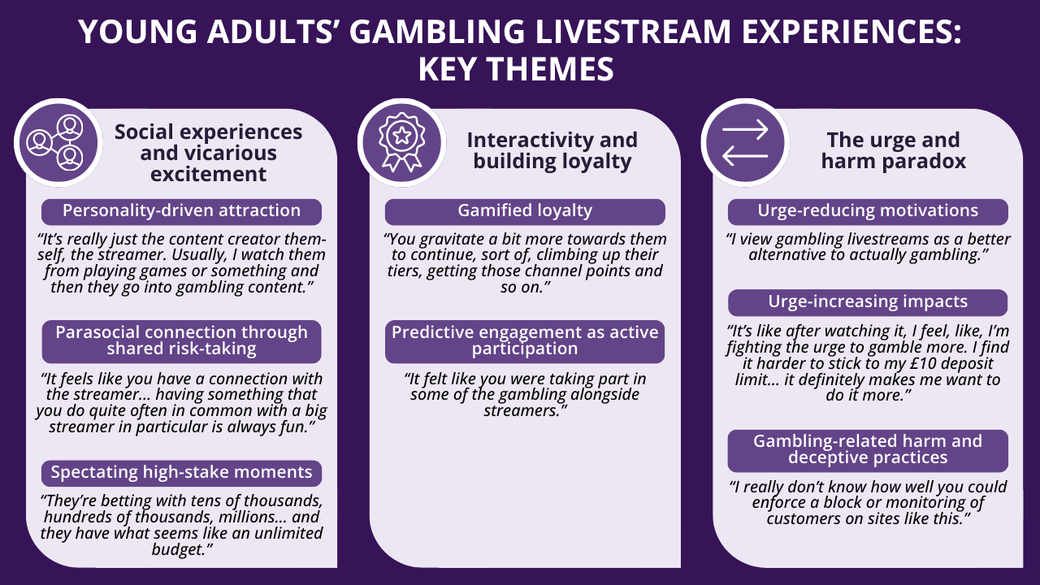 Figure. Key themes from young adults’ gambling livestream viewership, with quotes highlighting each subtheme. Click image to enlarge.
Why do these findings matter?
These findings show that young adults are drawn to gambling livestreams for various, often intertwined, reasons. Many viewers feel a personal connection to their favorite streamers. This sense of social connection and community is enhanced by interactive, gamified livestream features that encourage viewer engagement. These findings can inform regulatory policies intended to reduce potential harms. For example, streaming platforms might limit or ban gambling livestreams, or restrict gambling operators from advertising through streamers. The study also indicates that watching these streams is not a reliable way to manage gambling urges, and that for some viewers it may actually worsen cravings. Gambling treatment providers should be aware of gambling livestreams and factor the effects of watching and engaging in these streams into return-to-gambling prevention planning.
Every study has limitations. What are the limitations in this study?
More than half of the sample gambled frequently (20+ times in the past month) and were high-risk gamblers according to the Problem Gambling Severity Index. Therefore, these findings may not be generalizable to low-frequency or low-risk gamblers, or to contexts outside the U.K. where streaming culture, gambling culture, and regulations might differ. Finally, the study cannot determine the causal relationship between livestream viewership and gambling behavior.
Figure. Key themes from young adults’ gambling livestream viewership, with quotes highlighting each subtheme. Click image to enlarge.
Why do these findings matter?
These findings show that young adults are drawn to gambling livestreams for various, often intertwined, reasons. Many viewers feel a personal connection to their favorite streamers. This sense of social connection and community is enhanced by interactive, gamified livestream features that encourage viewer engagement. These findings can inform regulatory policies intended to reduce potential harms. For example, streaming platforms might limit or ban gambling livestreams, or restrict gambling operators from advertising through streamers. The study also indicates that watching these streams is not a reliable way to manage gambling urges, and that for some viewers it may actually worsen cravings. Gambling treatment providers should be aware of gambling livestreams and factor the effects of watching and engaging in these streams into return-to-gambling prevention planning.
Every study has limitations. What are the limitations in this study?
More than half of the sample gambled frequently (20+ times in the past month) and were high-risk gamblers according to the Problem Gambling Severity Index. Therefore, these findings may not be generalizable to low-frequency or low-risk gamblers, or to contexts outside the U.K. where streaming culture, gambling culture, and regulations might differ. Finally, the study cannot determine the causal relationship between livestream viewership and gambling behavior.