
Aug 7, 2024 | PROFESSIONALS, RESEARCH
Read the original article on The BASIS Here.
By John Slabczynski
Despite rising popularity, gambling remains a risky behavior that costs the U.S. an estimated $14 billion annually. One reason these costs are so high is because of the pervasiveness of gambling harms. Like other addictive behaviors, harms from gambling can stretch across multiple domains including social, occupational, health, financial, and even criminal. To minimize gambling harms, it is necessary to identify gamblers who might benefit from self-help tools or professional support, ideally before they experience severe consequences. One available screening tool is the Gambling Harms Scale 10 (GHS-10). One potential weakness of the GHS-10 is that it asks respondents to report whether they’re experiencing each harm using a simple “yes or no” format, rather than allowing them to report on how severely they’re experiencing a given harm. A person’s score is simply the total number of harms they’re experiencing. This week, The WAGER reviews a study by Philip Newall and colleagues that explored the validity of this measure by studying the lived experiences of gamblers in Australia with different levels of problem gambling severity according to the GHS-10.
What was the research question?
Is the GHS-10 a valid gambling harm screener, in that the lived experiences of gamblers relate in a logical way to their scores on the GHS-10?
What did the researchers do?
The researchers re-contacted a sample of 30 individuals from a previous study. These participants were recruited based on problem gambling severity according to scores on the GHS-10 from the previous study. Additionally, all participants were age 18 or older and had reported gambling within the past year. The research team then conducted semi-structured interviews with participants to elicit information about the role that gambling has played in their lives, including positive and negative experiences and harms to themselves and society more generally. The researchers grouped participants according to their GHS-10 scores (no-harm = 0 harms, low-harm = 1-2 harms, moderate-harm = 3-5 harms, and high-harm = 6-10 harms). Then they explored whether those with higher scores described having more severe negative experiences with gambling. This would support the idea that the GHS-10 is a valid measure.
What did they find?
Qualitative perceptions of gambling and experiences of harms were strongly related to participants’ GHS-10 scores (Figure shows themes and selected responses). For example, participants in the no-harm category described gambling as similar to any other leisure activity, with one participant describing the financial impact as the same as “collecting stamps”. In support of the GHS-10’s validity, as GHS-10 scores increased, so too did the propensity for financial harms. At the low-harm level, financial impacts were within reason but could veer towards regrettable. Participants in the moderate harm category occasionally experienced severe financial harms and participants in the high-harm category described significant financial harms. Interestingly, many other themes were present at multiple levels of problem gambling severity (e.g., gambling to build relationships) albeit with some adverse consequences or risk as problem gambling severity increased.
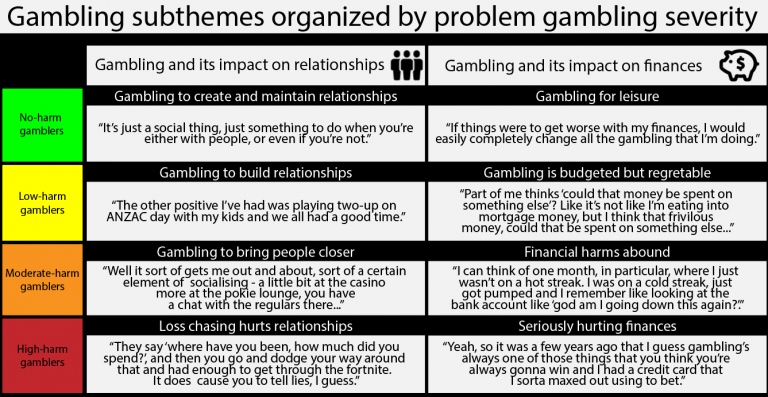 Figure: Displays the subthemes identified by the research team at each level of problem gambling severity, according to the GHS-10. A selected quote is shown under each subtheme that represents one participant’s understanding of each subtheme.
Why do these findings matter?
These findings are important because they provide more evidence for the utility of gambling harm screens, and the GHS-10 in particular. Specifically, this study showed that even without inquiring about the severity of gambling problems, the GHS-10 is able to discriminate between severe and less severe cases. Researchers should consider using this type of mixed methods approach that includes both quantitative and qualitative elements when studying gambling, as it can provide a more holistic view to better understand lived experiences.
Every study has limitations. What are the limitations in this study?
The researchers note that their background as gambling addiction researchers (and beyond that the developers of the GHS-10) might have biased their interpretations of participants’ qualitative responses. Additionally, though the overall sample contained 30 participants, no group of participants (i.e., across the no-harm, low-harm, moderate-harm, and high-harm gamblers groups) included more than eight participants, limiting the generalizability of this study.
Figure: Displays the subthemes identified by the research team at each level of problem gambling severity, according to the GHS-10. A selected quote is shown under each subtheme that represents one participant’s understanding of each subtheme.
Why do these findings matter?
These findings are important because they provide more evidence for the utility of gambling harm screens, and the GHS-10 in particular. Specifically, this study showed that even without inquiring about the severity of gambling problems, the GHS-10 is able to discriminate between severe and less severe cases. Researchers should consider using this type of mixed methods approach that includes both quantitative and qualitative elements when studying gambling, as it can provide a more holistic view to better understand lived experiences.
Every study has limitations. What are the limitations in this study?
The researchers note that their background as gambling addiction researchers (and beyond that the developers of the GHS-10) might have biased their interpretations of participants’ qualitative responses. Additionally, though the overall sample contained 30 participants, no group of participants (i.e., across the no-harm, low-harm, moderate-harm, and high-harm gamblers groups) included more than eight participants, limiting the generalizability of this study.
May 23, 2024 | ABOUT MNAPG, PROBLEM GAMBLING, PROFESSIONALS, RESOURCES
Minnesota Conference
The Minnesota Conference on Problem Gambling takes place on Thursday, Sept. 19 at the Hilton Minneapolis/Bloomington. While we’re still finalizing the day’s sessions, here are some topics we plan to cover:
- The intersection of gambling and suicide
- Financial counseling for families
- The impact of gambling on families
- Community leader panel discussion about gambling
- Update on sports betting legislation
- National gambling attitudes survey results
Please check mnapg.org in the coming months for additional information about the conference as we solidify the agenda.
National Conference
The National Conference on Gambling Addiction & Responsible Gambling takes place in San Diego on July 17-19. The conference brings together world-class presenters to deliver powerful and insightful messages about problem gambling and responsible gambling. For more information and to register, visit ncpgconference.org.
May 23, 2024 | ABOUT MNAPG, ADVOCACY, YOUTH GAMBLING
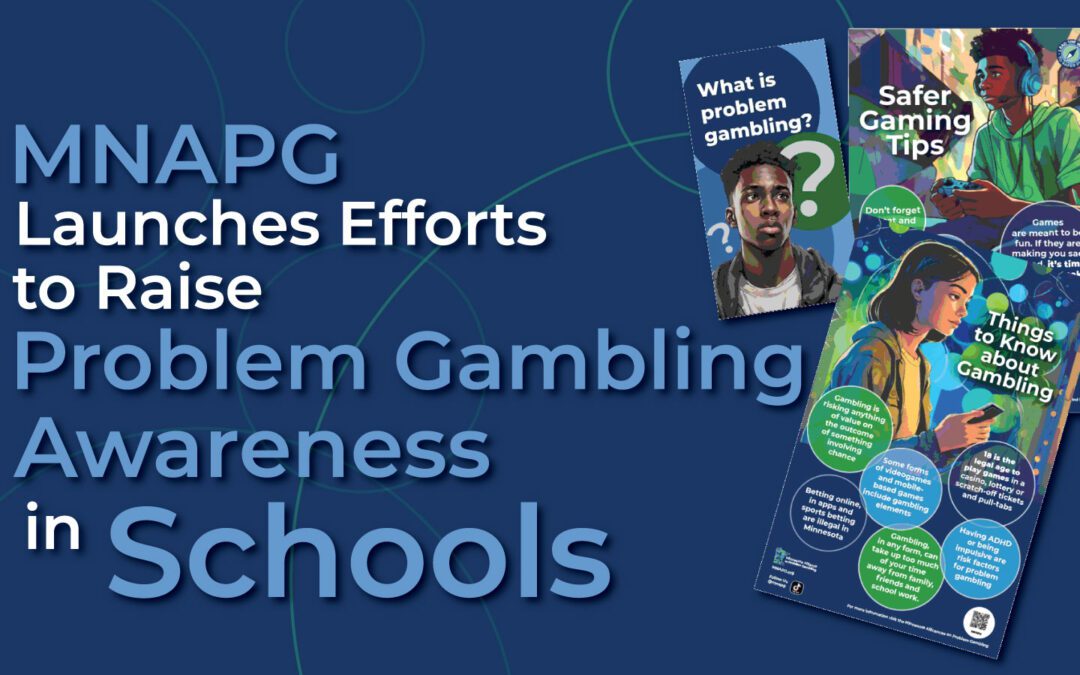
In today's digital age, the allure of online gaming and gambling platforms can be enticing, often leading to harmful consequences for our youth. To help build awareness of these risks, MNAPG has created a toolkit specially designed to help schools raise awareness to students. The dynamic, easy-to-use toolkit helps schools communicate gambling and gaming information in a way that promotes safety and understanding.
 The kit is free and includes materials for staff and parents (brochures and handouts, video links, PA announcements and content for parents) and materials for students (handouts, posters, bookmarks, and social media images and content).
Support is provided to participants at no cost, and includes MNAPG staff support and in-person speaker presentations. The kits benefit students, teachers, school counselors, coaches, PTA members and parents. If you’re interested in learning more about the toolkit, please contact Sonja Mertz at smertz@mnapg.org or visit https://school-toolkit.mnapg.org.
The kit is free and includes materials for staff and parents (brochures and handouts, video links, PA announcements and content for parents) and materials for students (handouts, posters, bookmarks, and social media images and content).
Support is provided to participants at no cost, and includes MNAPG staff support and in-person speaker presentations. The kits benefit students, teachers, school counselors, coaches, PTA members and parents. If you’re interested in learning more about the toolkit, please contact Sonja Mertz at smertz@mnapg.org or visit https://school-toolkit.mnapg.org.
May 23, 2024 | ABOUT MNAPG, ADVOCACY
The term “community engagement” is something you hear often. But what exactly is it and how can it be applied to problem gambling prevention and treatment?
Northern Light sat down with Adina Black, MNAPG program manager, to better understand community engagement in the context of problem gambling.
NL: How would you define “community engagement?”
AB: Community engagement is about utilizing peoples’ lived experiences to understand the needs and priorities of a community, and to use that knowledge to inform what kind of efforts need to take place. For example, when you think about a business selling a product to a target audience, they have to develop it so it speaks to the audience directly — to make sure it’s what they want and that they’re invested in it. It’s the same with solving community health issues. You want to make sure that whatever solutions, programs and initiatives you’re developing, that the direct audience is going to benefit and partake. I like to use an analogy that illustrates this aspect of community engagement. Suppose someone came to you out of the blue with soup and said, “Take this, it will make you feel better.” You’d be hesitant because you haven’t been told what’s ailing you, if you’ll even like it or have an allergy to it. You’d be asked to take something without the soup giver knowing about your needs or how to address them.
NL: How do you apply this to problem gambling?
AB: If look at problem gambling, you want to include those impacted by the problem. Either people with gambling disorders, those who treat them, or family and friends impacted by people with gambling problems. You want them to be involved and informed to address the problem. Nobody can speak to the problem better than those who have lived experience.
Then you also want to determine the issues that are most impactful and harmful and what resources we can create to meet those needs. For example, is it to create a clinic? And if so, will people feel comfortable going to those services?
NL: Do you feel we’re at a critical point in orchestrating community engagement with problem gambling?
AB: Definitely. We’re at an interesting point in Minnesota right now with so much gambling legislation pending. It feels as though we’re watching a gambling addiction epidemic taking place. We’re at a point where we can really do something. Now is the time to build relationships with the various community organizations that can impact the range of social factors that contribute to problem gambling. They will be integral to preventing and treating the issue as it grows. As the opportunity to gamble expands, we will also notice an increase in those who deal with issues around gambling. It’s important to work collaboratively to get ahead of the storm. What can we put in place for prevention, education and bringing awareness? Are we making sure that people in a position to potential diagnose a gambling problem are screening for the disorder? And for those in the throes of gambling addiction, how can we give them access to treatment?
NL: What can you tell us about current community engagement efforts?
AB: Currently, our work is focused on communities most at risk, such as communities of color, certain ethnic groups and groups catering to young men. These are the groups that are, statistically, most at risk to develop problems with gambling. I’m connecting with several groups that represent and provide services to those communities.
NL: Are there other areas you plan to pursue in the future?
AB: Yes. We plan to connect with groups in religious communities as well as in the corrections arena to help identify more people who are vulnerable or who may be experiencing gambling disorder. We’re also open to hearing feedback from community organizations that we haven’t connected with yet. We’d love to explore new collaborations we can undertake together, better serve the community and ultimately help produce better outcomes for all Minnesotans.

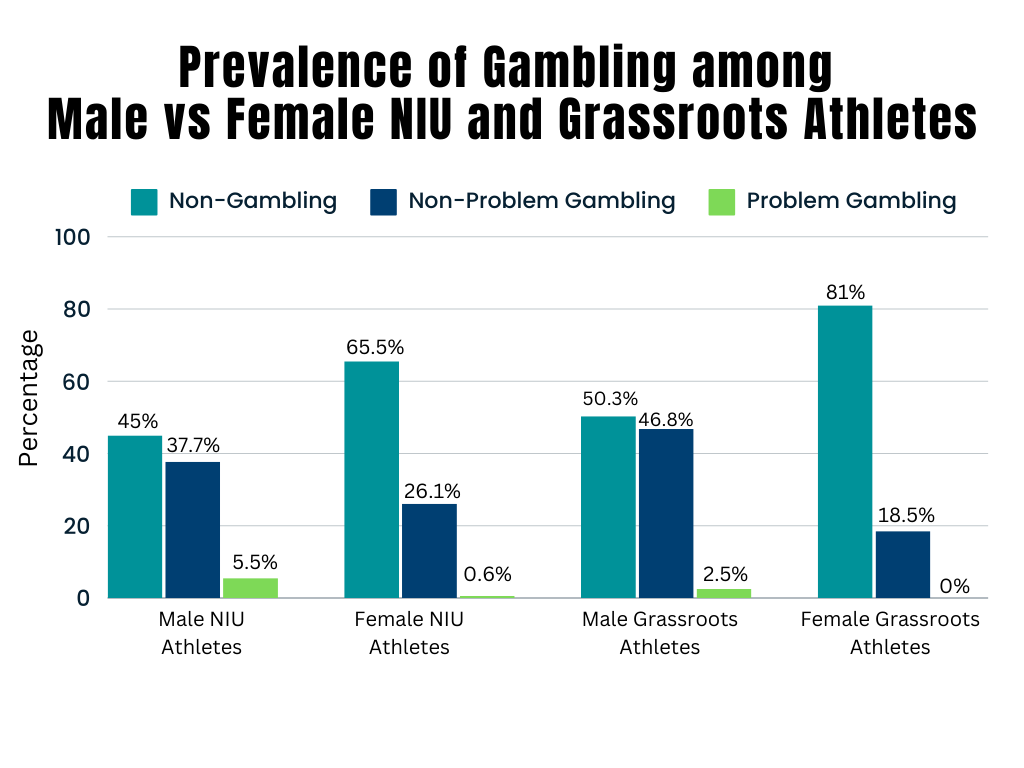 Figure. Prevalence of gambling and problem gambling among male and female NIU (i.e., elite) and grassroots (i.e., non-elite) athletes.
Why do these findings matter?
Gambling is prevalent among young athletes in Sweden, particularly among elite male athletes. This study suggests that they are especially vulnerable to developing problem gambling if they have family, teammates, or coaches with positive attitudes towards gambling. Thus, it is important to educate young athletes about the risks of gambling and to create targeted resources that address various contextual factors (e.g., school and team environments) that affect them. The NCAA’s
Figure. Prevalence of gambling and problem gambling among male and female NIU (i.e., elite) and grassroots (i.e., non-elite) athletes.
Why do these findings matter?
Gambling is prevalent among young athletes in Sweden, particularly among elite male athletes. This study suggests that they are especially vulnerable to developing problem gambling if they have family, teammates, or coaches with positive attitudes towards gambling. Thus, it is important to educate young athletes about the risks of gambling and to create targeted resources that address various contextual factors (e.g., school and team environments) that affect them. The NCAA’s