

Harnessing the Power of Data
It can be hard to measure the impact of problem gambling prevention and treatment efforts, especially at a time when gambling — and reported instances of gambling addiction — are on a rapid rise. But thanks to the development of a comprehensive database of helpline calls initiated by the California Council on Problem Gambling (CALPG) — in conjunction with TELUS Health — there is now a framework for analyzing data on a granular level. The database captures California helpline data dating back to 1998. While data was collected voluntarily, meaning not every caller answered questions, the database is exhaustive, amassing approximately 55,000 calls to the helpline. New data is added monthly. The data, which can be viewed at www.calpg.org/hidd, can be sliced and diced in numerous ways. Some of these aspects include: age; gender; ethnicity; primary gambling preference; caller language; stage of change; education level; age of first gambling experience; and type of gambler (action or escape). “The value in the database is that we can analyze it based on changes in targeted helpline marketing efforts as well as identify new trends,” says Robert Jacobson, executive director of the CALPG who helped develop the dashboard. For example, Robert noted that the impact of resources aimed at increasing engagement with California’s Hispanic community could be seen in the data through the use of different filters. Although California gambling helpline data doesn’t necessarily reflect behavior in other states, including Minnesota, it’s likely that the trends are significant. Here are some findings from the data: · Helpline volume (calls, texts and chats) reached its lowest point in 2020 due to the pandemic. However, total contacts (text, chat and calls) in 2023 increased by 25% compared to 2019. · Forty-one percent of people in the 46-55 age group chose to enroll in motivational text messaging when given the option, compared to about 38% each in the 26-35 and 36-45 age groups, and 35% in the 18-25 group. · Only 4.4% of helpline callers reported having a problem with gambling on the lottery in 2009. That has increased to 8.7% in 2024, nearly double. · Day stock traders represented 0.1% of calls in 2009 but, possibly due to crypto trading, has increased nearly twentyfold to just under 2% of calls year to date. · Since 2009, sports betting callers have increased from 2.2% to 11.8%, an increase of more than five times, despite sports betting not being legal in California. · Thirty percent of 5,576 help seekers since 2018 said that playing video games has cost them more time or money than they can afford. The TELUS data analysis model, first conceptualized by California, has been rolled out to several states, including Minnesota, which has a basic version. The potential of the database is immense. “Our vision is for the database to be consolidated with as many states as are willing to participate,” says Robert. “That will give us an even better picture of gambling behavior.”
The WAGER, Vol. 29(11) – Gambling helpline calls and the types of gambling that motivate these calls in Denmark, Finland, and Sweden
By John Slabczynski Read the original article on the BASIS HERE. Despite the growing popularity of gambling, most consumers, operators, and regulators recognize that this activity carries the potential for harm. Research indicates that some types of gambling appear to be more harmful than other types. To reduce harms from gambling, it is important to identify the gambling forms that are most often associated with harm. From there, researchers can work to identify the specific mechanisms that could make these forms more harmful than others and introduce factors to mitigate this risk. This week, The WAGER reviews a study by Virve Marionneau and colleagues that identified the forms of gambling most often referenced by callers of gambling support helplines in Denmark, Finland, and Sweden during the period 2019–2022. What were the research questions? (1) Which forms of gambling are most often referenced in calls to gambling support helplines in Denmark, Finland, and Sweden during 2019–2022? (2) Are these rates changing over time? What did the researchers do? The researchers collected data from four years of calls and chats to three different gambling support helplines from Denmark, Finland, and Sweden. All three helplines collect data on the types of gambling that clients have engaged in or identify as having led to harm. The researchers coded products into one of nine forms of gambling: (1) land-based sports betting, (2) online sports betting, (3) horse games (online and land-based), (4) land-based casino, (5) online casino, (6) poker, (7) land-based EGMs outside casinos, (8) lotteries, and (9) other. Then they performed linear regression to examine whether these longitudinal trends changed over time during the study period. What did they find? Online gambling, and online casinos in particular, constituted the main concerns among callers to all three helplines. Furthermore, the share of calls that referenced online casinos grew in all three nations, while calls focusing on land-based forms decreased. For example, in Denmark, the percentage of calls referencing online casinos rose from 35.7% in 2019 to 46.8% in 2022. At the same time, the percentage of calls focused on land-based sports betting decreased from 23.0% in 2019 to a mere 4.8% in 2022. Interestingly, however, the rate of change in calls relating to land-based sports betting in Finland and Sweden failed to reach statistical significance (see table).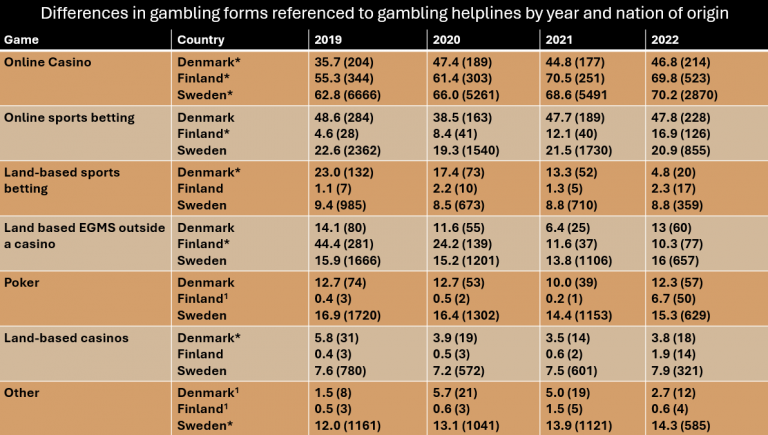 Table: The percentage and total number of helpline calls that referenced selected forms of gambling, by nation of origin and year. The * symbol indicates that the nation experienced a statistically significant change in the percentage of calls referencing that specific form of gambling during the window of observation. The "1" symbol indicates that the relationship was not tested due to violations in the assumptions for linear regression.
Why do these findings matter?
These findings provide insights into which forms of gambling are the most strongly related to harms as reported in helpline calls and can inform both public policy and research priorities. For example, because the authors found that online gambling was most strongly associated with harms, regulators may consider requiring that responsible gambling tools, such as voluntary self-limiting programs, be available on these platforms. Researchers may seek to prioritize studies on online gambling over other forms due to the increased risk of harm and could also consider studying self-reported harm across different types of gambling.
Every study has limitations. What are the limitations in this study?
This study tells us which gambling activities were mentioned in helpline calls, and presumably callers mentioned the games that caused them the most harm; however, the researchers did not measure the severity of callers’ problems. Although online gambling was the most commonly cited form of gambling by callers, it is unclear whether it is associated with a higher magnitude of harm compared to alternative forms of gambling. Furthermore, people who experience problem gambling rarely seek help due to stigma and other factors, so it is unclear how generalizable the findings are to gamblers who do not call the helpline.
Table: The percentage and total number of helpline calls that referenced selected forms of gambling, by nation of origin and year. The * symbol indicates that the nation experienced a statistically significant change in the percentage of calls referencing that specific form of gambling during the window of observation. The "1" symbol indicates that the relationship was not tested due to violations in the assumptions for linear regression.
Why do these findings matter?
These findings provide insights into which forms of gambling are the most strongly related to harms as reported in helpline calls and can inform both public policy and research priorities. For example, because the authors found that online gambling was most strongly associated with harms, regulators may consider requiring that responsible gambling tools, such as voluntary self-limiting programs, be available on these platforms. Researchers may seek to prioritize studies on online gambling over other forms due to the increased risk of harm and could also consider studying self-reported harm across different types of gambling.
Every study has limitations. What are the limitations in this study?
This study tells us which gambling activities were mentioned in helpline calls, and presumably callers mentioned the games that caused them the most harm; however, the researchers did not measure the severity of callers’ problems. Although online gambling was the most commonly cited form of gambling by callers, it is unclear whether it is associated with a higher magnitude of harm compared to alternative forms of gambling. Furthermore, people who experience problem gambling rarely seek help due to stigma and other factors, so it is unclear how generalizable the findings are to gamblers who do not call the helpline.

The WAGER, Vol. 29(10) – Sources of influence on the gambling trajectories of Australian adolescents
By Kira Landauer, MPH Read the original article on the BASIS HERE. Worldwide, many young people gamble before they reach legal gambling age, with a portion experiencing gambling-related problems. To reduce the potential for harm, we need to understand the factors that shape adolescents’ gambling attitudes and behaviors as they grow up. This week, The WAGER reviews a study by Nerilee Hing and colleagues that examined the gambling trajectories of Australian adolescents at different levels of gambling risk, and what influenced these trajectories during various stages of development. What were the research questions? What are the gambling trajectories of Australian adolescents at different levels of gambling risk? What influences these trajectories during different developmental stages? What did the researchers do? The researchers recruited 89 adolescents from New South Wales, Australia in 2022. They participated in interviews and online discussion communities, where they recounted their gambling experiences chronologically from childhood to present time. Participants were grouped by level of gambling risk based on a validated screen for gambling-related problems: (1) non-gambler (NG), (2) non-problem gambler (NPG), and (3) at-risk gambling or problems with gambling (ARPG). The authors performed thematic analyses to explore the gambling trajectories and their influences for each group during three developmental stages: (1) childhood, (2) early adolescence, and (3) later adolescence. What did they find? Childhood Many participants were first exposed to gambling in childhood (see Figure). Most ARPGs and NPGs were introduced to gambling through their parents, and sometimes passively included in gambling (e.g., gifted scratch tickets). ARPGs, in particular, had positive memories of gambling and remembered it being a fun family activity. Parental gambling was less common for NGs, who became aware of gambling through other sources such as ads. Early Adolescence Participants became more aware of gambling options and opportunities during early adolescence through friends, family, ads, and mass media. NGs refrained from gambling, typically because of age restrictions or parental disapproval. Conversely, many ARPGs and NPGs began participating in gambling activities—usually betting privately with friends. Many participants became interested in sports-related betting during this time. Later Adolescence The gambling trajectories further diverged in later adolescence. NGs continued to refrain from gambling, and NPGs’ gambling involvement remained consistent or declined. However, ARPGs began to participate in an even wider array of gambling activities, including some high-risk activities like sports betting and skin gambling. They saw gambling as a way to bond with peers—friends often taught and encouraged gambling. Some ARPGs viewed gambling as a way to make money or to demonstrate their skill, unlike most NGs and NPGs. Figure. Sources influencing the gambling trajectories of Australian adolescents (n = 89) at different levels of gambling risk and during different developmental stages: (1) childhood, (2) early adolescence, and (3) later adolescence. Themes pertaining to a specific risk level are indicated as such. Adapted from Hing et al. 2024.
Why do these findings matter?
Young people’s gambling behaviors evolve as they grow up. This evolution is shaped by multiple interacting sources of influence, including parents, friends, advertisements, and sports. Youth gambling prevention should focus on specific sources of influence at different developmental stages. Educational initiatives, like the Gift Responsibly Campaign, should inform parents of the potential risks of involving their children in gambling activities (e.g., via scratch tickets). Adolescents may also benefit from initiatives that focus on the development of social skills, like resisting peer pressure to gamble.
Every study has limitations. What are the limitations of this study?
Findings from this study might not be generalizable to adolescents in other Australian states or countries, where the gambling landscape and norms are different. This study relied on self-reported data, which may be subject to recall bias.
Figure. Sources influencing the gambling trajectories of Australian adolescents (n = 89) at different levels of gambling risk and during different developmental stages: (1) childhood, (2) early adolescence, and (3) later adolescence. Themes pertaining to a specific risk level are indicated as such. Adapted from Hing et al. 2024.
Why do these findings matter?
Young people’s gambling behaviors evolve as they grow up. This evolution is shaped by multiple interacting sources of influence, including parents, friends, advertisements, and sports. Youth gambling prevention should focus on specific sources of influence at different developmental stages. Educational initiatives, like the Gift Responsibly Campaign, should inform parents of the potential risks of involving their children in gambling activities (e.g., via scratch tickets). Adolescents may also benefit from initiatives that focus on the development of social skills, like resisting peer pressure to gamble.
Every study has limitations. What are the limitations of this study?
Findings from this study might not be generalizable to adolescents in other Australian states or countries, where the gambling landscape and norms are different. This study relied on self-reported data, which may be subject to recall bias.

The WAGER, Vol. 29(9) – The impact of celebrities and social media influencers in Australian gambling ads
By Annette Siu Read the original article on the BASIS here. Gambling is an increasing public health concern for adolescents. Even though most countries do not allow those under the age of 18 to gamble, adolescents are regularly exposed to gambling through various media outlets. Many recent gambling advertisements posted on platforms such as Instagram and TikTok feature celebrities and social media influencers, which may particularly appeal to younger audiences. This week, The WAGER reviews a study by Hannah Pitt and colleagues that examined youth perceptions of celebrities and social media influencers in Australian gambling advertisements. What were the research questions? (1) How do young people perceive the use of celebrities and social media influencers in gambling advertisements?, and (2) How do these types of advertisements influence gambling attitudes among young people? What did the researchers do? The researchers recruited 64 adolescents aged 12 – 17 years from Victoria and New South Wales (NSW) in Australia during November 2021 – September 2022. They conducted 22 online focus groups with 2 to 4 participants in each group. Participants were asked about their views of celebrities in gambling ads and the influence of these ads on young people. Participants gave their recommendations for restricting the use of celebrities and influencers in gambling promotions. The authors then used thematic analysis to identify key themes from the focus groups. What did they find? Four key themes emerged. First, celebrities and influencers increase the appeal of gambling advertisements (see Figure). Participants suggested that advertisements featuring celebrities and influencers were more attention-grabbing and memorable because they provided a sense of familiarity. The second theme was that celebrities and influencers increase the social acceptance of gambling. The use of celebrities in advertisements made it seem more acceptable to gamble and added credibility to the gambling company they were promoting. Many young people look up to and idolize celebrities, and participants were concerned that these types of ads might encourage young people to gamble. The third theme was that celebrities reduce the perceived risks associated with gambling. Participants commented that there were few ads in which celebrities emphasized the risks of gambling, which could contribute to gambling misconceptions among youth. The fourth theme was about reducing the impact of celebrity and influencer gambling advertisements on young people. Participants recommended that celebrities get more involved in educational gambling campaigns, and some even suggested completely restricting celebrities from promotional gambling advertisements to limit early exposure to gambling.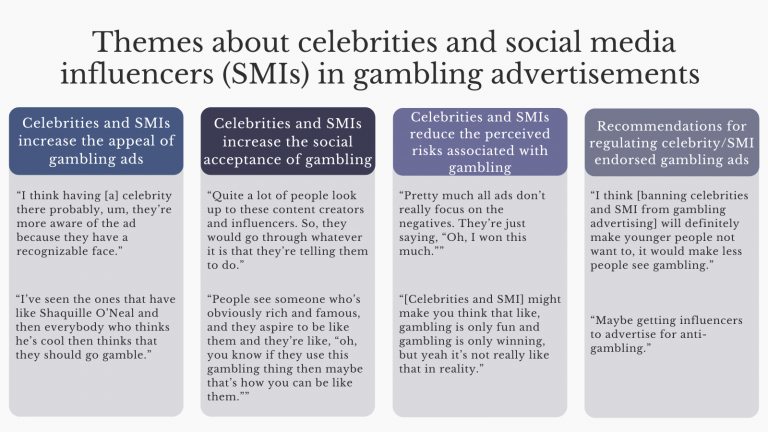 Figure. An overview of the four key themes that the researchers identified and relevant quotes from online focus group participants (n = 64).
Why do these findings matter?
The adolescents in this study voiced that the use of celebrities and influencers in gambling advertisements exposes young audiences to gambling, increases trust in gambling brands, and reduces perceived risks associated with gambling. These findings suggest that regulatory efforts—which have already been enacted in the United Kingdom, for example—are needed to protect youth from being influenced by gambling marketing. These regulatory requirements could include monitoring all types of gambling marketing, restricting gambling accessibility (e.g., with strict age verification processes), and creating more public education campaigns (e.g., similar to the National Council on Problem Gambling’s Safer Sports Betting Initiative).
Every study has limitations. What are the limitations in this study?
This study was conducted in two states in Australia, so the findings might not be generalizable to other countries with different gambling regulations and environments. Additionally, most participants were male, so they might have different perceptions and are typically more exposed to gambling compared to females.
Figure. An overview of the four key themes that the researchers identified and relevant quotes from online focus group participants (n = 64).
Why do these findings matter?
The adolescents in this study voiced that the use of celebrities and influencers in gambling advertisements exposes young audiences to gambling, increases trust in gambling brands, and reduces perceived risks associated with gambling. These findings suggest that regulatory efforts—which have already been enacted in the United Kingdom, for example—are needed to protect youth from being influenced by gambling marketing. These regulatory requirements could include monitoring all types of gambling marketing, restricting gambling accessibility (e.g., with strict age verification processes), and creating more public education campaigns (e.g., similar to the National Council on Problem Gambling’s Safer Sports Betting Initiative).
Every study has limitations. What are the limitations in this study?
This study was conducted in two states in Australia, so the findings might not be generalizable to other countries with different gambling regulations and environments. Additionally, most participants were male, so they might have different perceptions and are typically more exposed to gambling compared to females.