May 22, 2024 | RECOVERY, STORIES
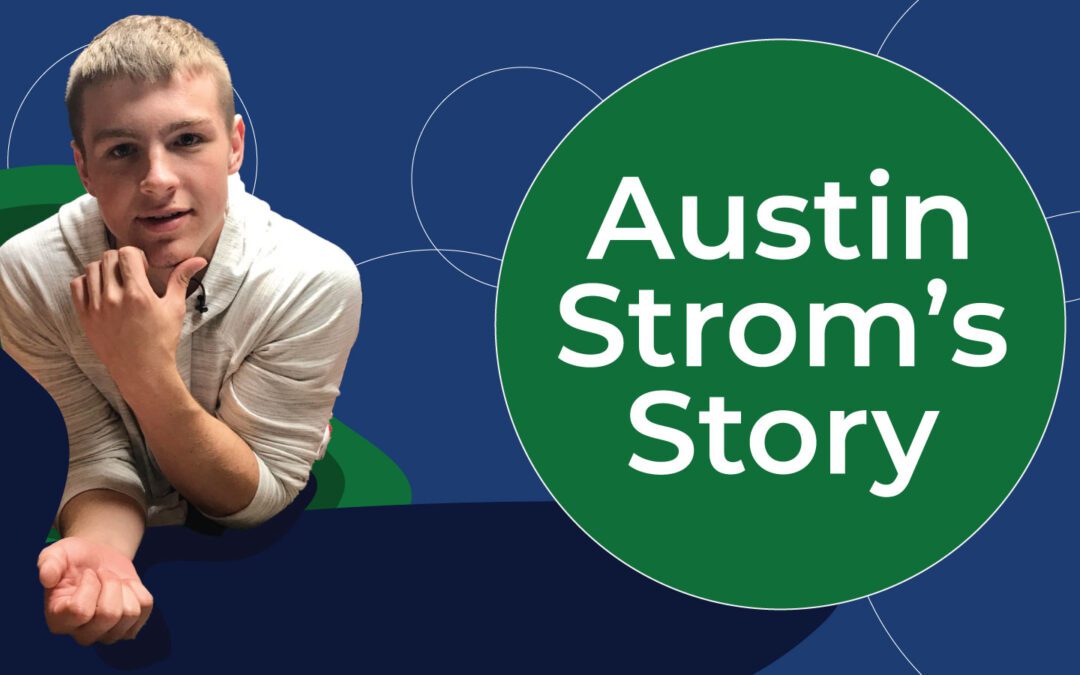
My name is Austin Strom, and I am a gambling addict. I am 24, and for the last seven years, gambling has been my life.
Gambling runs in my family. My parents and grandparents, who had their own gambling battles, would often gamble. I have numerous memories of them arranging a baby sitter to watch me when they would go out gambling.
So not surprisingly, when I had an assignment called “If I had 100 dollars!” in kindergarten or first grade, my response was “I would go to the casino!”
In high school, I would occasionally partake in friendly sports wagers involving my team against my friends’ teams. I would also play Blackjack with friends without betting money, but the objective never changed: win the game.
The day I turned 18 was long anticipated. I went to the casino with my parents and grandmother that day. I didn’t have the best luck, but since it was my birthday and my parents didn’t want me to lose on my birthday, they kept adding money in hopes of turning the tide. I don’t remember how that day played out, but I do remember spending about 12 hours at the casino, losing all I had with me. For the next month, I went to the casino multiple times, including a two-night stay by myself at the hotel. Other than a few hours of sleeping, the rest of the time was spent at the Blackjack tables. I remember one day all I had to eat was a piece of pizza because to me eating was time away from the table.
I was then introduced to websites such as DraftKings and Bovada, where I could partake in daily fantasy sports. Before switching to actual sports betting, I lost several thousand dollars on fantasy sports. I would spend the next two years betting on sports weekly, if not daily. I would wait until the day I got paid, just to eventually drain my account and wait two weeks for the next paycheck. By this time, all of my gambling, which also included blackjack, was done online and I rarely went back to a casino.
Once Covid hit and the accompanying shutdowns, I had no shortage of free time. By this time, my minimum bet was already at least ten times more than when I started. When I ran out of money, I learned about online personal loans. I took out a $1,500 loan and planned to make enough money to pay it off before my next paycheck. But that didn’t work out and I borrowed more and more, eventually owing up to $30,000 over a three-week period.
By this time, I was determined to keep the addiction to myself so that nobody would try to encourage me to stop. This pressure, combined with anxiety and depression I had struggled with for much of my life, brought me to consider suicide. This led to one of a few trips to the emergency room for personal safety.
At this time, I was ready to get the help that those around me had suggested, or so I thought. I enrolled in Gamblers Choice, essentially a 12-step program for gamblers. But my addiction continued, even while it was harder to hide. I came to realize that the program wasn’t something I wanted to do or what I was ready for at the time.
I continued to gamble, but eventually went to inpatient treatment at Project Turnabout in Granite Falls. I met great people who understood what I was going through. It also showed me that this addiction doesn’t care where you come from or what you do. My mindset improved but I left after three weeks, rather than stay for the full 30 days I was supposed to do. I re-enrolled in Gamblers Choice but would continue to gamble until Oct. 9, the day I placed my last wager. At this point, I had lost everything I could possibly lose, including my best friend. I was left with two choices — end it all or give it 60 days without gambling and see if living without gambling was something I could do.
I was assigned a “Goodbye Gambling” letter in my Gamblers Choice group, and I believe that really got me to a new place. Since then, I’ve really looked at everything after that as a new life. I’ve had to and am still currently rewiring my brain's definition of fun. Sure, the highs aren’t as high as they were when I was gambling, and they may never be that way. However, that also means the lows aren’t as low as they were while I was gambling, and that’s a trade I will take every day of the week. My entire outlook on life has changed since I’ve quit gambling. I’ve got a new hope towards life and what’s to come that excites me. I’m definitely a different person than I was even just several months ago. My gratitude for everything life has to offer has grown substantially, and none of that would have happened had I still been gambling. That’s why it’s important that I just don’t gamble today.
If you or somebody you know is struggling with a gambling addiction, please reach out for help. Do it for yourself. So often we see this message and just let it slide by without giving it any thought.
As dark as it may seem, I promise there is light at the end of the tunnel. Let the journey of recovery be that light for you, like it was mine and so many others. I leave you with this: “Sometimes when you’re in a dark place it feels like you’ve been buried alive. But perhaps, you’ve just been planted and now is your time to bloom.”
It is with great sadness MNAPG learned that Austin was fatally shot on August 17, 2024. Austin was actively embracing his recovery at the time of his death. We continue to publish his story as a lasting inspiration.
May 22, 2024 | PROBLEM GAMBLING, STORIES
Note: The following article was written by Bill Stein, MNAPG staff writer, for this year’s Problem Gambling Awareness Month theme: Every Story Counts.
Each March, the National Council on Problem Gambling recognizes Problem Gambling Awareness Month (PGAM). It’s an opportunity to raise awareness about problem gambling and promote prevention, treatment and recovery services. This year’s PGAM theme is “Every Story Matters.”
As one who’s chronicled the gambling struggles — and recoveries — of nearly 50 Minnesotans over the last 15 years, I believe in the power of stories to bring the reality of this addiction to light and to demonstrate how treatment can change lives.
There are an estimated 250,000 problem gamblers in Minnesota. And for every problem gambler, countless other people in their orbit are affected, including family members, friends and coworkers.
But numbers are one thing. The real impact that gambling disorder has on the lives of our neighbors, our parents, our siblings and our friends is quite another.
The stories of the people impacted by gambling addiction paint a more complete, human picture of the destruction this addiction can bring as well as the triumphs of those who have faced their demons and are living full, productive, satisfying lives.
Gambling addiction is an equal opportunity disorder. Virtually anyone – men or women, young or old, and those from every religion, race and socio-economic background – is at risk for developing a gambling problem.
The stories of Minnesotans I’ve documented have reflected this tapestry. Consider these:
• A member of the Navy, who was among the boots on the ground in the Middle East, was faced with the challenge of coming home and trying to match the excitement and high-tempo routine he had become accustomed. The closest adrenaline rush he could find was gambling. He eventually developed an addiction and accompanying depression before he found the help he needed.
• “Tim” became a kind of celebrity in his town after he won $500 in a church picnic at age of seven. He chased that high of winning for 34 years. Then he entered inpatient treatment for his gambling and has since turned his life around.
• “Jean” was the gambling addict you’d never suspect. She wasn’t a video gamer, didn’t like football pools and didn’t play the stock market. She didn’t even start gambling until she was almost 50. It took being fired from her job (from stealing money to support a gambling habit) and serving a lengthy prison sentence until she confronted her addiction and began her recovery.
• “Cecelia” was five months pregnant when she learned about her husband’s gambling activity. It ultimately became such a problem that he lost his job, the couple’s only source of income. She sought help from Gam-Anon, which helps those whose lives are negatively impacted by a problem gambler. She educated herself about her husband’s gambling addiction and ultimately left the roller coaster life her husband’s gambling had caused. She is now thriving, and working to support others who have been through what she has.
• “Dick” was a self-professed straight arrow, a regular church-goer and a good family man with a well-paying job in management. But once pressures drove him to make frequent visits to the casino, things changed significantly. Dick ended up with large credit card debts and owing the government thousands of dollars in taxes.
• “Lori” rarely gambled until work stresses and unresolved childhood trauma drove her to gamble as often as she could. In time, she put gambling ahead of her home, her husband, her kids and even food for herself. Depressed and suicidal, she’d planned to end her life until an eagle swooped over her car as she took her son to visit his grandmother. She saw the eagle as a sign of hope, went online to find help and learned of the successful recoveries that others had had. She subsequently started the 30-day inpatient gambling program at Project Turnabout in Granite Falls and turned her life around.
While each of these stories is unique, they often have a lot in common. I’ve found that many of the recovering gamblers we highlight have these characteristics:
• A big win early in their life that creates a high they “chase” for years.
• Their gambling often occurs with other mental health conditions. For example, a gambling addict may also experience substance or alcohol abuse.
• They are typically either: 1. An “escape gambler” who gambles to escape life’s problems, or 2. An “action gambler” who may appear egotistical, successful and outgoing, and often prefers to play games involving skill, such as poker or sports betting.
• Relapses are often stops along the way in their overall recovery process.
There many other similarities, such as lying about money and time spent gambling, stealing to acquire money and a preoccupation with gambling. Many of the gamblers I’ve profiled have also attempted suicide, sometimes several times.
What also comes through when sharing the stories of problem gamblers is the pain they feel for what their gambling has caused others. They regret the lies they’ve told, the gift money they’ve squandered, the retirement savings they’ve spent and the way they’ve prioritized gambling over family, friends, relationships and jobs.
These are good, well-meaning people. They often didn’t know there was such a thing as gambling addiction, and if they did, they weren’t sure how or where to get help. They struggled to find other people who understood them.
In the end, after speaking to so many people, I’ve come away with great admiration for those who have turned around their lives — and great hope that the many others currently suffering from this devastating disorder can eventually become success stories of their own.
May 22, 2024 | RESEARCH
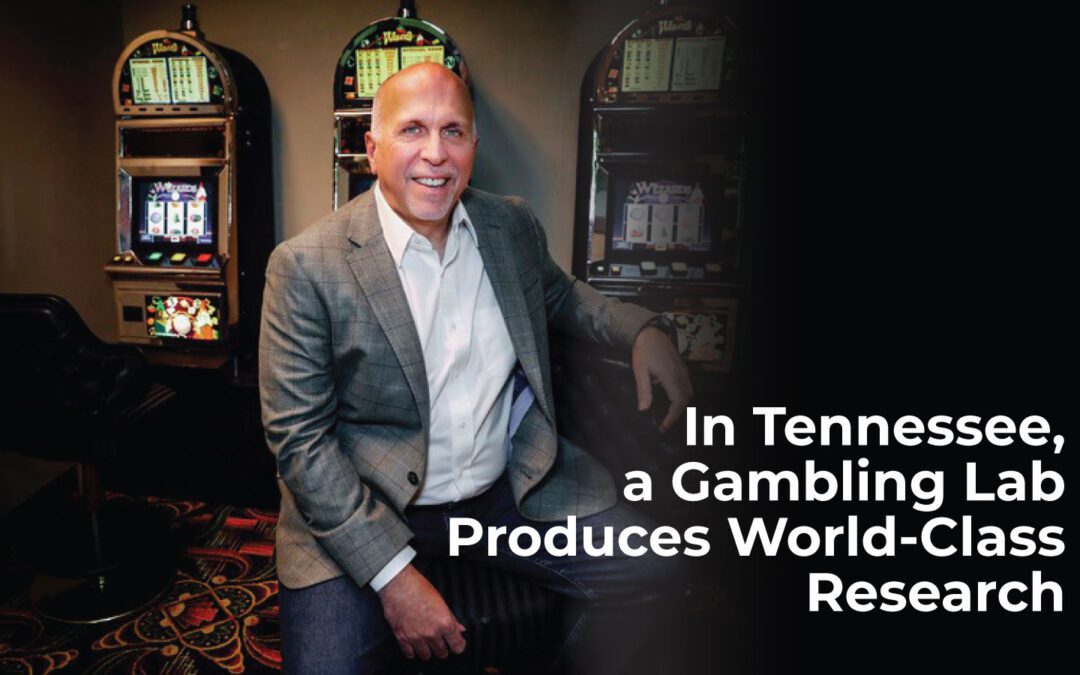
Inside an academic building at the University of Memphis, there’s a suite with a bank of slot machines and distinct casino carpeting. To the uninitiated, it seems every bit like a casino. But upon closer exam, it’s actually a gambling “lab,” a place where gambling behavior is studied and analyzed.
The lab is one of several ways that the Tennessee Institute for Gambling Education and Research (TIGER) conducts a wide range of gambling research. Along with other research approaches, such as community surveys and crowdsourcing (through the internet, social media and smartphone apps), TIGER research covers a wide range of topics, including:
• Addictive disorders
• Examining and mitigating health disparities in urban and rural communities
• Assessment, prevention and treatment
• Psychotherapy process and outcome research
• Validation of assessment tools
• Understanding the relations between gambling, substance use and other comorbid conditions
The research emphasizes real-world application. “We believe in reciprocity between the experimental approach and the clinical approach,” says James Whelan, Ph.D., professor and executive director of TIGER, which consists of two arms: a gambling clinic that provides treatment to people with gambling problems and a gambling lab where research takes place. “What we learn in the lab setting informs what we do in the clinical space. And many of our research questions originate from experiences with people.”
The clinic keeps a database of the approximately 1,800 people they’ve treated and can ask questions of the database that include factors such as a client’s risk factors and demographics. “It always comes back to our experiences learning from people with lived experiences,” says Dr. Whelan. “Our goal is to generate knowledge that we can apply to improve outcomes.”
TIGER was established in 1999 after Dr. Whelan had a client whose depression was caused by gambling. “I realized that nobody really knew how to approach treatment for someone with a gambling problem and that this was likely to be an increasing need in the community as casinos were built,” says Dr. Whelan. From that initial experience, TIGER has grown to become a national and international leader in addressing gambling disorders and in contributing to literature for prevention and assessment and treatment.
After 25 years of gambling research, what findings have been the most surprising? Dr. Whelan mentions two areas. One involves the effect of substance use on gambling. “We figured the effect of alcohol would mean taking greater risks and stupid gambling,” he says. “But we actually found that it’s the gambling experience itself that creates risky drinking behavior. It’s as much a psychological issue as it is a physiological one. Until someone has a blood alcohol level of close to .09 and over, it doesn’t seem to have any effect on risk-taking decisions.”
Another finding that Dr. Whelan found interesting was the impact of cognitive-based interventions coupled with at least one visit to Gamblers Anonymous (GA). “Our research demonstrated that those going to a single GA meeting along with cognitive treatment had better outcomes than those who didn’t attend any meetings.” Dr. Whelan surmises that the importance of seeing others who have the same issue — even just once — plays a key role.
As gambling addiction research continues to spread in various directions — a period that Dr. Whelan refers to as “the wild west” — there is much to be excited about at TIGER. Some areas under study include how to maximize the impact of peer recovery specialists and how responsible gambling messages should be tailored to individual demographics, including those engaging in ever-growing sports betting.
“One of our studies focuses on younger men and the type of messaging that’s appropriate for them,” says Dr. Whelan. “We’re finding that they won’t use the terms “therapy” or “help” but they might ask for a “class” they can attend to help with a gambling problem.”
Another study on young men focuses on the relationship between gambling and college success. TIGER research finds that the more they gamble, the more likely they are to drop classes, which threatens to jeopardize the money they’ve invested in college.
Looking ahead, Dr. Whelan says that the gambling field is at an interesting juncture with great opportunity. “There needs to be cooperation and shared responsibilities between gambling operators and regulators that’s guided by research,” he says. “And there has to be a healthy respect for individual responsibility.”
The Tennessee Institute for Gambling Education and Research (TIGER) is funded by the Tennessee Department of Mental Health and Substance Abuse Services. For more information, visit https://www.memphis.edu/gamblingclinic/.

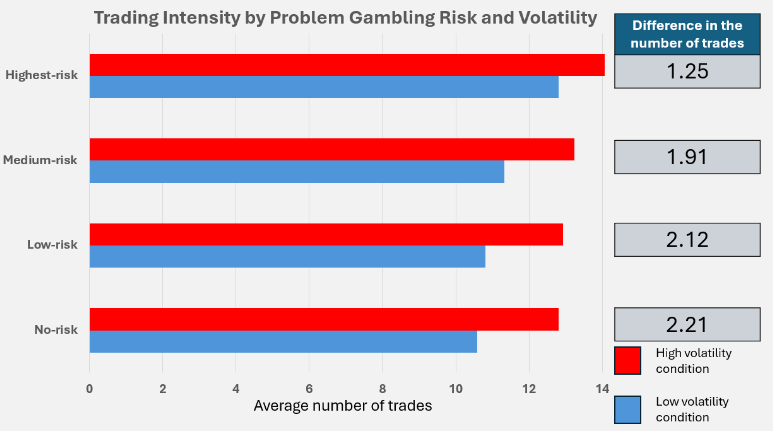 Figure. Displays the mean number of trades for each PGSI category between conditions from exploratory analyses. The boxes on the right represent the average difference between participants in the high volatility vs. low volatility conditions for each level of PGSI severity.
Why do these findings matter?
These findings are important for two reasons. Namely, they suggest that volatile assets such as
Figure. Displays the mean number of trades for each PGSI category between conditions from exploratory analyses. The boxes on the right represent the average difference between participants in the high volatility vs. low volatility conditions for each level of PGSI severity.
Why do these findings matter?
These findings are important for two reasons. Namely, they suggest that volatile assets such as